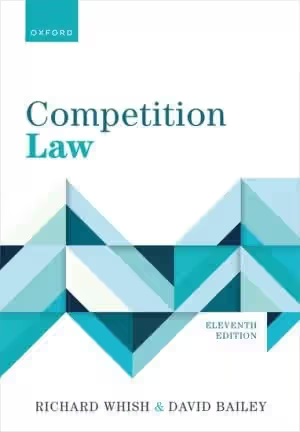
01 / Reading Guide
Reading Guide
Citation
Whish, R., & Bailey, D. (2024). Competition Law (11th ed.). Oxford University Press.
Chapter Summary
The publisher's contents list gives 23 chapters, and the book runs to more than 1,100 printed pages. It starts with competition policy and economics and an overview of EU and UK law, takes the core prohibitions (agreements, abuse of dominance) and their enforcement in the EU and the UK, then looks at the international dimension, horizontal and vertical agreements, abuse of dominance in detail, intellectual property, mergers and particular sectors. The publisher describes a critical and contextual approach that addresses the wider economic and practical realities of competition law.
Chapters 1–2: Competition Policy and Economics; Overview of EU and UK Competition Law
The first two chapters set the scene: the policy and economic thinking behind competition law, followed by an overview of how EU and UK competition law fit together.
Chapters 3–5: Article 101 (1); Article 101 (3); Article 102
These chapters take the main EU prohibitions in turn: the prohibition on anticompetitive agreements in Article 101(1), the exception under Article 101(3), and the prohibition on abuse of a dominant position in Article 102.
Chapters 6–8: The Obligations of Member States under the EU Competition Rules; Articles 101 and 102: Public Enforcement; Articles 101 and 102: Private Enforcement
Chapter 6 deals with what the competition rules require of Member States. Chapter 7 covers public enforcement of Articles 101 and 102 by the European Commission and national competition authorities under Regulation 1/2003, and Chapter 8 covers private enforcement in the courts of Member States.
Chapters 9–11: Competition Act 1998; Competition Act 1998 and the Cartel Offence; Enterprise Act 2002
The UK counterpart follows: the substantive provisions of the Competition Act 1998 (Chapter 9), its public enforcement and procedure together with the cartel offence (Chapter 10), and market studies and market investigations under the Enterprise Act 2002 (Chapter 11).
Chapter 12: The International Dimension of Competition Law
A single chapter addresses the international dimension of competition law.
Chapters 13–16: Horizontal Agreements (1)–(3); Vertical Agreements
Horizontal agreements are treated in three chapters: cartels (13); oligopoly, tacit collusion and collective dominance (14); and cooperation agreements (15). Chapter 16 covers vertical agreements. The publisher lists new block exemptions and guidelines for both horizontal cooperation and vertical agreements, in the EU and the UK, among the updates.
Chapters 17–19: Abuse of Dominance (1)–(2); The Relationship between Intellectual Property Rights and Competition Law
Abuse of dominance is covered in two chapters, one on non-pricing practices (17) and one on pricing practices (18). Chapter 19 turns to the relationship between intellectual property rights and competition law. The publisher mentions the Commission's review of Article 102 and digital platforms among the updates.
Chapters 20–23: Mergers (1)–(3); Particular Sectors
Merger control is covered in three chapters: an introduction (20), EU law (21) and UK law (22). Chapter 23 deals with particular sectors. The publisher also lists the EU Foreign Subsidies Regulation and the UK National Security and Investment Act among the initiatives referred to.
Key Concepts
Chapters 1–8: Foundations and EU Enforcement
- Article 101: the EU prohibition on anticompetitive agreements, with the paragraph (1) prohibition and the paragraph (3) exception treated in Chapters 3 and 4.
- Article 102: the EU prohibition on abuse of dominance (Chapter 5).
- Public and private enforcement: enforcement by the Commission and national authorities under Regulation 1/2003 and by private parties in national courts (Chapters 7 and 8).
Chapters 9–16: UK Law and Agreements
- Competition Act 1998: the UK prohibitions and their enforcement, including the cartel offence (Chapters 9 and 10).
- Market studies and market investigations: tools under the Enterprise Act 2002 (Chapter 11).
- Cartels, oligopoly and collective dominance: topics of the horizontal agreement chapters (13 and 14).
- Vertical agreements: the subject of Chapter 16.
Chapters 17–23: Dominance, Intellectual Property, Mergers and Sectors
- Pricing and non-pricing abuses: the two chapters on abuse of dominance (17 and 18).
- Intellectual property and competition: Chapter 19.
- Merger control: introduction, EU law and UK law (Chapters 20–22).
Critical Analysis
Strengths
- Both legal systems in one book. The contents list treats the EU rules (Articles 101 and 102, Regulation 1/2003) and the UK rules (Competition Act 1998, Enterprise Act 2002) together, with separate chapters on mergers in each, so a course covering both can be taught from one text.
- Breadth of sources. The publisher says the book assimilates a wide variety of resources, including judgments, decisions, guidelines and periodical literature, and that it is used in universities, law firms, economic consultancies, competition authorities and courts.
- Contextual approach. According to the publisher, the book addresses the wider economic and practical realities of competition law, and the first chapter pairs competition policy with economics.
- Up-to-date coverage. The 11th edition's listed updates include the new block exemptions and guidelines for vertical and horizontal cooperation agreements, digital platforms, the sustainability agenda and the review of Article 102.
- Reception. Comments attached to the publisher's description in a retailer's listing come from Thomas Jaeger (Professor of European Law, University of Vienna), who calls it an excellent structure with concise wording, and Cameron Firth (Partner, Macfarlanes LLP), who calls it a comprehensive and very reliable textbook; the listing does not say which edition they refer to.
Limitations
- Size. At more than 1,100 pages the book is a large text, and on a short course students will need to select chapters.
- Limited space for international and comparative law. One chapter covers the international dimension, and the contents list has no chapter devoted to competition law outside the EU and UK.
- Economics in a single opening chapter. Economics is introduced in Chapter 1 as part of the book's contextual approach; students who want a deeper economic treatment of markets and market power will need another source.
Where It Fits in the Course
Whish and Bailey is the broad main text of this course list for EU and UK competition law. Alison Jones and Niamh Dunne's Jones & Sufrin's EU Competition Law: Text, Cases, and Materials (9th edition) is a detailed alternative or companion for EU law, combining in-depth commentary with extracts from judgments, legislation and Commission decisions; it is the natural choice for readers who want primary material in the volume itself. Whish and Bailey is the one to read when UK law is part of the course.
Richard Baldwin, Martin Cave and Martin Lodge's Understanding Regulation and The Oxford Handbook of Regulation place competition law in the broader field of regulation, and Herbert Hovenkamp's The Antitrust Enterprise gives a view of US antitrust and its shifting goals. They are best read after Whish and Bailey, if a course needs the regulatory or US comparison.
How to Use This Book
The book is intended for students and practitioners of competition law. A grounding in EU law and in public or contract law helps, and since the contents list opens with a chapter on competition policy and economics, economics seems to be introduced within the book rather than assumed.
A practical plan:
- Core: Chapters 1–5 (policy, overview, Articles 101 and 102), then Chapters 7–8 on enforcement.
- UK law: Chapters 9–11, if the course covers the Competition Act 1998 and the Enterprise Act 2002.
- By topic: Chapters 13–16 on horizontal and vertical agreements, Chapters 17–18 on abuse of dominance, and Chapters 20–22 on mergers, read in groups.
- Optional: Chapters 6, 12, 19 and 23.
Check any discussion of guidelines, block exemptions or policy reviews against the current texts.