01 / Reading Guide
Reading Guide
Citation
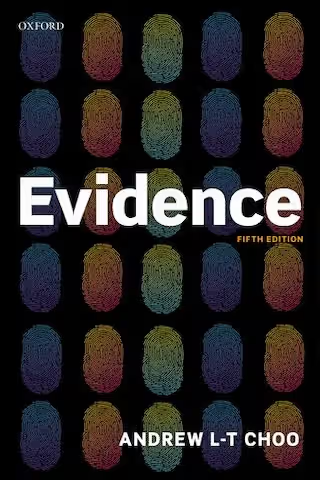
Choo, A. L-T. (2018). Evidence (5th ed.). Oxford University Press.
Chapter Summary
The book has fourteen chapters in about 400 pages of text. It covers civil and criminal evidence in England and Wales, moving from general principles through rules that exclude or protect particular material to the rules on character, hearsay, experts and witnesses.
Chapter 1: Introduction
The opening chapter sets out the vocabulary used throughout: facts in issue, relevance, admissibility and weight, direct and circumstantial evidence, testimonial and real evidence, and the difference between exclusionary rules and judicial discretions. It also looks at how trial by jury and the Human Rights Act 1998 shape the law.
Chapter 2: Burden and Standard of Proof
This chapter asks which party must prove what, and to what degree. It distinguishes the legal and evidential burdens, treats reverse burdens in criminal cases, and contrasts the criminal and civil standards of proof.
Chapter 3: The Course of Evidence
The chapter follows a trial in sequence. It places the adversarial tradition at the centre and explains examination-in-chief, cross-examination and re-examination, with the rules that govern what each stage may do.
Chapter 4: Confessions
Confessions are treated through the rules for excluding them: mandatory exclusion, discretionary exclusion, the effect of an earlier tainted confession on a later one, and the warnings required where the defendant has a mental handicap. The chapter also deals with a confession in a case with several defendants and with the voir dire used to decide admissibility.
Chapter 5: The Right to Silence and the Privilege against Self-Incrimination
The chapter examines the principles behind the right to silence and the privilege against self-incrimination, the statutory changes that qualify them, and the influence of the European Convention on Human Rights. Police questioning and court proceedings are the main settings discussed.
Chapter 6: Identification Evidence
A short chapter (about 16 pages) on eyewitness identification and the risk of mistake. It covers the Turnbull guidelines, discretionary exclusion, and the use of photographs and video in identification procedures.
Chapter 7: Investigatory Impropriety: Violations of the European Convention on Human Rights and Undercover Police Operations
The chapter considers whether evidence obtained by improper or unlawful means should be excluded, including Convention violations and undercover operations. The central question is how to balance deterring police misconduct against excluding reliable evidence.
Chapter 8: Public Interest Immunity and Related Matters
Public interest immunity is covered through its development, class claims and contents claims, and the balancing of secrecy against a fair trial. Related issues of confidentiality and the Freedom of Information Act 2000 close the chapter.
Chapter 9: Legal Professional Privilege
The chapter sets out the scope and limits of legal professional privilege, then covers without prejudice negotiations, other professional privileges and the circumstances in which privilege is lost.
Chapter 10: Character Evidence
Character evidence is examined in civil and criminal proceedings, with good character and bad character treated separately and with attention to the effect such evidence may have on a jury.
Chapter 11: Hearsay Evidence
The hearsay rule, its exceptions and the statutory reforms are set out for civil and criminal cases, together with the continuing debate about whether the rule is worth keeping and the difficulty of applying the exceptions.
Chapter 12: Expert Evidence
The chapter covers when expert evidence is admissible, the line between fact and opinion, an expert's use of hearsay, the presentation of expert evidence, conflicts between opposing experts and disclosure of expert reports.
Chapter 13: Witnesses
The longest chapter (about 50 pages) deals with competence and compellability, corroboration requirements and measures to ease the burden on witnesses, particularly vulnerable ones.
Chapter 14: Alternative Pathways to Proof
The final chapter covers proof without calling evidence in the ordinary way: formal admissions, judicial notice and presumptions.
Key Concepts
Chapters 1–3: Introduction; Burden and Standard of Proof; The Course of Evidence
- Relevance, admissibility and weight: evidence must bear on a fact in issue, must be legally receivable, and is then valued by the fact-finder.
- Exclusionary rules and discretions: some evidence is excluded automatically, other evidence only if a judge decides that its admission would be unfair.
- Legal and evidential burdens: the first is the duty to prove a fact; the second is the duty to produce enough evidence to raise the issue at all.
- Standards of proof: the criminal and civil standards differ, reflecting the different consequences of each kind of proceeding.
Chapters 4–7: Confessions; Silence; Identification; Investigatory Impropriety
- Voir dire: a hearing, outside the jury's presence, to decide whether contested evidence such as a confession may be heard.
- Privilege against self-incrimination: protection against being compelled to supply evidence that could lead to one's own prosecution.
- Turnbull guidelines: the judicial directions designed to reduce the risk of wrongful conviction on mistaken identification.
- Improperly obtained evidence: material gained through unlawful or unfair investigation, whose exclusion is weighed against the value of reliable proof.
Chapters 8–9: Public Interest Immunity; Legal Professional Privilege
- Class and contents claims: two ways in which the state may claim that material should be withheld from disclosure.
- Legal professional privilege: protection for confidential communications between lawyer and client, which may be lost or waived.
Chapters 10–12: Character; Hearsay; Experts
- Bad character evidence: material about a person's past conduct, admissible only through defined routes because of its prejudicial effect.
- Hearsay: an out-of-court statement offered for its truth, excluded in principle but admitted under statutory and common law exceptions.
- Fact and opinion: the distinction that determines when an expert may give an opinion.
Chapters 13–14: Witnesses; Alternative Pathways to Proof
- Competence and compellability: whether a person may give evidence and whether they can be required to.
- Judicial notice and formal admissions: ways of establishing facts without full proof.
Critical Analysis
Strengths
- Explains the reasons as well as the rules. The publisher describes the aim as a clear account of the core principles of civil and criminal evidence together with the rationales that underlie the law. The chapters on silence and investigatory impropriety, for example, are framed as balances between competing aims, which helps a reader who must argue a point rather than recite a rule.
- Wider sources. The author draws on comparative, socio-legal and empirical material where it is relevant, and thorough footnotes and further reading lists signpost additional sources. This suits essay work.
- Human rights integrated into the doctrine. The Human Rights Act 1998 and the Convention appear in the introductory chapter and recur in the chapters on silence and investigatory impropriety, so the topic is not left to a separate chapter.
- A manageable structure. Fourteen chapters, running from principle to specific rules, are easy to map onto an evidence syllabus.
Limitations
- Edition. This is the 2018 edition; a sixth edition has since been published, and rules on topics such as hearsay, bad character and vulnerable witnesses are the kind that move through case law and rule changes. Check the current edition before relying on it for practice.
- Uneven depth. Identification evidence (about 16 pages) and public interest immunity (about 14 pages) are much shorter than hearsay, expert evidence and witnesses, so those two topics need supplementing if a course spends longer on them.
- Jurisdiction. The treatment is of England and Wales; comparative material is used for argument, not as a basis for studying another system.
- Not a full treatise. At about 400 pages of text it is a student text, and a reader who needs detailed commentary on every provision will want a larger work.
Where It Fits in the Course
Choo suits a first course in evidence law that wants critical discussion as well as black-letter rules. Munday's Evidence is a more compact core text with a summary at the start of each chapter and self-test questions at the end, the lighter option for revision. Keane and McKeown's The Modern Law of Evidence is a course textbook covering criminal and civil proceedings and the policy questions raised by recent reforms, and is a close alternative as the main text. McGourlay, Thomas and Gower's Evidence: Law and Context places the rules in their political, theoretical and policy background, which makes it a good companion for the reasons behind the law.
For further reading, Roberts's Roberts & Zuckerman's Criminal Evidence treats the criminal rules as part of trial procedure and evaluates them against stated principles, while Dennis's The Law of Evidence is a fuller scholarly study of the subject's evolution and doctrines. Both are natural next steps after Choo.
How to Use This Book
The book is for law students taking evidence for the first time, and for anyone who wants an argument-led account that remains manageable in length.
A practical plan:
- Core: Chapters 1–3 first, since they supply the terms and the trial sequence used by every later chapter. Then Chapters 4, 10 and 11 (confessions, character, hearsay), which carry most of the weight in typical evidence courses.
- Selective: Chapters 5–9 can follow in any order, depending on the syllabus. Read Chapters 5 and 7 together, because both concern how the suspect is treated in the investigation, and Chapters 8 and 9 together as the two main immunities from disclosure.
- Later: Chapters 12–14 on experts, witnesses and alternative proof, with Chapter 13 read alongside the rules on the course of evidence in Chapter 3.
Use the footnotes selectively: choose a few sources on the topic of an essay rather than following every reference. For each chapter, practise stating the rule and its rationale in a sentence or two, and check the current position against recent case reports and the Criminal Procedure Rules.