01 / Reading Guide
Reading Guide
Citation
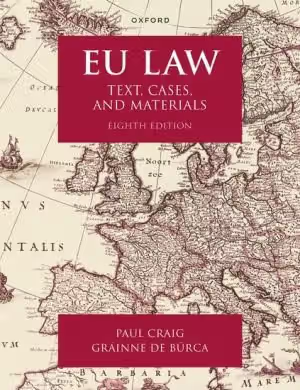
Craig, P., & de Búrca, G. (2024). EU Law: Text, Cases, and Materials (8th ed.). Oxford University Press.
Chapter Summary
A text, cases and materials book of about 1,200 pages in 31 chapters. Each topic is presented through authorial commentary linked to extracts from Treaty provisions, legislation, Court of Justice judgments and scholarship. The edition covered here is the EU edition (ISBN 9780198915522); the publisher notes that a separate UK version exists for readers studying EU law in the UK. The chapters fall into five broad groups.
Chapters 1–7: Integration, institutions and law-making
Chapter 1 covers the development of European integration. Chapter 2, Membership: Entry, Obligations and Exit, is a revised chapter in this edition and now includes entry as well as Member State obligations and exit. Chapter 3 treats the institutions and Chapter 4 competence. Chapter 5 deals with instruments and the hierarchy of norms. Chapter 6 is titled Legislation and Decision-making and Chapter 7 Legislation, Decision-making and Democracy; the publisher says these chapters were adjusted to allow fuller treatment of governance and democracy in the EU.
Chapters 8–12: The legal order and its relationship with national law
The nature and effect of EU law (direct effect and beyond); the application of EU law, with remedies in national courts; the relationship between EU law and national law, including primacy; EU international relations law; and human rights in the EU.
Chapters 13–17: Enforcement and judicial protection
Enforcement action against Member States; preliminary rulings; review of legality, treated in two chapters (access, then grounds of review); and damages actions and money claims.
Chapters 18–26: The single market, citizenship and economic and monetary union
The single market (Chapter 18); free movement of goods in two chapters (duties, charges and taxes, then quantitative restrictions); free movement of capital (Chapter 21), which the publisher says is now treated separately and at greater length; free movement of workers; freedom of establishment and to provide services; citizenship of the European Union; equal treatment and non-discrimination on the grounds of sex, race, disability, religion or belief and age; and economic and monetary union, also expanded in this edition.
Chapters 27–31: Criminal law, competition and the state
The area of freedom, security and justice as it concerns EU criminal law (Chapter 27); competition law, in three chapters on Article 101, Article 102 and mergers (Chapters 28–30); and the state and the common market, including state aids (Chapter 31).
Key Concepts
Chapters 1–12: Constitutional principles
- Competence and the hierarchy of norms: the Union's powers and the ranking of its instruments.
- Direct effect and primacy: how EU law operates inside national legal systems.
- Remedies in national courts: the obligations placed on national courts to protect EU rights.
- Human rights in the EU: the place of fundamental rights in the legal order.
Chapters 13–17: Judicial protection
- Preliminary rulings: the reference procedure between national courts and the Court of Justice.
- Review of legality: access to the Union courts and the grounds of review.
- Damages and money claims: liability and restitution.
Chapters 18–31: Substantive law
- The four freedoms: goods, capital, workers, establishment and services.
- Citizenship and non-discrimination: rights attached to Union status and equal treatment grounds.
- Competition law: Articles 101 and 102 and merger control.
- State aids and the common market: control of state intervention.
Critical Analysis
Strengths
- The text, cases and materials format. Commentary is combined with extracts from judgments, Treaty provisions, legislation and academic writing, so the primary sources are in the book itself. The publisher says it contains extracts from the key cases and materials.
- Coverage of the whole subject. The 31 chapters run from institutions and constitutional principles to judicial protection, the internal market freedoms, citizenship, equal treatment, economic and monetary union, criminal law and competition law, which makes it usable as a single text across the course.
- A reasoned structure. The sequence moves from the legal order to enforcement and then to substantive law. Each internal-market freedom and each branch of competition law has its own chapters.
- Revised in 2024. The publisher lists the changes in this edition: a revised chapter on membership, adjusted chapters on legislation, decision-making and democracy, expanded and separate treatment of free movement of capital and economic and monetary union, and new case law on competence, preliminary rulings, state aids, human rights, citizenship, competition, direct effect, establishment and international relations.
Limitations
- Length. At about 1,200 pages it holds more than a single course can use. Courses select chapters.
- Edition variants. The EU edition and the UK version are published separately, so readers should check which one their course expects.
- Dated quickly. EU case law and legislation move quickly, so newer developments need other sources.
Where It Fits in the Course
This is the main text, cases and materials book on the EU law list. EU Law Directions (Foster) is an introductory textbook for students meeting the subject for the first time, and Horspool, Humphreys and Wells-Greco's European Union Law is a compact core text with self-test questions. Barnard and Peers's European Union Law is an edited textbook with specialist contributors, and Schütze's European Union Law is a single-author text in three parts that uses diagrams. Lenaerts and Van Nuffel's EU Constitutional Law is a treatise on the constitutional and institutional law of the Union.
Craig and de Búrca suits students who want to read the judgments and not only a summary of them; it can be paired with a shorter text for the first pass.
How to Use This Book
No prior knowledge of EU law is assumed, though a first course in public or constitutional law is helpful. It suits undergraduate and postgraduate students who need a comprehensive text.
A practical plan:
- Core for most courses: Chapters 1–5 (integration, membership, institutions, competence, instruments), Chapters 8–10 (direct effect, remedies, primacy), Chapter 14 (preliminary rulings), and the chapters on goods, workers, establishment and services.
- By topic: Chapters 15–17 for judicial review and liability; Chapter 24 for citizenship; Chapters 28–31 for competition law and state aids.
- Optional: Chapter 11 on international relations law, Chapters 21 and 26 on capital and economic and monetary union, Chapter 27 on EU criminal law.
- Read the extracted cases, not only the commentary; the extracts show the Court's reasoning.