01 / Reading Guide
Reading Guide
Citation
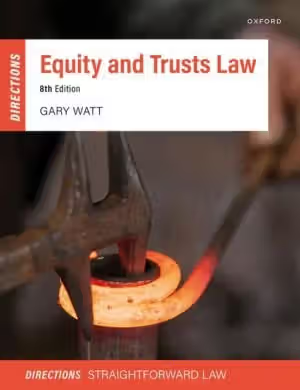
Watt, G. (2025). Equity & Trusts Law Directions (8th ed.). Oxford University Press.
Chapter Summary
The eighth edition runs to about 570 pages in twenty chapters, with no division into parts. The order moves from the nature of equity and the trust, through the requirements for creating a valid trust and the special cases of purpose and charitable trusts, to the office and duties of trustees, breach of trust, trusts that arise without express declaration, the remedies against property and third parties, and finally equity's doctrines and remedies outside trusts. The groupings below are for orientation only; the book itself numbers the chapters straight through. The publisher describes the Directions approach as scene-setting introductions, highlighted case extracts, an introduction to the key areas of debate, self-testing features and direction on going further. The author, Gary Watt, is a professor at the University of Warwick and a National Teaching Fellow, and also writes OUP's longer Trusts & Equity.
Chapters 1–2: Introduction to equity and trusts; Understanding trusts
Two opening chapters introduce equity as a body of law and the trust as its most important creation, before any of the formal requirements are discussed.
Chapters 3–6: Capacity and formality requirements; Certainty requirements; The constitution of trusts; Public policy limitations on the formation of trusts
The core of the creation of express trusts: who may create a trust and in what form, the certainties a valid trust needs, how property comes to be held on trust, and the limits that public policy places on what a trust may do. The publisher's notes on this edition mention the use of "massively discretionary trusts" and sham trusts to hide wealth from the tax authorities, and Supreme Court authority on a claimant's ability to recover in an action tainted by their own illegality.
Chapters 7–9: Purpose trusts; Charitable trusts; Variation of trusts
Three chapters on trusts that depart from the ordinary model of a trust for identified people. Chapter 7 treats purpose trusts and Chapter 8 charitable trusts; the publisher notes that this edition covers the implications of political controversies for the funding of charitable trusts. Chapter 9 deals with how the terms of an existing trust can be varied.
Chapters 10–14: Trustee appointments; The nature of trusteeship; Trustees' duties; Maintenance and advancement; Investment
Five chapters on trusteeship: how trustees are appointed, what kind of office trusteeship is, the duties it brings, the powers to apply trust funds for beneficiaries' maintenance and advancement, and investment. The new edition covers ethical investment by trusts, and Court of Appeal authority on the relationship between fiduciary duty and the duty of care.
Chapter 15: Breach of trust: Defences and relief
The consequences of a breach of trust and the defences and relief available to a trustee. The publisher mentions new material on remedies where fiduciary gains and careless losses arise from the same transaction.
Chapters 16–17: Resulting and constructive trusts; Informal trusts of land
Trusts that arise without an express declaration. Chapter 16 covers resulting and constructive trusts generally; Chapter 17 is devoted to informal trusts of land, the area of law that governs many disputes over shared homes.
Chapters 18–19: Tracing; The equitable liability of strangers to the trust
Two chapters on what happens to trust property and to outsiders when things go wrong: tracing into substitute assets, and the liability in equity of people who are not trustees. The edition adds discussion of cryptocurrency for the tracing of funds, and Supreme Court authority on an innocent claimant's recovery of wrongful fiduciary gains that the Crown Prosecution Service sought to confiscate.
Chapter 20: Equity: doctrines and remedies
The book closes with equity outside the trust: its doctrines and its remedies. The publisher notes new discussion of cryptocurrency and the specific performance of agreements.
Key Concepts
Chapters 1–9: Equity, the trust and its creation
- Equity: the body of rules and remedies, distinct from the common law, from which the trust developed.
- Formality and capacity: who may create a trust and the formal steps some trusts require.
- Certainty requirements: the conditions of certainty that an express trust must satisfy, the subject of Chapter 4.
- Constitution: the step by which property actually comes to be held on trust.
- Purpose and charitable trusts: trusts for purposes rather than people, and the special regime for charities.
- Variation of trusts: how the terms of an existing trust can be changed.
Chapters 10–15: Trusteeship and breach
- Trusteeship: an office with its own rules on appointment and its own duties.
- Maintenance and advancement: powers to use trust funds for a beneficiary before their full entitlement.
- Investment: the duties that govern how trustees invest, including questions of ethical investment.
- Breach of trust: liability for breach and the defences and relief available.
Chapters 16–20: Implied trusts, remedies and equity beyond trusts
- Resulting and constructive trusts: trusts imposed or presumed by law rather than declared.
- Informal trusts of land: trusts of land, typically homes, that arise without formal documents.
- Tracing: identifying trust property in its substitutes.
- Liability of strangers: equitable liability of third parties who become involved with trust property or a breach.
- Equitable doctrines and remedies: equity's remedies, such as specific performance, outside the trust.
Critical Analysis
Strengths
- Fine-grained chapters. Twenty chapters for one subject means each topic a course is likely to teach, from certainty and constitution to tracing and the liability of strangers, has its own chapter. Students can find a seminar topic directly from the contents.
- Current material. The eighth edition engages with recent developments: cryptocurrency in tracing and specific performance, discretionary and sham trusts used to shelter wealth from tax, ethical investment, and recent Court of Appeal and Supreme Court decisions on fiduciary duties, illegality and confiscation.
- An author known for teaching. Watt was named Law Teacher of the Year in 2009 and became a National Teaching Fellow in 2010, and the Directions features (scene-setting introductions, highlighted case extracts, self-tests) are designed for students meeting the subject for the first time.
- Trusts of land given separate attention. A whole chapter on informal trusts of land, separate from resulting and constructive trusts in general, gives the shared-home cases room of their own.
Limitations
- Equity outside trusts is compressed. Equitable doctrines and remedies share a single final chapter, so courses that give substantial time to injunctions, specific performance, rescission or equitable estoppel will need a fuller treatment.
- No separate chapter on fiduciaries. Fiduciary obligations do not appear in any chapter title and appear in the publisher's notes only in connection with trustees' duties and breach. Courses that treat fiduciary law as a topic in its own right may need to supplement.
- Not short. At about 570 pages the book is a substantial read for a first course, and it is longer than the Contract Law volume in the same series (about 460 pages).
Where It Fits in the Course
This book and Penner's The Law of Trusts are the two entry points in the course list. Watt's book is organised around how trusts are created and administered and is built for students meeting the subject for the first time; Penner's Core Text is a shorter and more conceptual book that engages with the controversies of trusts law. A student who finds the subject difficult can begin with Watt and then read Penner for the arguments.
Graham Virgo's The Principles of Equity and Trusts and Alastair Hudson's Equity and Trusts are fuller textbooks for students who want more depth: Virgo states the law and then examines its policy and theory, while Hudson also places trusts in their social and commercial settings, from the family home to financial markets. Hanbury & Martin: Modern Equity is a detailed academic treatise that engages closely with the scholarly debates, and Snell's Equity is a practitioners' treatise cited by the courts; both are for reference, dissertations and specific points, not for reading through in a first course.
How to Use This Book
The book is written for undergraduates taking equity and trusts for the first time and for students on conversion courses. No previous study of equity is assumed, but the basic property and contract concepts of first-year law help.
A practical plan:
- Read Chapters 1 and 2 before the course begins. They set up the vocabulary of equity and the trust on which every later chapter depends.
- Treat Chapters 3–6 as the core of the first term. Formality, certainty, constitution and public policy limits are the building blocks of express trusts and appear in most problem questions.
- Follow the course order for the rest. Courses vary in whether they teach trusteeship (Chapters 10–15) before or after resulting and constructive trusts (Chapters 16–17); the chapters stand well enough on their own to be read in either order.
- Pair Chapter 17 with the land law course, since informal trusts of the home sit between the two subjects.
- Use the self-test features after each chapter, and go to the leading judgments themselves for the topics that are examined, since the book gives highlighted extracts rather than full judgments.
- Supplement Chapter 20 from a fuller textbook if the course spends several weeks on equitable remedies.