01 / Reading Guide
Reading Guide
Citation
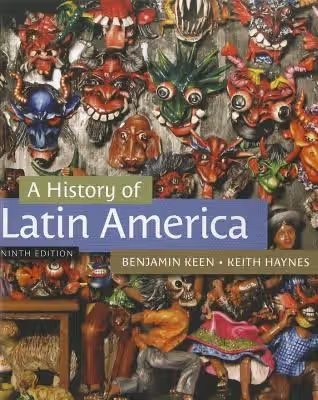
Keen, B., & Haynes, K. (2013). A History of Latin America (9th ed.). Cengage Learning.
Chapter Summary
This is a one-volume survey textbook of about 600 pages, spanning "pre-historic times to the present," for introductory Latin American history courses. Benjamin Keen, a professor emeritus at Northern Illinois University known especially for work on colonial Mexico, wrote the original text and died in 2002; Keith Haynes, a professor of history at The College of Saint Rose, who has taught Latin American and United States diplomatic history, co-authored the ninth edition. Cengage also sells the book in separate volumes for courses that split the history in two.
An integrating framework: dependency theory
The publisher says the book's integrating framework is dependency theory, which it calls the most popular interpretation of Latin American history. The theory stresses the economic relationship of Latin American nations to wealthier nations, particularly the United States. The framework gives the narrative a through-line, and readers should recognise it as an interpretation rather than a neutral summary.
Chronological and nation-by-nation approach
The book takes both a chronological approach and a nation-by-nation approach. A reader can follow the region through time and can also look up the history of a given country. The publisher says the text includes recent historical analysis and scholarship.
Political, economic, cultural and environmental history
The topics the publisher names are political and diplomatic theory, class structure and economic organisation, culture and religion, and the environment. These run alongside the narrative and give it breadth beyond the political history of states.
New emphasis in the ninth edition
According to the publisher, the ninth edition expands the coverage of social and cultural history throughout, including music, and gives increased attention to women, Indigenous cultures and Afro-Latino people, in order to give balanced coverage of the region's diverse histories.
Key Concepts
Interpretation and approach
- Dependency theory: the interpretive framework that stresses the economic ties between Latin American nations and wealthier countries, particularly the United States.
- Chronological and national treatment: the two ways in which the book organises the region's history.
Subject areas
- Class structure and economic organisation: the social and economic foundations the book addresses alongside politics.
- Culture and religion: treated as part of the region's history, along with music in the ninth edition.
- Environment: the natural setting is one of the named areas of coverage.
- Women, Indigenous cultures and Afro-Latino people: groups to which the ninth edition gives increased attention.
Critical Analysis
Strengths
- A single-volume introduction. The text is designed for introductory courses and covers the region from prehistory to the present in one book.
- Two ways in. Combining a chronological approach with a nation-by-nation approach lets a course move between region-wide topics and single-country case studies.
- Broad subject range. The coverage of class, economics, culture, religion, environment, women, Indigenous cultures and Afro-Latino people gives a fuller picture than a political history alone.
- Authors with long experience. The original author was a leading scholar of the colonial period, and the text has been revised through many editions (earlier editions are catalogued from 1991, 1996 and 2000).
Limitations
- One organising theory. The dependency framework is the book's declared lens, so a student should balance it with works that use other approaches to Latin American history.
- Breadth over depth. A single volume covering the whole region and all periods cannot treat any country or episode in detail, so students working on a particular country need monographs.
- Dated. The ninth edition dates from 2012–13, and its coverage of the most recent decades is necessarily limited.
Where It Fits in the Course
Keen and Haynes is a regional survey, and the closest parallel on this course list is Gelvin's The Modern Middle East, which does for another world region what Keen and Haynes does for Latin America. Both fit alongside the global textbooks that frame the course: Bulliet and colleagues' The Earth and Its Peoples, Bentley, Ziegler and Streets Salter's Traditions & Encounters, Strayer and Nelson's Ways of the World and Tignor and colleagues' Worlds Together, Worlds Apart all place regional histories in a world context.
For a closer study of one Latin American society, Carrasco's The Aztecs: A Very Short Introduction gives a concise account of Aztec society and the Spanish invasion. On method, Conrad's What Is Global History? explains the approach that connects regions, and Osterhammel's The Transformation of the World offers a thematic global history of the nineteenth century.
How to Use This Book
The book suits undergraduates taking a survey of Latin American history and general readers wanting an orientation. Only general secondary-school history is expected, and no Spanish or Portuguese is needed.
A practical plan:
- Read in order at first. The chronological structure builds from early societies to the modern period, so earlier material supports later chapters.
- Select by country. If a course focuses on one country, read the regional narrative first and then the sections on that country.
- Test the framework. Because dependency theory is the organising lens, ask in each period what the framework explains well and what it leaves out, and compare with a global text.
- Add primary sources and monographs. For topics such as Indigenous histories, slavery and emancipation, or women's history, move to specialised works once the overview is in place.
- Check the volume and edition. Cengage also offers separate volumes, and the ninth edition differs from earlier ones, so confirm which version your course uses.