01 / Reading Guide
Reading Guide
Citation
Moore, R. I. (2007). The Formation of a Persecuting Society: Authority and Deviance in Western Europe 950–1250 (2nd ed.). Wiley-Blackwell.
Chapter Summary
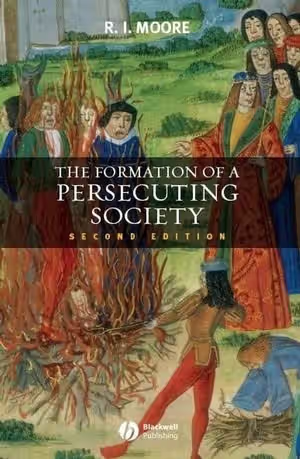
The book is short, about 170 pages of main text plus a bibliographical excursus, and its argument is its main content. The publisher's description sets out the problem: between the tenth and thirteenth centuries Europe saw the appearance of popular heresy and the establishment of the Inquisition, the expropriation and mass murder of Jews, and elaborate measures to segregate lepers and curtail their civil rights. These were traditionally explained separately, each in terms of the problems its victims presented to medieval society. Moore argues that the coincidences in the treatment of these and other minority groups cannot be explained independently, and that all belong to a pattern of persecution that made Europe a persecuting society. First published in 1987, the second edition adds a preface, a new final chapter, a critical bibliography and a response to criticism.
Introduction
A brief introduction of about five pages opens the argument and the questions the book pursues.
Chapter 1: Persecution
The longest chapter, at some fifty-five pages, opens the case. Its title and the publisher's description place persecution itself at issue, the treatment of heretics, Jews and lepers that the introduction to the book sets side by side.
Chapter 2: Classification
The second chapter, about thirty pages, takes up classification, the term the contents list uses for how people and groups were sorted into categories.
Chapter 3: Purity and Danger
The chapter title is also the title of Mary Douglas's well-known anthropological study of ritual purity and pollution. At about twenty-three pages it is the shortest of the main chapters.
Chapter 4: Power and Reason
At about twenty-seven pages, this chapter pairs power with reason. The book's subtitle, Authority and Deviance, names the two terms in which the argument is framed.
Chapter 5: A Persecuting Society
New in the second edition, the final chapter of some twenty-eight pages returns to the idea of the "persecuting society" in light of research since 1987. The publisher says Moore refines the conception and addresses criticisms of the first edition.
Bibliographical Excursus: Debating the Persecuting Society
A critical bibliography of about twenty-five pages follows, then the bibliography and index. It surveys the debate the book has provoked, which makes it the guide to the scholarly argument.
Key Concepts
Introduction and Chapters 1–3
- Persecuting society: the publisher's phrase for a Europe in which the persecution of minority groups formed a pattern that appeared in the tenth to thirteenth centuries and has persisted.
- Classification: the sorting of people into categories, the subject of Chapter 2.
- Purity and danger: the title of Chapter 3, borrowed from Mary Douglas's study of ritual purity.
Chapters 4–5 and the Excursus
- Authority and deviance: the pairing in the subtitle that structures the analysis.
- A pattern, not isolated incidents: the thesis that different persecutions form one development.
- Historiographical debate: the critical bibliography records how scholars responded after 1987.
Critical Analysis
Strengths
- Concentrated argument. At roughly 170 pages of text the book makes its case briefly, which suits teaching.
- Connects separate topics. The description presents the book as showing that heresy, anti-Jewish violence and the treatment of lepers should be studied together.
- A second edition that engages critics. The new preface, final chapter and critical bibliography address a generation of research and criticism, and Wiley calls the book a classic of medieval history.
Limitations
- Contested thesis. The publisher itself describes the argument as controversial, and the second edition exists partly to answer criticism, so the book is best read together with the critical bibliography.
- Focus on Western Europe. The scope is limited to Western Europe from 950 to 1250.
- Not a survey. The book is an argued thesis, so readers need the background of a general medieval history before starting.
Where It Fits in the Course
In the medieval history course, Moore is an argued short study to read after a survey. Wickham's Medieval Europe, Rosenwein's A Short History of the Middle Ages and Bennett and Bardsley's Medieval Europe: A Short History give the narrative within which the tenth to thirteenth centuries sit. Rubin's The Middle Ages: A Very Short Introduction is a thematic introduction that treats how people lived and thought. Wickham's Framing the Early Middle Ages covers earlier centuries (400–800) on a huge scale; Moore is brief and concerned with the high medieval period.
How to Use This Book
Moore is suited to students who have studied medieval Europe and know the outline of the eleventh- and twelfth-century church. Read the introduction, then Chapter 1 and Chapter 5 to meet the thesis and its revision, and take Chapters 2–4 as the argument that links them. Use the Bibliographical Excursus to see the arguments for and against, and choose a case (heresy, Jews or lepers) to test the argument against specialist reading.
A short seminar plan: one session on Chapter 1, one on Chapters 2–4, and one on Chapter 5 with the Excursus, asking whether the pattern Moore describes holds for each group in turn.
Alongside the book, keep a timeline of the period 950–1250, including the church reforms and the first inquisitorial institutions, because the argument treats these as one connected development. When working on the thesis it helps to write a one-paragraph summary of Moore's explanation after Chapter 5, then read the Excursus and note which criticisms bear on each element. Students can also set Moore beside a survey chapter on heresy or on the Jews in medieval Europe to see what a general account leaves out.