01 / Reading Guide
Reading Guide
Citation
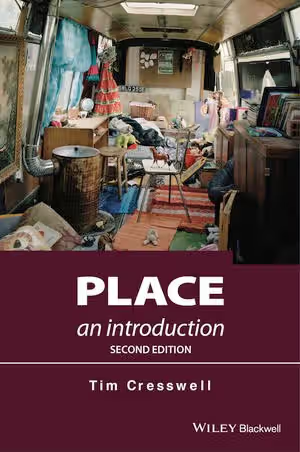
Cresswell, T. (2014). Place: An Introduction (2nd ed.). Wiley-Blackwell.
Chapter Summary
The second edition has about 240 pages in seven chapters: an introduction that defines the concept, a history of the idea, two chapters on mobility and on a single influential paper, two chapters of research examples, and a final chapter of resources. Cresswell writes in the first person, draws on news stories, novels and his own family history, and returns to New York's Lower East Side throughout the book as a running example.
Chapter 1: Introduction: Defining Place
The chapter opens by showing how widely place is invoked, by nature writers and conceptual artists, by GIS scholars and app developers, by OpenStreetMap volunteers and by protesters in Tahrir Square and the Occupy camps, and argues that the word is so familiar that its meaning is rarely examined. Using John Agnew's three aspects of place (location, locale and sense of place), it defines place as a meaningful location, and then distinguishes place from space (drawing on Yi-Fu Tuan's image of space as movement and place as pause, and Jonathan Raban's account of how Indigenous canoeists and colonial explorers read the same coast) and from landscape, which is looked at rather than lived in. It ends with the claim that place is also a way of understanding the world, "space invested with meaning in the context of power", and outlines the rest of the book.
Chapter 2: The Genealogy of Place
The history of the concept runs from its emergence in Western thought through regional geography's descriptions of places and the humanistic geography of the 1970s (Relph and Tuan, building on Heidegger and Merleau-Ponty), to radical human geography and the politics of place. The chapter then contrasts place as "being-in-the-world" with place as social construct, considers newer work on assembling place, and closes by summarising the different versions of place.
Chapter 3: Place in a Mobile World
The chapter examines the relation between place and mobility: place as practice and process (including David Seamon's account of bodily routines in place), place as open and changing, the arguments that time–space compression and globalization produce "placelessness" and the "end of place" (Augé, Harvey), and the connections between place, identity and mobility, including anthropological work on cosmopolitanism and "friction".
Chapter 4: Reading "A Global Sense of Place"
A whole chapter is given to Doreen Massey's paper, which argues for an open, extroverted sense of place made by connections rather than roots. After setting out the historical context, Cresswell contrasts Massey with David Harvey's more sceptical treatment of place and with Jon May's study of a London neighbourhood, and ends by looking beyond the opposition of "reactionary" and "progressive" senses of place.
Chapter 5: Working with Place – Creating Places
The first chapter of applications shows how places are made: in a mobile world, through memory and heritage sites such as museums, in architecture and the idea of genius loci, through the marketing of "a nice place to live", at the scale of regions and nations, in the digital world, and in art.
Chapter 6: Working with Place – Anachorism
The second applications chapter concerns things "out of place", drawing on Cresswell's own work on transgression. It discusses how sexuality, homelessness and animals are made to seem out of place, and how ideas of appropriate place create normative "moral geographies" of who and what belongs where.
Chapter 7: Place Resources
The final chapter is an annotated guide to key books on place, introductory texts, key papers, other books and papers, journals and web resources, with suggestions for student projects and essays.
Key Concepts
Chapter 1: Introduction: Defining Place
- Place as meaningful location: the basic definition, built from Agnew's location (where), locale (the material setting of social life) and sense of place (attachment and meaning).
- Space and place: space as abstract and open, place as space that has been given meaning, for instance through naming or dwelling.
- Landscape: a visual idea in which the viewer stands outside; places, by contrast, are lived in.
- Place as a way of knowing: place not only as a thing in the world but as a way of seeing that can resist abstraction or justify exclusion.
Chapters 2–4: The Genealogy of Place; Place in a Mobile World; Reading "A Global Sense of Place"
- Humanistic geography: the 1970s approach that placed human experience and meaning at the centre of the study of place.
- Place as social construct: the view that the meanings of places are made, and fought over, through social and political processes.
- Placelessness and time–space compression: the arguments that mobility and globalization erode distinctive places.
- Global (progressive) sense of place: Massey's idea of place as open, hybrid and made by connections.
Chapters 5–6: Creating Places; Anachorism
- Genius loci: the "spirit of place" invoked in architecture and design.
- Place and memory: the creation of heritage places, such as museums, that keep the past visible.
- Anachorism and moral geographies: being "out of place", and the normative maps of who and what belongs where.
Critical Analysis
Strengths
- Concrete, familiar examples. As the publisher's description promises, abstract arguments are explained through stories from the news, popular culture and everyday life. Chapter 1 moves from a student decorating a college room to the coordinates and the history of the Lower East Side, Tompkins Square Park and its community gardens, and the Lower East Side recurs through the book.
- Clear definitions without oversimplifying. The first chapter gives students a working definition (Agnew's three aspects) and then shows why place is still a contested concept, separating it from space and landscape and presenting it as a way of knowing as well as a thing.
- History and debate in one short book. The genealogy in Chapter 2 runs from Western philosophy through humanistic and radical geography, and Chapter 4's close reading of Massey's paper against Harvey and May models how to read a key text critically.
- Built for teaching. The resource chapter's annotated bibliography, journal and web lists and student project ideas make the book easy to build a course or essay around.
Limitations
- Anglo-American framing. The genealogy centres on North American and British geography, and the running example is New York's Lower East Side.
- An argued perspective. Cresswell writes in the first person and builds Chapter 6 on his own earlier work on transgression, In Place/Out of Place; this gives the book a clear voice, but readers get his map of the field.
- Short treatment of each topic. Each of the creating-places topics (memory, architecture, regions, digital place, art) has between three and ten pages, so the book introduces debates rather than settling them.
Where It Fits in the Course
Among the course books, Cresswell is the most direct introduction to the concept of place and works well as a first reading. Yi-Fu Tuan's Space and Place, a short classic of humanistic geography, is the source of the space-as-movement, place-as-pause idea quoted in Chapter 1 and is best read alongside or just after Chapter 2. Chapter 4's reading of "A Global Sense of Place" prepares students for Doreen Massey's For Space, the theoretical book in which she develops a relational view of space and place, and the brief references to social space prepare for Henri Lefebvre's The Production of Space, the most demanding work on the list.
For cultural geography more broadly, Don Mitchell's Cultural Geography: A Critical Introduction treats culture as a field of struggle, a natural continuation of Chapter 6's moral geographies, while Norton and Walton-Roberts's Cultural Geography offers a broader textbook survey of culture–place relationships.
How to Use This Book
The publisher addresses the book to students of human geography and allied disciplines; it starts from everyday uses of the word and needs no prior reading in theory.
- Read Chapter 1 slowly. Its definitions (location, locale, sense of place; space, place, landscape) are used throughout.
- Read Chapters 2–4 as a unit on theory. Read Massey's paper itself before or alongside Chapter 4, so the chapter's comparison with Harvey and May is easier to follow.
- Use Chapters 5–6 for applications and essays. Pick one topic (heritage, homelessness, digital place) and follow the readings cited there.
- Apply the concepts to a local example. Cresswell's Lower East Side case is a model: take a neighbourhood you know, trace its location, locale and sense of place, and ask who decides what belongs there.
- Use Chapter 7 for further study. Its key books and journals list, and its project suggestions, are a ready-made starting point for coursework.