01 / Reading Guide
Reading Guide
Citation
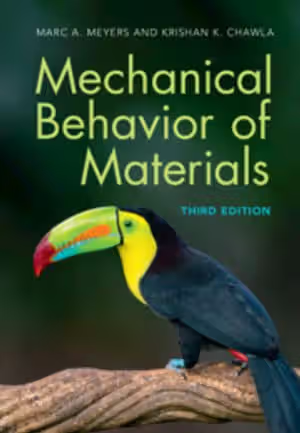
Meyers, M. A., & Chawla, K. K. (2025). Mechanical Behavior of Materials (3rd ed.). Cambridge University Press.
Chapter Summary
The book has sixteen chapters of about 960 pages. According to the third-edition preface, its fundamental theme is the mechanisms responsible for the mechanical properties of different materials under a variety of environmental conditions, presented in a unified way for metals, polymers, ceramics, composites, biological materials and electronic materials. The underlying idea is that structure at the micro- or nanometer level controls properties. The authors say the book is meant mainly for upper-division and graduate courses in mechanical engineering and in materials science and engineering, that its mathematics is kept quite simple, and that Chapter 1 supplies the materials background needed. They also describe it as a reference for practising engineers and researchers, with more material than a single semester course can cover.
Chapter 1: Materials: Structure, Properties, and Performance
An introduction to the book's themes. It covers monolithic, composite and hierarchical materials, and the structure of crystals, metals, ceramics, glasses, polymers, liquid crystals, biological materials and biomaterials, porous and cellular materials, active materials, electronic materials and nanotechnology, ending with the strength of real materials. The authors suggest using it as a reference chapter and as a self-study resource.
Chapter 2: Elasticity and Viscoelasticity
Stress and strain, strain energy, Poisson's ratio, complex states of stress and the Mohr circle, anisotropic stiffness and compliance in tensor form, elastic properties of polycrystals, of different material classes and of fibre composites, viscoelasticity, rubber elasticity, elastic properties of biological and electronic materials, and the relation between elastic constants and bonding.
Chapter 3: Plasticity
Plastic deformation in tension and compression, the Bauschinger effect, plastic deformation of polymers and glasses, flow, yield and failure criteria (including Tresca and von Mises), hardness and indentation including nanoindentation, formability, buckling, muscle force and the mechanical properties of some biological materials.
Chapters 4–5: Imperfections: Point and Line Defects; Imperfections: Interfacial and Volumetric Defects
Chapter 4 starts from the theoretical shear strength and treats point defects and line defects in detail: dislocation behaviour, stress fields, energy, sources, interactions and the Peierls–Nabarro stress. Chapter 5 covers grain boundaries, twinning, grain-size strengthening (Hall–Petch and other theories), nanocrystalline materials, volumetric defects, imperfections in polymers and micro-pillar compression testing.
Chapter 6: Geometry of Deformation and Work-Hardening
The geometry of slip, stereographic projections, the stress needed for slip, work-hardening in polycrystals and the theories of Taylor, Seeger and Kuhlmann-Wilsdorf, softening mechanisms and texture strengthening.
Chapters 7–9: Fracture: Macroscopic Aspects; Fracture: Microscopic Aspects; Fracture Testing
Chapter 7 covers theoretical tensile strength, stress concentration, the Griffith criterion, linear elastic fracture mechanics, fracture toughness parameters (crack extension force, crack opening displacement, J-integral, R curve) and statistical analysis of failure strength. Chapter 8 treats fracture mechanisms in metals, ceramics, polymers and biological materials, and fracture mechanism maps. Chapter 9 describes impact, fracture toughness, flexure and other fracture tests.
Chapters 10–12: Solid Solution, Precipitation, and Dispersion Strengthening; Martensitic Transformation; Special Materials: Intermetallics and Foams
Strengthening mechanisms in alloys, including the precipitation hardening of microalloyed and advanced steels; the structure, strength and shape-memory effect of martensite; and ordered intermetallics and cellular materials.
Chapters 13–14: Creep and Superplasticity; Fatigue
Time-dependent deformation, with diffusion creep, power-law creep, deformation-mechanism maps, creep fracture and superplasticity; and fatigue, from S–N curves and cumulative damage to crack nucleation and propagation, fracture mechanics applied to fatigue and fatigue testing.
Chapters 15–16: Composite Materials; Environmental Effects
Types of composites, interfaces, properties, load transfer, fracture and applications; and the environmental effects of corrosion, oxidation, environmentally assisted fracture and hydrogen damage on metals, polymers and ceramics.
Key Concepts
Chapters 1–3: Structure, elasticity and plasticity
- Hierarchical structure: how structure from the nano- to the macroscale controls properties.
- Anisotropic elasticity: Hooke's law in tensor form for materials whose stiffness depends on direction.
- Yield criteria: Tresca and von Mises, and criteria for brittle and composite materials.
Chapters 4–6: Defects and deformation mechanisms
- Dislocations: line defects whose motion produces plastic deformation.
- Grain-size strengthening: the Hall–Petch relationship and other theories.
- Work-hardening: strengthening during deformation, with the theories listed in Chapter 6.
Chapters 7–9: Fracture
- Griffith criterion and linear elastic fracture mechanics: the energy and stress-intensity description of crack growth.
- Fracture toughness: its measurement and use as a material property.
Chapters 10–16: Strengthening, time-dependence and environment
- Precipitation and dispersion hardening: strengthening alloys with fine second-phase particles.
- Creep and fatigue: failure under sustained or cyclic load.
- Load transfer in composites: how matrix and fibre share load.
- Environmentally assisted fracture: stress corrosion cracking and hydrogen damage.
Critical Analysis
Strengths
- A single mechanisms-based framework across material classes. The authors present metals, ceramics, polymers, composites, biological and electronic materials together, linked by the theme that micro- and nanostructure controls properties, rather than in separate chapters by material.
- Mechanisms before models. Chapters 4–6 on defects and deformation, and Chapters 10–14 on strengthening, creep and fatigue, explain properties from dislocations, grain boundaries and microstructure.
- Test methods alongside theory. Chapter 9 is devoted to fracture testing, and Chapters 3, 5 and 14 cover hardness and nanoindentation, micropillar compression and fatigue testing.
- Exercises and reading lists at the end of each chapter. Every chapter has suggested reading and exercises, and the authors say the third edition added worked examples and exercises.
- Updated for the third edition. The preface lists new coverage of biological materials, the Arzt heptahedron, high-entropy alloys, micropillar testing, EBSD and coincidence site lattices, and the fracture toughness of biological materials.
Limitations
- Too much for one semester. The authors acknowledge that the book contains more than a normal semester-long course can cover, so instructors must select.
- Assumes some background. The authors describe the mathematics as quite simple, but the book is aimed at upper-division readers, Chapter 1 is meant to supply the materials-level background, and the tensor treatment of anisotropic elasticity in Chapter 2 and the fracture mechanics of Chapter 7 go beyond basic mechanics of materials. Readers new to materials will lean heavily on Chapter 1.
- Cross-class organisation can scatter a single material. Because chapters are organised by phenomenon rather than by material, studying only metals or only polymers means moving through many chapters.
Where It Fits in the Course
In this materials science course, Meyers and Chawla is the specialised mechanical-behaviour text. Ashby, Shercliff and Cebon's design-led introduction and Callister and Rethwisch's Materials Science and Engineering: An Introduction are first-course texts that connect structure, processing and properties; Callister also reaches atomic bonding, crystal structures and mechanical behaviour, and Hall's Materials: A Very Short Introduction is a short, everyday-examples introduction. Any of these gives the background for Chapter 1.
Porter, Easterling and Sherif's Phase Transformations in Metals and Alloys is an advanced text on how thermodynamics, diffusion and interfaces control the microstructures that form. It complements Meyers and Chawla's Chapters 10 and 11 on strengthening and martensite: Porter explains how microstructures form, Meyers and Chawla how those microstructures determine strength and fracture.
How to Use This Book
The book suits upper-division mechanical engineering and materials science students and graduate students who have taken a first course in materials and basic mechanics of materials. Chapter 1 provides the necessary structural background and can be used for reference.
A practical plan for a one-semester course:
- Core: Chapters 2 and 3 (elasticity and plasticity), Chapters 4 and 6 (dislocations and work-hardening), Chapters 7 and 8 (fracture) and Chapter 14 (fatigue).
- Next: Chapter 5 on grain boundaries and strengthening, Chapter 10 on alloy strengthening, and Chapter 13 on creep.
- By emphasis: Chapter 15 for composites, Chapter 16 for environmental effects, Chapters 11 and 12 for martensite, intermetallics and foams, and Chapter 9 for the testing laboratory.
Use the exercises after each chapter to test understanding, and the suggested reading to go beyond the text. Treat Chapter 1 as a reference to return to when a later chapter uses a structural term you have not met.