01 / Reading Guide
Reading Guide
Citation
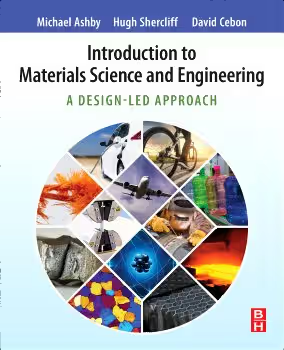
Ashby, M. F., Shercliff, H., & Cebon, D. (2023). Introduction to Materials Science and Engineering: A Design-Led Approach. Butterworth-Heinemann (Elsevier).
Chapter Summary
The book runs to about 700 pages: twelve chapters, four "Guided Learning Units" that take up topics needing more practice, and an appendix of material property data. The publisher describes its method as design-led: properties are first analysed and matched to design requirements through case studies, and the science behind each property follows. The chapter titles show the resulting pattern. Each mechanical property is paired with the class of applications it limits.
Chapter 1: Introduction: materials — history, classification, and properties
The opening chapter places materials in their historical setting, sorts them into classes and introduces the properties by which engineers compare them.
Chapter 2: Materials, processes, and design
This chapter sets out the link the whole book is built on: a design needs materials with suitable properties, and those properties depend on how the material is processed.
Chapter 3: Material properties and microstructure — overview and atom-scale fundamentals
The science enters here, with an overview of how properties arise from microstructure and from structure at the scale of atoms. The first Guided Learning Unit, on crystallography, extends this chapter.
Chapters 4–6: Elastic stiffness and stiffness-limited applications; Plasticity, yielding and ductility, and strength-limited applications; Fracture, fatigue, and fracture-limited applications
The mechanical core of the book. Each chapter takes one family of properties (elastic stiffness; yielding, plasticity and ductility; fracture and fatigue) and pairs it with the designs that the property limits: components that must not deflect too much, must not yield, or must not break.
Chapters 7–8: Materials and heat: thermal properties; Materials at high temperatures: diffusion and creep
Two chapters on temperature: first the thermal properties of materials, then what happens when they are used hot, where diffusion and slow creep deformation control performance.
Chapter 9: Surfaces: friction, wear, oxidation, corrosion
This chapter covers what happens at surfaces, mechanically through friction and wear, and chemically through oxidation and corrosion.
Chapter 10: Functional properties: electrical, magnetic, optical
The single chapter on non-mechanical properties covers electrical, magnetic and optical behaviour.
Chapter 11: Manufacturing processes and microstructure evolution
This chapter returns to processing and treats manufacturing as the stage at which microstructure, and therefore properties, are set. Guided Learning Units 3 and 4 (process selection; phase diagrams and phase transformations) support it.
Chapter 12: Materials, environment, and sustainability
The book closes with the environmental side of materials use and sustainability.
Guided Learning Units 1–4 and Appendix A
The four units are "Simple ideas of crystallography", "Material selection in design", "Process selection in design" and "Phase diagrams and phase transformations". The publisher describes them as topics expanded separately from the main chapters. Appendix A collects material property data.
Key Concepts
Chapters 1–3: Materials, design and microstructure
- Material classes: the classification of engineering materials into families with characteristic property ranges.
- Materials–process–design triangle: the idea that design requirements, material choice and processing route must be decided together.
- Microstructure: the internal structure of a material above the atomic scale, which links atom-scale bonding to measurable properties.
Chapters 4–6: Mechanical properties
- Stiffness-limited design: designing components whose deflection under load, set by elastic modulus and shape, must stay within limits.
- Yielding and ductility: the onset of permanent deformation and the capacity to deform before failure, which govern strength-limited applications.
- Fracture and fatigue: failure by crack growth under a single load or under repeated loading.
Chapters 7–10: Thermal, surface and functional properties
- Creep: slow, time-dependent deformation at high temperature, controlled by diffusion.
- Corrosion and oxidation: chemical attack of surfaces by their environment.
- Functional properties: electrical, magnetic and optical behaviour, as distinct from mechanical performance.
Chapters 11–12 and the Guided Learning Units
- Processing and microstructure evolution: how manufacturing steps change microstructure and therefore properties.
- Phase diagrams: maps of the equilibrium phases of an alloy as composition and temperature change.
- Material and process selection: systematic choice among candidate materials and processes against design requirements.
Critical Analysis
Strengths
- The design question comes first. The publisher explains that properties are first matched to design through real-world case studies before their scientific origins are examined. The chapter titles show this pattern throughout Chapters 4–6, where each property is named together with the applications it limits. Students who are motivated by what materials are for, rather than by crystallography, are the intended audience.
- Visual communication. Like Ashby's other textbooks, the book relies on material property charts and schematics, which the publisher says are used to show where properties come from, how they can be changed and what limits them.
- Low mathematical demand. The publisher states that the book requires only the minimum mathematics needed for a first materials course, which suits a first-year module for students from several engineering disciplines.
- Separable practice units. Crystallography, selection methods and phase diagrams are held in Guided Learning Units rather than in the main chapters. Instructors can schedule them where they fit, and students who need extra work on a topic know where to find it. A solutions manual and an image bank are available to instructors.
Limitations
- Breadth over depth in the science. Atom-scale fundamentals occupy a single overview chapter, and electrical, magnetic and optical properties share one chapter. Students in materials or electrical programmes will need a more science-led text for these topics.
- Phase transformations are not in the main sequence. Phase diagrams appear only as a Guided Learning Unit, so courses that treat alloy microstructure as central will have to bring that unit forward deliberately.
- A long book for a first course. At about 700 pages, it holds more than most one-semester modules can cover, and instructors must choose.
Where It Fits in the Course
This is the most design-oriented of the full textbooks in the materials course list. Christopher Hall's Materials: A Very Short Introduction is a short, non-technical narrative of the whole field and can be read in a few evenings before starting this book. Callister and Rethwisch's Materials Science and Engineering: An Introduction covers similar ground in the opposite order: it starts from atomic bonding and crystal structure and builds up to properties, with phase diagrams in the main sequence. Students who find Ashby's property-first approach too light on structure can use Callister as a companion for Chapters 3, 8 and 11 and for Guided Learning Unit 4.
After a first course, Porter, Easterling and Sherif's Phase Transformations in Metals and Alloys deepens the physical metallurgy that this book treats only in a learning unit. Meyers and Chawla's Mechanical Behavior of Materials explains the mechanisms behind the stiffness, yielding, fracture and creep that Chapters 4–8 use for design.
How to Use This Book
The publisher addresses the book to undergraduates in materials, mechanical, chemical, civil and aeronautical engineering taking their first materials course. School-level mathematics, physics and chemistry are enough to start.
A practical reading plan:
- Core sequence: Chapters 1–6 in order. They introduce the classes and properties, the link between materials, processes and design, the microstructural basis, and the three mechanical property chapters. Work through Guided Learning Unit 1 (crystallography) alongside Chapter 3.
- Selection skills early: Guided Learning Unit 2 (material selection) is worth doing once Chapter 4 is finished. Practising selection with the data in Appendix A gives the design side of later chapters something concrete to work on.
- Second half of a module: Chapters 7–9 for thermal, high-temperature and surface behaviour, then Chapter 11 with Guided Learning Units 3 and 4 for processing and phase diagrams.
- Selective reading: Chapter 10 for students who need functional properties, and Chapter 12 for courses with a sustainability component.
For each property chapter, check that you can name a component limited by that property and explain which material characteristic you would change to improve it. Pair the book with Callister if the course examines crystal structures or phase diagrams in detail.