01 / Reading Guide
Reading Guide
Citation
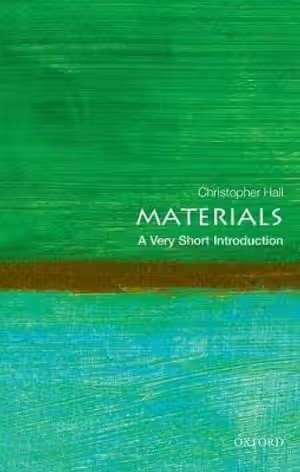
Hall, C. (2014). Materials: A Very Short Introduction. Oxford University Press.
Chapter Summary
The book is a pocket-sized volume in Oxford's Very Short Introductions series, with six chapters of roughly 15–20 pages each (about 120 pages of text), followed by a further-reading list and an index. Christopher Hall, who was the University of Edinburgh's first Professor of Materials, organises it around a few memorable images rather than the conventional textbook sequence. The chapter titles are allusive rather than descriptive.
Chapter 1: Gold, sand, and string
The book begins with the Periodic Table as the source of every material and uses three everyday substances to stand for the three great resource families: gold for metals, sand for inorganic materials and string for organic ones. Along the way it describes the atomic structure of gold, silver, iron and copper and the alloys made from them (bronze, brass and steel), quartz and calcite as the minerals behind glass and cement, and cellulose, the chain polymer at the heart of cotton, wood and paper.
Chapter 2: Close inspection
This chapter argues that understanding internal structure is the core of materials science: without it, behaviour can be neither explained nor improved. It traces how that understanding was won, from the microscopes of Hooke and van Leeuwenhoek to X-ray diffraction and electron microscopy at atomic resolution, and ends with two-dimensional graphene and one-dimensional carbon nanotubes.
Chapter 3: Tough but slippery
The chapter on physical properties covers density (with the contrasting needs of aerospace engineers and well-drilling engineers), thermal expansivity, specific heat and thermal conductivity. It then turns to mechanical properties (stiffness, strength, hardness, brittleness and toughness), singling out yield and plasticity as the most significant properties of metals, and also treats the elasticity of polymer molecules and the viscosity of fluids.
Chapter 4: Electric blue
Electrical and optical behaviour: why materials conduct or resist, why they are transparent, opaque, shiny or coloured. Starting from Faraday, Siemens, Hertz and Edison, it shows how the quantum theory of electrons in solids explains conduction and underpins semiconductor technology, and it covers superconductors, magnetism and computer models of "virtual materials" across many scales.
Chapter 5: Making stuff and making things
Processing: the step-by-step making of glass, silicon, nickel superalloys, fibres and textiles, and plastics, and how these materials feed into the manufacture of other goods. Pottery, bricks and tiles are the contrasting case, where the material and the object are made in one firing. The chapter closes by looking ahead to the future of the field.
Chapter 6: Such quantities of sand
The final chapter looks at sustainability. It identifies three problems in the global materials system (carbon dioxide emissions, energy supply and finite resources), describes the enormous scale of material flows, and argues for a circular economy of repair, re-use and recycling and for reducing the rate at which materials pass through the economy.
Key Concepts
Chapters 1–2: Resources and structure
- Metals, inorganic and organic materials: the three resource families that gold, sand and string stand for.
- Alloys: mixtures of metals, such as bronze, brass and steel, with properties their components lack.
- Internal structure: the arrangement of atoms and crystals that determines behaviour and must be re-engineered to make better materials.
- Diffraction and microscopy: the experimental methods that made atomic-scale structure visible.
Chapters 3–4: Properties
- Stiffness, strength and toughness: separate mechanical properties, each describing a different response to load.
- Yield and plasticity: permanent deformation beyond the elastic range, which the book treats as the most valuable mechanical behaviour of metals.
- Electrons in solids: the quantum account of why some materials conduct, some insulate and some are semiconductors.
Chapters 5–6: Making and sustainability
- Processing: the sequence of steps that turns raw materials into engineering materials and then into objects.
- Material flows: the global quantities of materials extracted, used and discarded.
- Circular economy: closing the loop through repair, re-use and recycling instead of extract, make, use and discard.
Critical Analysis
Strengths
- A whole-field map in a short book. In six chapters the book moves from atoms and resources through structure, properties and processing to the global scale of material use. Sustainability and resource flows are not an afterthought: they take the whole final chapter, as Oxford's description of the book also stresses.
- Concrete anchors. Abstract categories are carried by tangible examples: gold, sand and string for the material families; barytes in drilling muds for density; glass, silicon, superalloys and pottery for processing. Readers new to the subject get familiar objects to attach each idea to.
- Science in historical context. The chapters on structure and on electrical behaviour tell how ideas developed, from early microscopy to diffraction and quantum theory, which helps readers see why the modern explanations are believed.
- Written for newcomers. Oxford pitches the series at readers who want to get into a new subject quickly, and its description presents the book as a tour from steel, wood and rubber to gold, silicon and graphene rather than as a course.
Limitations
- Not a textbook. The contents run straight from the six chapters to further reading and an index, with no exercise sets or data appendix. It explains what the field is about but does not teach the calculations a materials course examines.
- Uneven coverage by design. Each chapter ranges widely in about 20 pages, and topics central to a first materials course, such as phase diagrams, fatigue or corrosion, do not appear in Oxford's chapter abstracts. Readers should not take it as a syllabus.
- Allusive chapter titles. Titles such as "Electric blue" or "Tough but slippery" say little about content, so the book is better read straight through than consulted for a specific topic. The index helps here.
Where It Fits in the Course
Within the materials course list, this is the shortest and least technical book and the natural first read. It works best before or in the first weeks of a course built on a full textbook. Ashby, Shercliff and Cebon's Introduction to Materials Science and Engineering: A Design-Led Approach starts from what designs require of materials. Callister and Rethwisch's Materials Science and Engineering: An Introduction builds up from atomic bonding and crystal structure. Hall's chapters map onto both: Chapter 2 previews the structure chapters, Chapter 3 the mechanical and thermal properties, Chapter 4 the electrical, magnetic and optical properties, Chapter 5 processing and Chapter 6 the sustainability material.
The specialist texts in the list, Porter, Easterling and Sherif on phase transformations and Meyers and Chawla on mechanical behaviour, lie far beyond this book. Hall gives only the vocabulary and the motivation that make them easier to approach.
How to Use This Book
The book suits school leavers deciding whether to study materials or a related engineering degree, first-year students who want an overview before detail, and students from physics, chemistry or design who need a sense of what materials science covers. School science is a sufficient background for a series written for newcomers.
- Read it whole. At about 120 pages of text it can be finished in two or three sittings, and the chapters build on each other: structure (Chapter 2) explains properties (Chapters 3–4), and processing (Chapter 5) shows how materials and objects are made.
- Read with a purpose. While reading, note each material mentioned and which family it belongs to. A table of metals, ceramics and inorganic materials, and polymers and natural materials, with one property each, is a useful bridge to the first lectures.
- Return to it later. Chapter 6 is worth rereading at the end of a first course, when its discussion of material flows can be connected to the property and processing knowledge gained in between.
- Use the further reading. The list at the back points onward for readers who want more on a particular chapter.