01 / Reading Guide
Reading Guide
Citation
Nellis, G. F., & Klein, S. A. (2021). Introduction to Engineering Heat Transfer. Cambridge University Press.
Chapter Summary
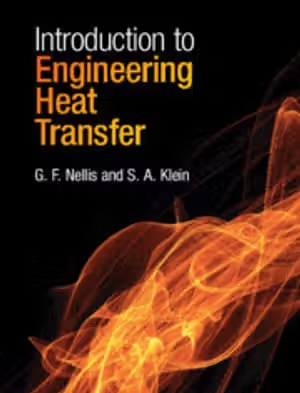
The book runs to about 1,000 pages: 14 chapters, appendices of thermophysical property tables, tutorials for the three software packages it uses (Engineering Equation Solver, Finite Element Heat Transfer and MATLAB), and answers to selected problems. It grew out of the authors' undergraduate heat transfer course at the University of Wisconsin–Madison. The preface sets out the approach: each problem is separated into formulation (defining and simplifying the problem), analysis (deriving equations from first principles), solution (often by computer) and exploration (parametric, optimisation and design studies), so that software solves the equations without doing the thinking. Each chapter ends with conclusions and learning objectives, problems grouped by topic, and several project problems that use the computer tools. A sample one-semester programme of 45 lectures maps the sections onto a 15-week course.
Chapter 1: Introduction
Why heat transfer matters, how it relates to thermodynamics, the problem-solving methodology, the three mechanisms (conduction, convection, radiation) and thermophysical properties, including real fluids and the ideal-gas and incompressible-substance models.
Chapter 2: One-Dimensional, Steady-State Conduction
At over 150 pages, the foundation of the book. Fourier's law and thermal conductivity; the plane wall derived step by step from a differential control volume; the thermal resistance concept for plane, cylindrical and spherical geometries, with convection, contact and radiation resistances; conduction with uniform and nonuniform heat generation; and numerical solution by finite differences, solved in EES, by matrix decomposition and by Gauss–Seidel iteration, including temperature-dependent properties.
Chapter 3: Extended Surface Problems
The extended surface approximation and the Biot number, the analytical solution of the fin equation (with a review of hyperbolic functions and linear ODEs), fin efficiency, tip convection, fin resistance and finned surfaces, and numerical solutions.
Chapter 4: Two-Dimensional, Steady-State Conduction
The governing equation and boundary conditions, conduction shape factors and their meaning as resistances, finite-difference solutions by the three methods of Chapter 2, and finite-element solutions in FEHT, with mesh convergence and engineering judgement.
Chapter 5: Lumped Transient Problems
The lumped capacitance assumption, the Biot number and time constant, analytical solutions for step and ramped ambient temperatures, and numerical integration: the Euler, predictor–corrector and implicit methods, and the ODE solvers in EES and MATLAB.
Chapter 6: Transient Conduction
Conceptual tools (diffusive transport, the diffusive time constant, the semi-infinite resistance), analytical solutions for semi-infinite bodies and for plane walls, cylinders and spheres (exact and approximate), and one- and two-dimensional numerical solutions, including transient finite-element analysis.
Chapter 7: Convection
The conceptual basis of convection: laminar velocity and thermal boundary layers, the Prandtl and Reynolds numbers, friction coefficient and Nusselt number, the Reynolds analogy, turbulent boundary layers and the critical Reynolds number, the boundary layer equations, and dimensional analysis leading to correlations.
Chapter 8: External Forced Convection
How to use a convection correlation, then flow over a flat plate (smooth and rough, unheated starting length, constant heat flux), flow across cylinders and other extrusions, and flow past a sphere.
Chapter 9: Internal Forced Convection
Hydrodynamic and thermal aspects of internal flow (developing and fully developed regions, entry lengths, friction factor, mean temperature), correlations for laminar and turbulent flow, including EES's internal-flow library, and the energy balance for specified heat flux, wall temperature or external temperature.
Chapter 10: Free Convection
Buoyancy-driven flow and its dimensionless groups (the Grashof and Rayleigh numbers), external correlations for plates at various orientations, spheres and cylinders, internal correlations for vertical channels and enclosures, and combined free and forced convection.
Chapter 11: Boiling and Condensation
Pool boiling and the boiling curve, flow boiling, film condensation on walls, plates, cylinders and finned tubes, and flow condensation, each with correlations.
Chapter 12: Heat Exchangers
Applications and classifications, overall energy balance and conductance (including fouling), flow across tube banks and compact heat exchanger correlations, the counter-flow solution, the log-mean temperature difference method, and the effectiveness–NTU method, ending with how effectiveness behaves in limiting cases and how it informs design.
Chapter 13: Mass Transfer
Composition relationships, Fick's law and diffusion coefficients, concentrations at interfaces, transient diffusion in a solid, diffusion with advection (evaporation through a gas layer), the analogies between momentum, energy and mass transfer, and simultaneous heat and mass transfer.
Chapter 14: Radiation
Blackbody emission and Planck's law, view factors (including the crossed-strings method and EES view-factor libraries), radiation exchange between black surfaces, emissivity and the radiative properties of real surfaces with Kirchhoff's law, and diffuse gray surface exchange using radiosity and resistance networks.
Key Concepts
Chapters 1–4: Steady conduction
- Thermal resistance: treating conduction, convection, contact and radiation as resistances combined in circuits.
- Fin efficiency and the Biot number: when a surface can be treated as an extended surface, and how well a fin transfers heat.
- Shape factor: a geometry-dependent resistance for two-dimensional conduction.
- Finite differences and finite elements: numerical solutions of conduction problems, checked for convergence.
Chapters 5–6: Transient conduction
- Lumped capacitance and time constant: transient behaviour of objects with nearly uniform temperature.
- Diffusive time constant and semi-infinite body: how far and how fast a thermal disturbance penetrates.
- Explicit and implicit time integration: Euler, predictor–corrector and implicit methods and their use through ODE solvers.
Chapters 7–11: Convection and phase change
- Boundary layers and the Reynolds analogy: the link between friction and heat transfer at a surface.
- Convection correlations: Nusselt-number relations for external, internal and free convection.
- Boiling curve and film condensation: heat transfer with phase change.
Chapters 12–14: Exchangers, mass transfer and radiation
- LMTD and effectiveness–NTU: the two standard methods for analysing heat exchangers.
- Fick's law and the heat–mass transfer analogy: diffusion of species and its parallels with heat transfer.
- View factors and radiosity: the geometry and surface properties that control radiation exchange.
Critical Analysis
Strengths
- A clear problem-solving discipline. The preface's separation of formulation, analysis, solution and exploration is carried into the worked examples, which teaches students to set up a model before reaching for software and then use software to explore it.
- Computation integrated, not appended. EES, MATLAB and FEHT appear inside the chapters, with numerical methods developed alongside the analytical ones (finite differences in Chapters 2 and 4, time integration in Chapters 5 and 6, finite elements in Chapters 4 and 6). Tutorials are provided as appendices, and EES's Heat Transfer Library supplies properties, shape factors, view factors and correlations that would otherwise come from charts.
- Well-supported practice. Problems are grouped by topic, every chapter has project problems for guided exploration, and answers to selected problems are included. Endorsements quoted by the publisher, from Ernest Tollner, Thomas Merrill and Marc Hodes, praise the clear computer-based solutions and the way software use keeps the emphasis on the solution.
- Ready-made course plan. The sample 45-lecture programme shows how the whole book can be taught in one semester.
Limitations
- Dependence on specific software. Much of the book's value comes from EES, FEHT and MATLAB. The authors note that educational versions are available, but students without access will lose the computational half of many examples and projects.
- Mixed units. By design, examples and problems mix English and SI units, relying on EES unit checking; this reflects practice but asks more of students used to SI only.
- Length. At about 1,000 pages, with Chapter 2 alone over 150 pages, the text is long for a first course, even though the sample programme covers it in 45 lectures.
Where It Fits in the Course
Nellis and Klein is the computationally oriented introduction in the heat transfer list. Lienhard and Lienhard's A Heat Transfer Textbook, free from its authors, covers similar ground from physical principles with attention to dimensional analysis and engineering judgement; it is a good second explanation, especially for students without access to EES. Çengel and Ghajar's Heat and Mass Transfer: Fundamentals and Applications and Kreith and Manglik's Principles of Heat Transfer are conventional undergraduate textbooks that can serve as the main text where the course does not use EES; Nellis and Klein's chapters on numerical methods then become a useful supplement.
Bergman, Lavine, Incropera and DeWitt's Fundamentals of Heat and Mass Transfer is a more extensive treatment for students who want greater depth after this book or a reference for later courses, and Ghiaasiaan's Convective Heat and Mass Transfer is a graduate text that takes Chapters 7–10 and 13 much further. The same authors' more advanced Heat Transfer, mentioned in the preface, is the natural continuation for readers who like this approach.
How to Use This Book
The book is intended for undergraduate heat transfer courses and as a reference for practising engineers. Calculus, ordinary differential equations and a first thermodynamics course are needed; some fluid mechanics helps with the convection chapters.
- Core one-semester course: the sample programme covers all 14 chapters in 45 lectures, about three a week; courses with less time can shorten Chapters 11 and 13.
- Essential: Chapters 2, 5, 7 and 12. The resistance concept, lumped transient analysis, boundary-layer ideas and heat exchanger methods underpin everything else.
- Can be shortened: the numerical-method sections, if the course does not use software, though doing so removes a distinctive part of the book; Chapter 13 if mass transfer is taught elsewhere.
Install the educational version of EES early and work through Appendix E before Chapter 2's numerical sections. For each problem, write down the formulation and analysis by hand before solving it in software, then use the exploration step, such as a parametric study, to ask how the answer depends on each input. Try at least one project problem per chapter.