01 / Reading Guide
Reading Guide
Citation
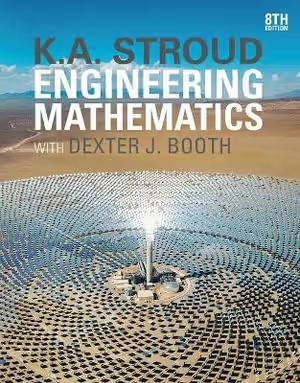
Stroud, K. A., with Booth, D. J. (2020). Engineering Mathematics (8th ed.). Bloomsbury Academic (Red Globe Press).
Chapter Summary
The eighth edition runs to about 1,190 pages and is divided not into chapters but into "programmes": 13 foundation programmes (numbered F.1 to F.13) in Part I and 29 programmes in Part II, followed by answers. The publisher describes the method that gives the book its character: the text takes the reader through each topic in small steps, asking them to complete steps that follow from earlier examples before new ones are introduced, so that by the time they try exercises alone they have already worked through many with the authors. The approach goes back to Ken Stroud's own teaching. In a 2000 tribute in Times Higher Education, Nigel Steele explained that Stroud designed the programmes for first-year mechanical and production engineering students, each one meant to take about a week of study, and tested the material against a control group before it settled into book form.
Part I, Programmes F.1–F.4: Arithmetic; Introduction to Algebra; Expressions and Equations; Graphs
The foundation section, which the publisher says covers mathematics from GCSE onwards, starts with number work and basic algebra and moves on to manipulating expressions and drawing graphs. It is intended for revision and filling gaps, so readers can start at the point their own preparation reaches.
Part I, Programmes F.5–F.8: Linear Equations; Polynomial Equations; Binomials; Partial Fractions
Solving linear and polynomial equations, the binomial expansion and partial fractions: the algebraic tools that the calculus and transform programmes of Part II rely on.
Part I, Programmes F.9–F.13: Trigonometry; Functions; Trigonometric and Exponential Functions; Differentiation; Integration
Trigonometry and the language of functions, the trigonometric and exponential functions, and a first introduction to differentiation and integration, which Part II then takes up again at greater depth.
Part II, Programmes 1–6: Complex Numbers 1 and 2; Hyperbolic Functions; Determinants; Matrices; Vectors
Part II opens with two programmes on complex numbers and one on hyperbolic functions, then turns to linear algebra and vectors. The publisher notes that the Matrices programme was revised for this edition to emphasise eigenvalues and eigenvectors and to introduce the Cayley–Hamilton theorem.
Part II, Programmes 7–13: Differentiation; Differentiation Applications; Tangents, Normals and Curvature; Sequences; Series 1 and 2; Curves and Curve Fitting
A full treatment of differentiation and its applications, including the geometry of curves, followed by sequences and series and the fitting of curves to data.
Part II, Programmes 14–15: Partial Differentiation 1 and 2
Functions of more than one variable and their partial derivatives, in two programmes.
Part II, Programmes 16–24: Integration 1 and 2; Reduction Formulas; Integration Applications 1–3; Approximate Integration; Polar Coordinate Systems; Multiple Integrals
Integration takes up the largest block of the book: techniques of integration, reduction formulas, three programmes of applications, numerical (approximate) integration, polar coordinates and multiple integrals.
Part II, Programmes 25–29: First-Order Differential Equations; Second-Order Differential Equations; Introduction to Laplace Transforms; Statistics; Probability
The book ends with ordinary differential equations of first and second order, an introduction to Laplace transforms, and one programme each on statistics and probability.
Key Concepts
Part I: Foundation topics
- Algebraic manipulation: rearranging expressions and solving linear and polynomial equations, the basis of everything later.
- Partial fractions and the binomial expansion: tools for breaking down rational expressions and expanding powers, reused in integration, series and Laplace transforms.
- Functions: trigonometric and exponential functions as the building blocks of engineering models.
Part II: Core first-year mathematics
- Complex numbers: numbers with real and imaginary parts, treated over two programmes.
- Matrices, eigenvalues and eigenvectors: the linear-algebra content strengthened in this edition.
- Differentiation and integration: the calculus of one variable, with applications.
- Partial differentiation and multiple integrals: calculus for functions of several variables.
- Ordinary differential equations and Laplace transforms: methods for first- and second-order equations.
Critical Analysis
Strengths
- A tested self-study format. The programmed method makes the reader do each step before moving on. Steele's account shows that it was developed and evaluated with first-year engineering students before it became a book, and the publisher describes the same small-step structure in the current edition.
- A genuine starting point for weaker backgrounds. The thirteen foundation programmes begin with arithmetic and algebra, so students with gaps in their school mathematics can repair them inside the same book before tackling Part II.
- Free practice online. The publisher's companion site hosts a Personal Tutor that takes students step by step through the odd-numbered questions from the book, with hints and fully worked solutions, together with PowerPoint slides and sets of additional problems for each programme. The additional problems draw on engineering situations such as electrical networks, gas laws and stresses in structures.
- Revised for this edition. Besides the general revision and the matrices changes, the publisher lists new review summaries and a quick reference for checking back.
Limitations
- Small steps take time. The method that helps a struggling student can feel slow for a well-prepared one, and the book's length reflects it. Steele also observed that the challenge after the first year is to equip students to take larger steps with less guidance, which this format does not set out to do.
- First-year scope. The contents stop at Laplace transforms and introductory statistics and probability. Fourier series, vector calculus and partial differential equations are not in the table of contents; the same authors cover further topics in a separate Advanced Engineering Mathematics.
- Formatted for working through, not looking up. Because ideas are developed across many short steps, the book is less convenient as a quick reference than a conventional textbook; the new review summaries partly address this.
Where It Fits in the Course
Stroud and Booth is one of the two first-year books in the engineering mathematics list, and the more self-paced of the two. Croft and Davison's Mathematics for Engineers covers a similar first-year syllabus in conventional chapters, with worked examples and exercises, and adds an introduction to Fourier series and the Fourier transform. Stroud suits students who like to be led step by step or who are studying alone; those who prefer to read an explanation and then practise may prefer Croft and Davison. The two can also be used together, with Stroud's programmes as remedial practice on any topic that the other book moves through too quickly.
After the first year, Glyn James's Advanced Modern Engineering Mathematics is a second-level British text on matrix methods, transforms, vector calculus and complex variables. Kreyszig's Advanced Engineering Mathematics and Riley, Hobson and Bence's Mathematical Methods for Physics and Engineering are broad references that go well beyond this book, and Bender and Orszag's Advanced Mathematical Methods for Scientists and Engineers is a graduate text on approximate and asymptotic methods.
How to Use This Book
The book is aimed at foundation-year and first-year students in engineering and science. School mathematics is enough to start, because Part I revises it from the beginning.
- Diagnose first. Before working through a foundation programme, try a few of its questions in the Personal Tutor or the additional problems; if they cause no difficulty, move on. Most students with a full school mathematics background can pass quickly through F.1–F.8 but should still check F.9–F.13 before Part II.
- Follow the method. Write down an answer at every step before reading on. The book's value depends on actively doing the steps rather than reading through them.
- Core of a first-year course: Part II Programmes 1–8 (complex numbers, hyperbolic functions, matrices, vectors and differentiation), 14–21 (partial differentiation and integration) and 25–27 (differential equations and Laplace transforms). The remaining programmes on curvature, series, curve fitting, approximate integration, polar coordinates, multiple integrals, statistics and probability can follow the module syllabus.
- Use the companion site. The Personal Tutor gives extra worked practice on the odd-numbered questions, and the additional problems show where each topic appears in engineering work.
Treat one programme as roughly a week's work, following the way Stroud originally designed them, and keep up a steady pace rather than trying to cover several programmes at once before an examination.