01 / Reading Guide
Reading Guide
Citation
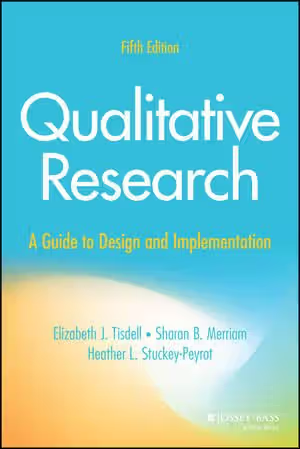
Tisdell, E. J., Merriam, S. B., & Stuckey-Peyrot, H. L. (2025). Qualitative Research: A Guide to Design and Implementation (5th ed.). Jossey-Bass (Wiley).
Chapter Summary
The fifth edition runs to about 448 pages in eleven chapters and a short appendix, grouped into three parts: The Design of Qualitative Research (Chapters 1–5), Collecting Qualitative Data (6–8) and Analyzing and Reporting Qualitative Data (9–11). The publisher describes it as a guide to understanding, designing, conducting and presenting a qualitative study, with an expanded interdisciplinary focus on the medical and health professions, social sciences, education and humanities, and new discussion of online data collection and of artificial intelligence in qualitative research. A foreword by Paul Haidet precedes the text.
Chapter 1: What Is Qualitative Research?
The chapter distinguishes basic, applied, evaluation and action research, contrasts qualitative work with experimental and survey designs, and traces qualitative research from anthropology and the Chicago sociologists through Glaser and Strauss's grounded theory and Guba's naturalistic inquiry. It then sets out philosophical perspectives (positivist, interpretive and constructivist, critical, postmodern and poststructural) and the defining characteristics: a focus on meaning and understanding, the researcher as primary instrument, an inductive process and rich description.
Chapter 2: Six Common Qualitative Research Designs
The chapter surveys the main designs, including descriptive studies, phenomenology, ethnography, grounded theory and case study, so that readers can match a design to a question.
Chapter 3: Expanding the Qualitative Paradigm: Critical Research, and Action and Community-Based Participatory Research (CBPR)
These are the approaches aimed at change as well as understanding. The chapter treats critical research, with attention to positionality and reflexivity, and action research and CBPR, including their principles and types.
Chapter 4: Qualitative Research in Mixed Methods and Arts-Based Approaches
The chapter explains how qualitative work combines with quantitative work in convergent, explanatory sequential and exploratory sequential designs, and introduces arts-based research.
Chapter 5: Designing Your Study and Selecting a Sample
This chapter turns to planning: the problem statement, the purpose of the study, the theoretical or conceptual framework, the literature review, and sampling, from purposeful sampling to snowball and convenience sampling.
Chapters 6–8: Conducting Effective Interviews; Being a Careful Observer; Mining Data from Documents and Artifacts
Part Two covers the three main data sources. Chapter 6 treats interviews, including the structure continuum, group and online formats, writing questions, and recording and transcribing. Chapter 7 treats observation, including field notes, the observer's role and online observation. Chapter 8 treats documents and artifacts, including personal and visual documents and judging their authenticity.
Chapter 9: Qualitative Data Analysis
The longest chapter covers managing data, coding and building categories, the constant comparative method, analysis within particular traditions such as grounded theory and phenomenology, and computer-assisted analysis software, including a discussion of AI tools.
Chapter 10: Validity, Reliability, and Ethics
The chapter discusses credibility and its strategies (triangulation, member checks, researcher reflexivity), consistency and intercoder reliability, generalizability and transferability, and research ethics, including institutional review.
Chapter 11 and Appendix: Writing Up Qualitative Research; The Methodology Section of a Qualitative Research Study
Chapter 11 covers determining the audience, choosing a focus, reporting guidelines such as COREQ, and writing for dissertations and journals. The appendix by Sharan Merriam illustrates the methodology section of a qualitative study.
Key Concepts
Part One: Design
- Interpretive stance: the assumption that reality is socially constructed and that the aim is to understand how people make meaning.
- Researcher as primary instrument: the researcher's responsiveness is a strength, so subjectivities must be identified and monitored.
- Inductive process: building concepts, themes or theory from data rather than testing hypotheses.
- Purposeful sampling: choosing information-rich cases deliberately.
Part Two: Data collection
- Interview structure continuum: interviews range from highly structured to unstructured.
- Field notes: descriptive and reflective records of observation.
- Documents and artifacts: written, visual and material sources assessed for authenticity.
Part Three: Analysis and reporting
- Coding and categories: assigning codes to data and building categories through constant comparison.
- Trustworthiness strategies: triangulation, member checks and reflexivity.
- Transferability: the qualitative counterpart of generalizability.
Critical Analysis
Strengths
- Follows the life of a project. The three-part structure moves from design to collection to analysis and writing, matching the order in which a researcher meets decisions.
- Philosophy and practice in one text. Chapter 1 explains the philosophical orientations before the later chapters turn to procedures, so choices of design are tied to assumptions about knowledge.
- Wide coverage of approaches. Beyond the established designs, it includes critical research, action research, CBPR, mixed methods and arts-based research, and the fifth edition extends its examples across health professions, education and the humanities.
- Practical write-up support. A full chapter on reporting and an appendix on the methodology section help readers writing a dissertation or article.
Limitations
- Breadth over depth. All six designs share a single chapter (Chapter 2) and analysis has one chapter, so readers committing to a particular tradition such as grounded theory or phenomenology will need a dedicated text.
- Not a statistics or software manual. The treatment of analysis software and AI tools is a discussion of uses and cautions, not step-by-step instruction.
- Length. At about 448 pages, the book is a substantial reference; readers with a single focused project will use only parts of it.
Where It Fits in the Course
Within the educational research methods course, this is the qualitative specialist. Creswell and Guetterman's Educational Research treats quantitative, qualitative and mixed-methods designs in a single step-by-step framework, and Cohen, Manion and Morrison's Research Methods in Education is a comprehensive reference across the field; both are broader and shallower on qualitative work. Bell, Waters and Johnson's Doing Your Research Project and Gary Thomas's How to Do Your Research Project are step-by-step guides for first-time researchers carrying out a small project.
Murnane and Willett's Methods Matter is the counterpart on the quantitative side: it concerns causal inference from randomized experiments and quasi-experiments, which lie outside this book's focus. Students who will read or conduct both kinds of research benefit from pairing the two.
How to Use This Book
The book suits graduate students and researchers in education, health professions and the social sciences planning a qualitative study. A general research methods course covering the basic differences between quantitative and qualitative approaches is sufficient preparation.
A practical plan:
- Core: Chapter 1, the design chapter that matches your question (Chapter 2), and Chapter 5 on problem, framework and sampling.
- By method: read the data-collection chapter for each method you will use (Chapter 6, 7 or 8) and then Chapter 9 for analysis.
- Before reporting: Chapter 10 on trustworthiness and ethics and Chapter 11 on writing, with the appendix as a model methodology section.
- Optional: Chapters 3 and 4 when the study is change-oriented, participatory, mixed or arts-based.
Draft a problem statement and a sampling plan as you read Chapter 5, then revisit them after the analysis chapter.