01 / Reading Guide
Reading Guide
Citation
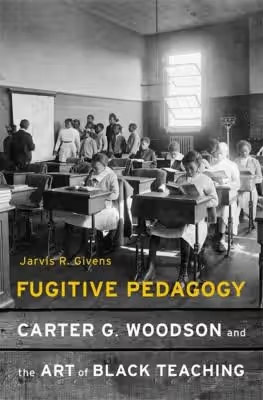
Givens, J. R. (2021). Fugitive Pedagogy: Carter G. Woodson and the Art of Black Teaching. Harvard University Press.
Chapter Summary
The book is a history of Black education in the United States told through Carter G. Woodson, the historian who founded the Association for the Study of African American Life and History (ASALH) and Negro History Week, the forerunner of Black History Month. It has a preface, an introduction, six chapters and a conclusion, followed by notes; the print edition runs to about 320 pages. Its organising term is "fugitive pedagogy," which the publisher's description defines as a theory and practice of Black education that began in clandestine pursuit of learning, often against law and custom, and was carried on by Black teachers under Jim Crow.
Preface and Introduction: A New Grammar for Black Education; Blackness and the Art of Teaching
The preface opens with the claim that the language available for talking about Black education is impoverished, and sets out to supply a new vocabulary. The introduction presents the central concept of fugitive pedagogy and the argument that Woodson succeeded because he belonged to a wider world of Black teachers. Reviewers describe the book's method as reading for hidden meanings in context, using a wide range of sources such as the Journal of Negro History, the Negro History Bulletin, children's textbooks, autobiographies, school reports and ASALH meeting notes.
Chapter 1: Between Coffle and Classroom: Carter G. Woodson as a Student and Teacher, 1875–1912
The first chapter gives the origin story. It follows Woodson's early education, including his first teachers, his formerly enslaved uncles, and ties it to the pursuit of literacy by enslaved and formerly enslaved people. It shows how ideas of freedom and education were joined in Black communities long before Woodson's own career.
Chapter 2: "The Association . . . Is Standing Like the Watchman on the Wall": Fugitive Pedagogy and Black Institutional Life
This chapter turns to ASALH. It examines the role of schoolteachers in building and sustaining the organisation, the programme Woodson ran through it, and the importance of community engagement in his work.
Chapter 3: A Language We Can See a Future In: Black Educational Criticism as Theory in Its Own Right
Chapter 3 argues that Woodson's criticism of the education given to Black students should be read as theory in its own right and studied under the conditions in which Black educators lived and worked. According to one reviewer, it also draws on decolonial writers beyond the United States.
Chapter 4: The Fugitive Slave as a Folk Hero in Black Curricular Imaginations: Constructing New Scripts of Knowledge
The fourth chapter looks at textbooks written for Black children. Authors such as Edward A. Johnson, Leila Amos Pendleton and Woodson himself used the figure of the fugitive and the heroic tradition to give students resources for imagining a different social order.
Chapter 5: Fugitive Pedagogy as a Professional Standard: Woodson's "Abroad Mentorship" of Black Teachers
Chapter 5 follows the networks through which Woodson mentored Black teachers across the country, many of whom he never met, and shows how mentorship worked as a professional standard.
Chapter 6: "Doomed to Be Both a Witness and a Participant": The Shared Vulnerability of Black Students and Black Teachers
The last numbered chapter moves to students. It treats them as participants in Black education, sharing vulnerability with their teachers, and considers the plays, competitions and other activities that formed part of Black schooling.
Conclusion: Black Schoolteachers and the Origin Story of Black Studies
The conclusion argues that the rise of Black studies can be traced to Black schoolteachers: reviewers note the claim that many Black studies scholars and institution builders were students of Black teachers under Jim Crow.
Key Concepts
Preface and Chapters 1–2
- Fugitive pedagogy: the book's term for the physical and intellectual acts of subversion through which Black people pursued education, and for the teaching tradition built on them.
- Origin story of Black education: the account, in Chapter 1, of enslaved and freed people's pursuit of literacy as the root of later Black schooling.
- Black institutional life: the role of an organisation such as ASALH, sustained by teachers, in shaping a new body of knowledge.
Chapters 3–6 and Conclusion
- Black educational criticism: Woodson's critique of miseducation, which Chapter 3 treats as theory.
- Scripts of knowledge: the narratives of Black history and heroism that textbook authors offered children in place of dominant accounts.
- Abroad mentorship: Woodson's nationwide mentoring of Black teachers.
- Shared vulnerability: the common exposure of Black students and teachers to hostile systems.
Critical Analysis
Strengths
- A new frame for a familiar figure. The book places Woodson within a community of teachers instead of treating him as a lone founder. A reviewer in College & Research Libraries also notes that Givens declines to add Woodson as a third pole to the familiar Booker T. Washington and W. E. B. Du Bois opposition.
- Teachers and students as thinkers. The chapters on textbooks, mentorship and student participation present classroom practice and school activities as intellectual work.
- Varied sources. According to the reviewers, the evidence ranges from journals and bulletins to children's textbooks, autobiographies, school district reports, plays and newspapers.
- Readable for several audiences. A review in the African American Intellectual History Society's blog describes it as written for both general and academic readers, and the College & Research Libraries reviewer praises the prose.
Limitations
- A history, not a practice guide. The book is a scholarly monograph with notes; it does not offer lesson plans or methods, though reviewers draw links to present-day debates.
- Centred on one figure and one network. The six chapters follow Woodson, ASALH and the teachers connected to them,.
- Specialised vocabulary. The argument is built on its own terms, such as "fugitive pedagogy" and "scripts of knowledge," which a reader new to the history of Black education will need to learn as the chapters proceed.
Where It Fits in the Course
In the foundations of education course, this is the book that brings a historical case into a list otherwise made of philosophical and critical classics. Dewey's Democracy and Education and How We Think are the standard statements of the progressive tradition, Freire's Pedagogy of the Oppressed and hooks's Teaching to Transgress are critical pedagogy, and Illich's Deschooling Society is a critique of institutional schooling. Givens shows a tradition of Black teaching working in practice, so it pairs well with Freire and hooks as an example of education as resistance.
For a gentler start, Gary Thomas's Education: A Very Short Introduction and Noddings's Philosophy of Education are broad introductions that supply general background before a specialised monograph like this one.
How to Use This Book
The book suits graduate students and advanced undergraduates in education, history and African American studies, and teacher educators who want foundations courses to include Black educational thought. Some knowledge of United States history from slavery through Jim Crow is helpful; no prior reading of Woodson is assumed.
A practical plan: read the preface and introduction for the concept, then Chapters 1 and 2 for the historical grounding in Woodson's life and in ASALH. Chapter 3 is the most theoretical and can be read alongside Woodson's own writing. Chapters 4 to 6 are the core for readers interested in curriculum, teachers and students, and can be taken in any order. The conclusion is short and gives the book's wider claim about Black studies. In a seminar, pair Chapter 4 with a sample of the textbooks it discusses, and Chapter 5 with discussions of teacher mentoring today.