01 / Reading Guide
Reading Guide
Citation
Cahuc, P., Carcillo, S., & Zylberberg, A. (2014). Labor Economics (2nd ed.; W. McCuaig, trans.). MIT Press.
Chapter Summary
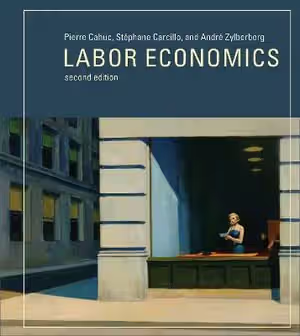
The second edition is a graduate-level text and reference of more than 1,000 pages. It opens with an introduction, moves through labor supply and demand, wage setting, unemployment and policy, and closes with mathematical appendices. The publisher says the models are kept as simple as possible and are each tied to empirical results, with examples from many countries.
Introduction
Sets out the scope of the book and the questions that labor economics asks. The sections that follow move from individual decisions, through the working of markets and institutions, to unemployment and public policy.
Labor Supply; Labor Demand
The first two sections cover the two sides of the market: how individuals and households decide whether and how much to work, and how firms decide how many workers to employ. They supply the basic models that later sections modify.
Competitive Equilibrium and Compensating Wage Differentials; Education and Human Capital
These sections bring the two sides together in a competitive market, where wage differences can compensate for differences in job characteristics, and then turn to education and the accumulation of human capital as a source of wage differences between workers.
Imperfect Competitive Labor Markets; Job Search
From here the book relaxes perfect competition, under the heading Imperfect Competitive Labor Markets, and takes up job search, the framework that later material uses to study matching and unemployment.
Contracts, Risk-Sharing and Incentive; Collective Bargaining and Labor Unions; Discrimination
Three topics on how employment relationships are organised and how wages are set when markets are not simply competitive: employment contracts that share risk and provide incentives, wage setting through unions and collective bargaining, and discrimination in labor markets. The publisher names discrimination among the topics given new chapters in this edition.
Job Creation, Job Destruction and Unemployment; Equilibrium Unemployment
The core of the book's treatment of unemployment: how jobs are created and destroyed, and how unemployment is determined in equilibrium. This pair builds directly on the job search material.
Technological Progress, Unemployment and Inequality; Globalization, Employment and Inequality
Two sections on large-scale forces acting on employment and the distribution of earnings, technological change and globalization. Globalization is listed by the publisher among the topics given new chapters in this edition.
Public Policies; Income Redistribution; Insurance Policies; Active Labor Market Policies
The final block turns to policy. Under the heading Public Policies it covers income redistribution, insurance policies and active labor market policies. The publisher describes the edition as devoting more space to public policy and the levers available to policy makers.
Mathematical Appendices
A toolkit of mathematical material that the publisher describes as the means for understanding the models in the main text.
Key Concepts
Supply, demand and wages (Labor Supply to Education and Human Capital)
- Labor supply and labor demand: the decisions of workers and of firms about hours, participation and employment.
- Compensating wage differentials: wage differences that offset differences in the pleasantness or risk of jobs.
- Human capital: skills acquired through education and training that raise a worker's productivity and earnings.
Imperfect markets and institutions (Imperfect Competitive Labor Markets to Discrimination)
- Job search: the process by which workers and firms look for each other when information is costly.
- Incentive contracts and risk-sharing: employment contracts designed to motivate effort and to allocate risk between employer and worker.
- Collective bargaining: wage setting between employers and unions rather than by individual negotiation.
- Discrimination: differences in labor market treatment or outcomes between groups.
Unemployment, inequality and policy (Job Creation to Active Labor Market Policies)
- Job creation and job destruction: the flows of jobs that underlie changes in employment and unemployment.
- Equilibrium unemployment: unemployment that persists as an outcome of the market's matching process.
- Technological progress and globalization: forces that change relative demand for different workers and so affect inequality.
- Income redistribution, insurance and active labor market policies: the policy instruments the last sections examine.
Critical Analysis
Strengths
- Models tied to evidence. Each topic is presented with a small, simple model that is then related to empirical findings, which suits readers who want to see how the theory is taken to data. The empirical methods are illustrated through studies the publisher calls milestones of the field.
- Breadth of coverage. The contents run from labor supply and human capital through bargaining, discrimination and unemployment to redistribution and active labor market policy, so a single volume can serve as the main reference for a graduate field course.
- A policy-heavy second edition. The policy material at the end makes up a substantial share of the book, and the publisher highlights the expanded treatment of public policy as a feature of this edition.
- Supporting materials. The publisher states that the data and code of the cited studies, tables and figures on how labor markets function, and slides are provided on the website labor-economics.org, which helps readers who want to replicate results.
- International examples. The book draws on evidence from many countries, not only the United States.
Limitations
- Size. At more than 1,000 pages the book cannot be read straight through in one course; courses and independent readers need to choose among sections.
- Graduate prerequisites. The book is pitched at graduate students and researchers and relies on formal models, with mathematical appendices as the toolkit. Readers who have not met these tools will find it heavier going than an undergraduate text.
- Dated evidence. This is a 2014 edition; studies and policy episodes after that date are not covered.
Where It Fits in the Course
This is the most advanced labor economics book in the course list. Ehrenberg, Smith and Hallock's Modern Labor Economics is an undergraduate text that builds the analysis of labor markets from supply and demand and applies it to policy questions; it is the natural first read, and Cahuc, Carcillo and Zylberberg is the step up when formal models and a broad review of the econometric literature are needed.
The other items on the list approach neighbouring ground from the public economics side. Gruber's Public Finance and Public Policy is an undergraduate treatment of the economics of government, Stephen Smith's Taxation: A Very Short Introduction is a compact introduction to why and how governments tax, and Piketty's The Economics of Inequality is a short primer on measuring and explaining inequality. These can precede the policy material in Cahuc and colleagues. Levine and Rubinstein's paper on entrepreneurs is a single empirical study that illustrates, in the form of a journal article, the kind of evidence that this textbook surveys.
How to Use This Book
The book is for master's and doctoral students in economics, for advanced undergraduates who have already studied labor or public economics, and for researchers and policy analysts who want one reference that combines models with a review of empirical work. Intermediate microeconomics, calculus and introductory econometrics are the minimum preparation.
A practical plan for a one-semester field course:
- Core: the sections on labor supply, labor demand, human capital, job search, and the two sections on job creation, job destruction and equilibrium unemployment. Read the mathematical appendices as needed alongside them.
- Second pass, by interest: compensating wage differentials, contracts and incentives, collective bargaining and discrimination for the study of wage setting and inequality in earnings.
- Policy track: technological progress, globalization and the policy material, read after the unemployment sections. This is the part to prioritise for readers heading into policy evaluation.
For independent study, use the website's data and code to repeat one of the empirical studies cited in a section, and pair a section with the original journal article it relies on.