01 / Reading Guide
Reading Guide
Intermediate microeconomics: choose a model before optimizing
Compare three microeconomics texts and solve consumer-choice cases with kinks, corners and ties, checking budgets and the limits of utility comparisons.
Study route and exercise: University Reading List editorial project.
Citation
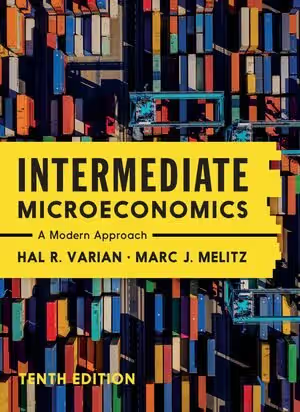
Varian, H. R., & Melitz, M. (2024). Intermediate Microeconomics: A Modern Approach (10th ed.). W. W. Norton & Company.
Chapter Summary
The tenth edition has a preface, 37 short chapters, a mathematical appendix and an online ebook chapter on information technology. The international print edition runs to 816 pages. Norton presents the book as built from short, topical chapters, and each chapter takes up a single topic. The sequence follows the standard intermediate course. It moves from consumer theory to the firm, then to market structures and strategic behaviour, and finally to general equilibrium, welfare and market failure.
Chapters 1-8: The Market; Budget Constraint; Preferences; Utility; Choice; Demand; Revealed Preference; Slutsky Equation
The opening block is a complete treatment of the consumer. Chapter 1, "The Market", opens the book. Chapters 2-5 build the budget constraint, preferences, utility and optimal choice, and Chapter 6 derives demand. Chapters 7 and 8 return to demand from two further angles: revealed preference and the Slutsky equation.
Chapters 9-15: Buying and Selling; Intertemporal Choice; Asset Markets; Uncertainty; Risky Assets; Consumer's Surplus; Market Demand
Consumer theory is extended to endowments (buying and selling), choices over time, asset markets, uncertainty and risky assets. Chapter 14 measures consumer's surplus, and Chapter 15 aggregates individual demands into market demand.
Chapters 16-18: Equilibrium; Measurement; Auctions
Chapter 16 puts supply and demand together in equilibrium. Chapter 17 is titled "Measurement". Chapter 18 treats auctions and comes before the chapters on the firm.
Chapters 19-24: Technology; Profit Maximization; Cost Minimization; Cost Curves; Firm Supply; Industry Supply
The producer side mirrors the consumer side. It covers the technology a firm has, the choice of inputs and outputs that maximises profit, and the minimisation of cost. It then derives the resulting cost curves and the supply of the firm and then the industry.
Chapters 25-27: Monopoly; Monopoly Behavior; Factor Markets
Two chapters treat monopoly, the second on how a monopolist behaves. A chapter on factor markets follows.
Chapters 28-31: Oligopoly; Game Theory; Game Applications; Behavioral Economics
The strategic block moves from oligopoly into game theory and its applications. The block closes with a chapter on behavioral economics.
Chapters 32-34: Exchange; Production; Welfare
These chapters treat the economy as a whole: exchange (Chapter 32), production (Chapter 33) and welfare (Chapter 34).
Chapters 35-37: Externalities; Public Goods; Asymmetric Information
The final block covers three further topics: externalities, public goods and asymmetric information.
Appendix and online chapter
A mathematical appendix follows the chapters. The publisher notes that in the calculus-based companion version this material is integrated into the text. An online and ebook chapter on information technology is listed with the end matter, and answers close the print volume.
Key Concepts
Chapters 1-15: The consumer
- Budget constraint, preferences and utility: the three building blocks of consumer choice in Chapters 2-4.
- Revealed preference and the Slutsky equation: two further ways of analysing demand (Chapters 7-8).
- Intertemporal choice and uncertainty: extensions of consumer choice across time and risk (Chapters 10-13).
- Consumer's surplus: a measure of benefit introduced in Chapter 14.
Chapters 16-37: Firms, markets and welfare
- Cost minimization and cost curves: the producer-side counterpart of consumer optimisation.
- Monopoly and oligopoly: market structures treated in Chapters 25-28.
- Game theory: strategic interaction and its applications in Chapters 29-30.
- Welfare, externalities and public goods: the topics of Chapters 34-36.
- Asymmetric information: the topic of the final chapter.
Critical Analysis
Strengths
- Short, single-topic chapters. The publisher describes the book as long valued for short chapters and interesting examples. With 37 titled chapters, an instructor or student can take one topic at a time. Courses use this flexibility. The UF course described below, which used the 9th edition, does not follow the book's order. It teaches market demand (Chapter 15) with the consumer block, then moves to the firm. Consumer surplus (Chapter 14) and equilibrium (Chapter 16) come later, alongside monopoly.
- Two versions for two levels of mathematics. The tenth edition is the algebra-based version. A separate calculus-based companion, Microeconomics with Calculus (2nd edition), integrates the mathematical appendix into the text. A student can therefore choose the version that fits their preparation.
- Updated examples and practice. Norton lists new applications drawn from research, industry and Melitz's teaching, including the demand for electric cars and inflation after the pandemic. Interactive features appear in 17 of the most-used chapters. The Check Your Understanding questions and Smartwork problem sets provide practice with feedback.
- Wide coverage of topics. Beyond the core consumer-and-firm sequence, the book includes auctions, behavioral economics, asymmetric information and an information-technology chapter.
Limitations
- Long for a single course. With 37 chapters and 816 pages in the international edition, the book supplies more than one semester of material, so a syllabus has to select. The UF outline below is an example. It covers the consumer core, the firm, equilibrium, monopoly and oligopoly. The game-theory, general-equilibrium, welfare and market-failure chapters do not appear in that outline.
- Mathematical level. The tenth edition is the algebra-based version, and its mathematics sits in an appendix. Students who want optimisation done inside the chapters need the separate calculus-based companion.
- Digital features tied to the publisher's platform. Much of the new support is delivered through Norton's platform, including the interactive features, the Illumine ebook and Smartwork. Access depends on the purchased package.
Where It Fits in the Course
This is the main intermediate text in the intermediate-microeconomics list. It takes students who have had a principles course and teaches them to derive and apply the standard models. For example, the UF course described under Common course assignments below required Varian's 9th edition. Parkin's Microeconomics is a principles-level textbook, and Dixit's Microeconomics: A Very Short Introduction is a short non-technical overview. Either can come before Varian and Melitz.
Pindyck and Rubinfeld's Microeconomics is another intermediate textbook. It develops the same core topics through graphs and verbal reasoning, with optional calculus appendices, so the choice between it and Varian and Melitz is a matter of course preference. The two can also sit side by side. The same UF course lists Pindyck and Rubinfeld (9th edition) as an optional recommended text, not a required one.
After this book, Mas-Colell, Whinston and Green's Microeconomic Theory and Jehle and Reny's Advanced Microeconomic Theory are the graduate-level treatments. Both assume intermediate microeconomics, multivariable calculus and more mathematics than Varian and Melitz require.
How to Use This Book
The book is for undergraduates who have taken a principles course. Norton describes this edition as the algebra-based version, with a separate calculus-based companion, so comfort with algebra and graphs is the main requirement.
A practical plan:
- Work through Chapters 1-8 in order, because every later chapter builds on the consumer's problem.
- Chapters 9-15 extend the consumer's problem and can be chosen according to the syllabus. Chapters 12-13 on uncertainty and risky assets matter most to students heading to finance.
- Read Chapters 16 and 19-24 for the competitive firm and industry.
- Read Chapters 25-28 for market power and Chapters 29-30 for game theory.
- Chapters 32-37 are the capstone on general equilibrium, welfare and market failure.
Auctions (Chapter 18), behavioral economics (Chapter 31) and the online information-technology chapter are good candidates for optional reading. Use the Check Your Understanding questions after each section, and the Smartwork problems if the course provides access.
Common course assignments
UF ECO3101 Intermediate Microeconomics (Spring 2022) assigned the 9th edition. The chapter numbers below follow that syllabus. The edition listed here is the 10th (2024), so match section titles against your copy. The course is organised into three exam blocks:
- Exam 1, Chapters 1-9 and 15:
- Market and Budget Constraint (Chapters 1-2, weeks 1-2)
- Preferences (3), Utility (4), Choice (5), Demand (6)
- Revealed Preference (7), Slutsky Equation (8), Buying and Selling (9)
- Market Demand and elasticity (15)
- Exam 2, Chapters 19-24: Technology (19), Profit Maximization (20), Cost Minimization (21), Cost Curves (22), Firm Supply (23) and Industry Supply (24).
- Exam 3, Chapters 14, 16, 25-26 and 28: Consumer Surplus (14), Equilibrium (16), Monopoly (25), Monopoly Behavior (26) and Oligopoly (28).
This sequence is a useful template for self-study in one semester. It covers the consumer core first and adds market demand early. It then covers the full producer side before returning to surplus, equilibrium and market power. Intertemporal choice, uncertainty, factor markets, game theory and the general-equilibrium and market-failure chapters do not appear in that outline. Treat them as extensions if your course follows a similar plan.
Edition and sources
Norton's page for this edition lists the tenth-edition paperback, ISBN 9781324034292. Regional publication and on-sale dates differ, so match edition and format rather than choosing by a page date alone. The publisher's international-edition contents show the opening sequence Budget Constraint, Preferences, Utility, Choice and Demand. Use those titles to locate material if your edition has different pagination.
Syllabi may cite an earlier edition. The UF course above used the 9th, so compare topic titles rather than relying on chapter numbers alone. Begin by drawing a budget set and solving both a kink and a corner choice before moving to later market models. Norton's digital tools have product-specific access conditions; check the purchased package, especially for used or standalone print copies.