01 / Reading Guide
Reading Guide
Citation
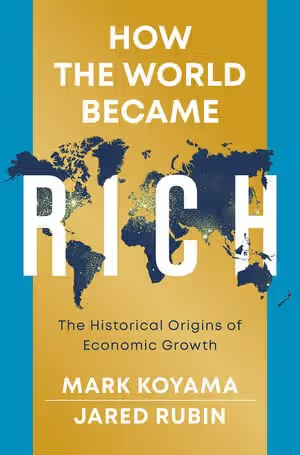
Koyama, M., & Rubin, J. (2022). How the World Became Rich: The Historical Origins of Economic Growth. Polity.
Chapter Summary
The book is short: eleven chapters, a preface and a bibliography, about 260 pages in the paperback. It falls into two halves. Chapters 2–6 each take one family of explanations for long-run prosperity and ask how far the evidence supports it; Chapters 7–11 then follow the history itself, from the rise of northwestern Europe to the spread of growth around the world. Most chapter titles are questions, which signals the book's method: it weighs arguments rather than defending a single thesis.
Chapter 1: Why, When, and How Did the World Become Rich?
The opening chapter sets out the puzzle that the publisher's description puts at the centre of the book: most people today are far richer than their ancestors, and almost all of that wealth was gained in the last two centuries. It frames the questions the rest of the book answers, about when sustained growth began, where, and why it spread unevenly.
Chapter 2: Did Some Societies Win the Geography Lottery?
The first of the explanatory chapters considers geographic accounts of prosperity, in which climate, location and natural endowments shape which societies could grow.
Chapter 3: Is it all Just Institutions?
A full chapter on political and economic institutions, the explanation most associated with Acemoglu and Robinson. The title already signals the book's stance: institutions matter, but the authors test whether they are the whole story. Joel Mokyr's review for EH.Net notes that the book treats both institutions and culture at chapter length and summarises some of the strongest recent work on each.
Chapter 4: Did Culture Make Some Rich and Others Poor?
The cultural explanations: whether beliefs, values and norms help account for why some societies became rich. Mokyr points out that the deeper question of how culture and institutions shape each other remains open, and the chapter is best read as a survey of a young literature.
Chapter 5: Fewer Babies?
The demographic chapter. Mokyr's review describes the consensus the book lays out on why the world before about 1750 stayed poor, and the first of its three brakes on growth is Malthusian: population growth absorbed the gains from whatever productivity growth occurred. Demographic change is therefore part of how the brakes came off.
Chapter 6: Was it Just a Matter of Colonization and Exploitation?
The chapter on colonialism, slavery and the slave trade, which Mokyr identifies as the one place where the authors take a relatively firm position. According to his review, they conclude that colonialism and the slave trade played a large role in making the modern world, but that the evidence that they made the world rich is mixed, and they stress that without institutional support for innovation, constraints on rulers and a comparatively inclusive society, exploitation alone would not have produced modern growth.
Chapter 7: Why Did Northwestern Europe Become Rich First?
The historical half begins by asking why the first region to escape stagnation was northwestern Europe. Here the explanations from Chapters 2–6 are brought to bear on a specific case.
Chapter 8: Britain's Industrial Revolution
The chapter addresses the publisher's question of why the Industrial Revolution began in eighteenth-century Britain. Among the contested issues the book takes up, Mokyr lists whether high wages helped or hindered technological progress, the role of craft guilds and the effects of war.
Chapter 9: The Rise of the Modern Economy
How a one-off industrial breakthrough became sustained growth. Mokyr credits the book with explaining in detail how the three pre-modern brakes (population pressure, predatory and extractive rulers, and the lack of institutions for building and sharing useful knowledge) gradually dissolved.
Chapter 10: Industrialization and the World it Created
The spread of industrialisation: why some European countries, the United States and Japan caught up in the nineteenth century, why most other countries had to wait until the late twentieth or twenty-first century, and the inequality between countries that this sequence left behind.
Chapter 11: The World is Rich
The concluding chapter, which Mokyr summarises as the authors' verdict that the world in 2022 is rich, even though growth was unequal and poverty persists. The publisher's description gives the policy lesson: there are prerequisites that all successful economies seem to share, but no single remedy, because a society's history, institutions and culture shape how it can develop.
Key Concepts
Chapters 1–6: Explanations of Long-Run Growth
- Modern economic growth: sustained, compounding growth in income per person, which the book dates to roughly the last two centuries.
- Geographic explanations: accounts in which natural endowments and location determine which societies could prosper.
- Institutions: the political and economic rules of a society, examined as one explanation among several rather than as the single cause.
- Culture: shared beliefs and norms as a possible cause of divergent development.
- Malthusian constraint: the pre-modern pattern in which population growth swallowed productivity gains and kept living standards low.
- Colonialism and exploitation thesis: the claim that the West became rich at the expense of the colonised and enslaved, which the book weighs against the evidence.
Chapters 7–11: The Path to Modern Riches
- Industrial Revolution: the onset of sustained technological change in eighteenth-century Britain.
- Catch-up growth: the later industrialisation of other European countries, the United States and Japan, and the much later growth of most of the world.
- Divergence: the gap between early and late industrialisers that the uneven spread of growth created.
Critical Analysis
Strengths
- Even-handed survey. Mokyr's EH.Net review describes balanced and fair surveys of each debate and contrasts the book's measured tone with the strongly argued positions of Gregory Clark's A Farewell to Alms and Deirdre McCloskey's Bourgeois Dignity. For a student, this means each chapter is a map of a debate rather than one side of it.
- Built for teaching. The structure, one explanation per chapter followed by the historical narrative, lends itself to a weekly course. Mokyr recommends that instructors assign it to students and judges it well suited to courses on global economic history for economics students; the publisher quotes the Economic History Review calling it timely, consolidated and succinct.
- Up to date with the research. Both authors are economic historians who have contributed to this literature, and the reviews emphasise the long, current bibliography, which makes the book a good entry point for essays.
- Short. At about 260 pages it can be read in full in a term alongside other reading.
Limitations
- Reluctant to adjudicate. The same balance has a cost: Mokyr notes that the authors seldom take strong positions, so readers looking for a single argued thesis will find it in other books.
- Open questions left open. By Mokyr's account, why societies develop different institutions, how those institutions change, and how culture shapes them remain unresolved at the end of the book.
- A survey, not a textbook. The book is a summary of research written as connected essays, and in a book of this length the coverage of each debate is necessarily brief; it points to the literature rather than reproducing it.
- Contested ground in Chapter 6. The conclusions on colonialism and slavery are the book's firmest, and the review itself frames them within a live dispute with historians of capitalism; students should read the other side as well.
Where It Fits in the Course
Among the books for this economic history course, this is the natural starting point: a short map of the main explanations for why some countries are rich. Acemoglu and Robinson's Why Nations Fail makes a sustained, case-rich argument that institutions explain prosperity; Koyama and Rubin devote Chapter 3 to that view and test it against geography, culture, demography and colonialism. Reading Koyama and Rubin first lets a student see Why Nations Fail as one influential position within a wider debate.
For a fuller narrative, Neal and Cameron's A Concise Economic History of the World surveys the whole span from the earliest agricultural societies to the present, and Joerg Baten's edited A History of the Global Economy summarises quantitative research region by region since 1500; both are longer textbooks that fill in the history Chapters 7–11 compress. Douglass North's Institutions, Institutional Change and Economic Performance and Acemoglu and Robinson's Economic Origins of Dictatorship and Democracy are theoretical works; read them after this book, when the institutional debate it surveys is familiar.
How to Use This Book
The book is written for students and general readers; no background in economics or history is required, though comfort with basic ideas such as income per person and productivity helps.
- Read Chapter 1 first, then Chapters 2–6 as a set. For each, note the explanation, the strongest evidence for it and the main objection. A one-page table of the five explanations is a useful revision tool.
- Read Chapters 7–11 as the test. Ask which of the explanations from the first half each historical episode supports. Chapters 7 and 8 on northwestern Europe and Britain are the core of the second half.
- Pair chapters with course mates. Read Chapter 3 alongside Why Nations Fail and Chapter 6 alongside the critics of the authors' view, then compare.
- Use the bibliography. For essays, follow the references in the chapter closest to the topic rather than relying on the book's summary.
For self-study, the whole book can be read in two or three weeks; for a course, one or two chapters per week alongside a fuller textbook works well.