01 / Reading Guide
Reading Guide
Citation
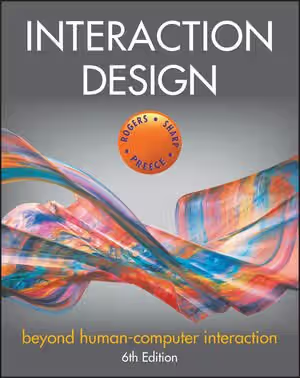
Rogers, Y., Sharp, H., & Preece, J. (2023). Interaction Design: Beyond Human-Computer Interaction (6th ed.). Wiley.
Chapter Summary
The sixth edition has sixteen chapters, an epilogue, a reference list of more than fifty pages and an index, about 720 pages in all. The chapters fall into four groups: what interaction design is and how it is done (1–3); people and the interfaces they use (4–7); gathering and analysing data (8–10); and the design and evaluation process (11–16). The sample first chapter shows the apparatus used throughout: a list of objectives, boxed asides, "Dilemma" panels, activities each followed by a comment, links to videos, a summary, key points, further reading and an in-depth activity at the end. Six chapters close with an interview with a researcher or practitioner, and a companion website hosts further resources.
Chapter 1: What Is Interaction Design?
Contrasts good and poor design (a cluttered remote control against the TiVo remote, designed with users involved), weighs what is gained and lost when activities become digital, and defines interaction design and its relation to human-computer interaction. It introduces people-centred design, which this edition now prefers to "user-centred", then accessibility and inclusiveness, the six usability goals (effectiveness, efficiency, safety, utility, learnability, memorability), user experience goals, dark patterns, and the design principles of visibility, feedback, constraints, consistency and affordance. It ends with an interview with Harry Brignull.
Chapter 2: The Process of Interaction Design
What is involved in interaction design as a process, followed by a section on practical issues; the index shows that generating and selecting between design alternatives are among them.
Chapter 3: Conceptualizing Interaction
Conceptual models, interface metaphors and interaction types, then the paradigms, visions, theories, models and frameworks that inform design. Interview with Albrecht Schmidt.
Chapter 4: Cognitive Aspects
What cognition is, in a long first section that, according to the index, covers attention, perception, memory, learning, reading and planning, and the cognitive frameworks used to explain how people interact with technology.
Chapter 5: Social Interaction
Being social, face-to-face conversation, remote collaboration and communication, co-presence and social games. The publisher describes this chapter as completely updated, with new emphasis on hybrid and online working.
Chapter 6: Emotional Interaction
Emotions and behaviour, expressive interfaces, affective computing and emotional AI, persuasive technologies and behaviour change, and anthropomorphism.
Chapter 7: Interfaces
The longest chapter, a survey of interface types (more than sixty pages in its main section), followed by natural user interfaces and guidance on choosing an interface. Interview with Leah Buechley.
Chapter 8: Data Gathering
Six key issues in planning data gathering, capturing data, interviews, questionnaires and observation, and how to combine the techniques in practice.
Chapter 9: Data Analysis, Interpretation, and Presentation
Quantitative and qualitative data, basic analysis of each, analytical frameworks such as conversation analysis, tools for analysis, and interpreting and presenting findings.
Chapter 10: Data at Scale and Ethical Concerns
Approaches to collecting and analysing data at scale, visualising and exploring data, and ethical design concerns. The publisher notes an emphasis on human-centred AI in this edition.
Chapter 11: Discovering Requirements
What requirements are, data gathering for requirements, personas and scenarios, and use cases.
Chapter 12: Design, Prototyping, and Construction
Prototyping, conceptual and concrete design, generating prototypes, and construction. Interview with Jon Froehlich.
Chapter 13: Interaction Design in Practice
AgileUX, design patterns, open-source resources and tools for interaction design. Interview with Luciana Zaina.
Chapter 14: Introducing Evaluation
The why, what, where and when of evaluation, types of evaluation, case studies and what they teach, and other issues to consider.
Chapter 15: Evaluation Studies: From Controlled to Natural Settings
Usability testing, experiments and in-the-wild studies. Interview with danah boyd.
Chapter 16: Evaluation: Inspections, Analytics, and Models
Heuristic evaluation and walk-throughs, analytics and A/B testing, and predictive models. An epilogue follows.
Key Concepts
Chapters 1–3: Foundations
- Interaction design: designing interactive products to support how people communicate and interact in everyday and working life; the book treats it as multidisciplinary.
- People-centred design: the edition's preferred term for designing around people's needs, with "user-centred" kept where a specific interface is meant.
- Usability and user experience goals: measurable qualities such as effectiveness and learnability, alongside experiential qualities such as enjoyment.
- Design principles: visibility, feedback, constraints, consistency and affordance.
- Conceptual model: a high-level description of how a product is organised and works, as the user is meant to understand it.
Chapters 4–7: People and Interfaces
- Cognitive frameworks: theories that explain how people think and act when using technology.
- Remote collaboration and co-presence: how technology supports working and being together at a distance.
- Affective computing and persuasive technology: systems that respond to or try to change people's emotions and behaviour.
- Interface types: the range of interface styles a designer can choose from.
Chapters 8–10: Data
- Data gathering techniques: interviews, questionnaires and observation.
- Quantitative and qualitative analysis: numerical summaries and the interpretation of themes and patterns.
- Data at scale and ethics: large data sets, their visualisation, and the ethical problems they raise.
Chapters 11–16: Design and Evaluation
- Requirements, personas and scenarios: ways of capturing what a product must do and for whom.
- Prototyping: low- and high-fidelity models used to explore and test designs.
- AgileUX and design patterns: integrating interaction design into agile development and reusing proven solutions.
- Evaluation methods: usability testing, experiments, field studies, inspections, analytics, A/B testing and predictive models.
Critical Analysis
Strengths
- Built for active learning. The sample chapter shows a dense teaching apparatus: stated objectives, activities with worked comments, dilemmas for discussion, and an in-depth activity in which students evaluate a real product. Students learn by applying the ideas, not only by reading about them.
- Complete design cycle. The book runs from concepts and human factors through data gathering, requirements and prototyping to three chapters on evaluation, so a course can follow a project from start to finish within one text.
- Interdisciplinary and current. The publisher stresses foundations drawn from design, computer science and psychology, and the sixth edition adds hybrid and online working, affective computing and emotional AI, human-centred AI and new interface types. Interviews with researchers and practitioners connect the methods to working practice.
- Ethics and inclusion are built in. Accessibility and inclusiveness appear in the first chapter, dark patterns are discussed with examples, and Chapter 10 pairs data at scale with ethical concerns.
Limitations
- Very long. At about 720 pages and sixteen substantial chapters, the book holds more than a single course can cover; Chapter 7 alone has a section of more than sixty pages on interface types.
- Breadth over depth in methods. Statistics, experimental design and qualitative analysis each receive a section or two within broader chapters (for example, basic quantitative analysis in about ten pages of Chapter 9). Students conducting a serious study will need a dedicated research-methods text.
- Little on implementation. Construction appears as one section of Chapter 12; the book teaches how to design and evaluate interactive products, not how to program them.
Where It Fits in the Course
This is the human-computer interaction text in a course that otherwise centres on computer graphics, and it can be read independently of the graphics books. None of the other books in the course covers user research, design process or evaluation. Gabriel Gambetta's Computer Graphics from Scratch is a short programmer's introduction to raytracing and rasterising; Marschner and Shirley's Fundamentals of Computer Graphics and Angel and Shreiner's Interactive Computer Graphics are the standard undergraduate graphics texts, the latter with WebGL programming from the start. Pharr, Jakob and Humphreys's Physically Based Rendering and Akenine-Möller and colleagues' Real-Time Rendering are specialist works on rendering.
Students following the HCI side of the course should treat this book as the main text throughout. Students on the graphics side will find Chapters 1, 3 and 7 useful context on how people experience the interactive systems they build, and Chapters 14–16 a guide to testing those systems with real users.
How to Use This Book
The book suits undergraduate and graduate students of human-computer interaction, interaction design, software engineering, web design and information studies, and practitioners moving into user experience work. No technical background is needed.
- Foundations: Chapters 1–3, read in full, including the activities.
- People: Chapters 4–6 can be read selectively; Chapter 4 matters most for interface design decisions.
- Interfaces: treat Chapter 7 as a reference and read the sections on interface types relevant to your project.
- Method core: Chapters 8–9 and 11–12 for a design project, then Chapters 14–15, and Chapter 16 if you plan expert reviews or analytics.
- Optional by course: Chapter 10 for data-intensive or AI-related work; Chapter 13 for students who will work in agile teams.
Do the activities before reading the comments, and use the in-depth activity at the end of each chapter as a small assignment. The most effective way to study the book is alongside a small project with real people: gather data, write personas and scenarios, prototype, then evaluate. Read the interviews for a sense of how the methods are used in research and industry, and consult the companion website for additional material.