01 / Reading Guide
Reading Guide
Citation
Silverstein, R. M., Webster, F. X., Kiemle, D. J., & Bryce, D. L. (2015). Spectrometric Identification of Organic Compounds (8th ed.). Wiley.
Chapter Summary
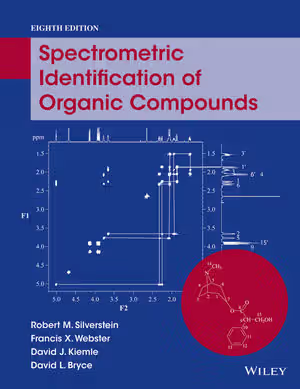
The book has eight chapters in about 460 pages. Chapters 1 to 6 are method chapters, each ending in student exercises and most with appendices of reference charts; Chapters 7 and 8 are collections of problems. Wiley describes the aim as a unified approach to structure determination built on mass spectrometry, infrared spectroscopy and multinuclear, multidimensional nuclear magnetic resonance, with emphasis on how the spectra work together.
Chapter 1: Mass Spectrometry
Introduces ionization methods (gas-phase methods such as electron impact and chemical ionization; desorption methods; evaporative methods including electrospray) and mass analyzers (magnetic sector, quadrupole, ion trap, time-of-flight, Fourier transform and tandem instruments). It then teaches interpretation of electron-impact spectra: recognising the molecular ion, determining a molecular formula, the index of hydrogen deficiency, fragmentation and rearrangements. A long section surveys the mass spectra of chemical classes from hydrocarbons to heteroaromatic compounds. Appendices tabulate formula masses, common fragment ions and common fragments lost.
Chapter 2: Infrared Spectroscopy
Covers theory (coupled interactions, hydrogen bonding), instrumentation and sample handling, and general interpretation of spectra. Its main section lists the characteristic group absorptions of organic molecules, from alkanes through carbonyl compounds and nitrogen compounds to sulfur, silicon, phosphorus and heteroaromatic compounds. Wiley notes that the 8th edition adds material on polymers and phosphorus functional groups. Appendices give solvent transparent regions and absorption charts.
Chapter 3: Proton (1H) Magnetic Resonance Spectroscopy
Starts with theory, instrumentation and sample handling, chemical shift, and spin-spin coupling with multiplets and spin systems. It continues with exchangeable protons on oxygen, nitrogen and sulfur, coupling to other nuclei, chemical and magnetic equivalence, rigid three-spin systems, weak and strong coupling, chirality, vicinal and geminal coupling constants, long-range coupling, double resonance and the nuclear Overhauser effect. Appendices are charts of chemical shifts and coupling constants, residual solvent signals and trace impurities.
Chapter 4: Carbon-13 NMR Spectroscopy
Theory (proton decoupling, chemical shift range, relaxation, the nuclear Overhauser effect, C-H coupling, sensitivity, solvents) is followed by the interpretation of a simple spectrum (diethyl phthalate), quantitative analysis, chemical equivalence and DEPT. The remainder organises chemical shifts by chemical class. Appendices give solvent and impurity shifts, shift ranges and shifts of several natural products.
Chapter 5: Two-Dimensional NMR Spectroscopy
After a short theory section, the chapter works through correlation experiments on specific molecules: COSY, double-quantum-filtered COSY, HETCOR, HMQC and HMBC on ipsenol; the same family on caryophyllene oxide; INADEQUATE; and lactose, used for TOCSY (two- and one-dimensional), HMQC-TOCSY and ROESY. It closes with pulsed field gradient NMR.
Chapter 6: Multinuclear Magnetic Resonance Spectroscopy
General considerations, then NMR of 15N, 19F, 29Si and 31P. An appendix tabulates properties of magnetically active nuclei. Wiley notes that this edition adds further isotopes and more tables of shifts and coupling constants.
Chapter 7: Solved Problems
Opens with an introduction and then discusses six worked problems (7.1 to 7.6) in detail, followed by student exercises.
Chapter 8: Assigned Problems
A large collection of problems with spectral data for the reader to solve. Wiley identifies the practice and real-data problems of Chapters 7 and 8 as the key strength of the book.
Key Concepts
Chapter 1: Mass Spectrometry
- Molecular ion and fragmentation: the intact ionized molecule and the pieces it breaks into, from which formula and structure are inferred.
- Index of hydrogen deficiency: a count of rings and multiple bonds computed from the molecular formula.
- Ionization methods and mass analyzers: how ions are made and separated.
Chapters 2–4: Infrared and one-dimensional NMR
- Characteristic group absorptions: infrared bands that identify functional groups.
- Chemical shift and spin-spin coupling: the position and splitting of NMR signals.
- Chemical and magnetic equivalence: which nuclei are indistinguishable and why that changes the spectrum.
- DEPT: an experiment that sorts carbon signals by number of attached hydrogens.
Chapters 5–6: Two-dimensional and multinuclear NMR
- COSY, HMQC, HMBC, TOCSY, ROESY, INADEQUATE: correlation experiments that connect signals through bonds or space.
- Multinuclear NMR: spectra of nuclei such as 15N, 19F, 29Si and 31P.
Chapters 7–8: Problems
- Combining spectra: using mass, infrared and NMR data together to reach a single structure.
Critical Analysis
Strengths
- Problem-based design. Wiley calls the extensive practice and real-data problem sets, in Chapters 7 and 8, the key strength; Chapter 7 discusses six solved problems in depth before Chapter 8 hands problems over, and each method chapter has its own student exercises.
- Reference material built into the chapters. Appendices collect formula masses, fragment ions, infrared absorption charts, proton and carbon shift charts, solvent and trace-impurity shifts and nuclear properties, so the book serves as a working reference as well as a text.
- Worked two-dimensional examples. Chapter 5 follows ipsenol, caryophyllene oxide and lactose through successive experiments rather than describing each experiment in the abstract.
- Maintained edition. The 8th edition adds a co-author, David Bryce, updates chapters 2, 3 and 6, and the text has been in print for over 40 years.
Limitations
- Organic focus. The book is written by and for organic chemists; it is not a general instrumental analysis text, and ultraviolet-visible spectroscopy has no chapter of its own in the contents.
- Reference-heavy. Long class-by-class sections in Chapters 1, 2 and 4 are designed for lookup rather than first reading, and each method chapter has only a short theory section before moving to interpretation.
- Assumes organic chemistry. Functional groups and structures are used freely from Chapter 1.
Where It Fits in the Course
In the quantum chemistry and spectroscopy course, this is the structure-determination book. Pavia's Introduction to Spectroscopy covers a similar set of methods (infrared, NMR, ultraviolet-visible and mass spectrometry) at an accessible introductory level with solved examples and graded problems; it is the gentler first book, with Silverstein as the deeper, problem-heavy second. Engel and Reid, McQuarrie and Thakkar address the underlying quantum theory of why molecules absorb and emit, and Jensen's Introduction to Computational Chemistry addresses calculation; they explain the physics behind the spectra that Silverstein teaches the reader to read.
How to Use This Book
The book suits students who have finished organic chemistry and want to learn to assign structures from spectra; instrumental analysis is useful but not required.
A practical plan:
- Core: Chapter 1 (sections 1.1 to 1.5), Chapter 2 (sections 2.1 to 2.5), Chapters 3 and 4 in full; these give the standard toolkit.
- Reference sections: treat the class-by-class tables (1.6, 2.6, 4.7) and the appendices as lookup material, consulting them while working problems.
- Advanced: Chapter 5 for students whose course covers two-dimensional NMR; Chapter 6 only when heteroatom NMR is needed.
- Practice: do the student exercises at the end of each chapter, study the solved problems in Chapter 7, then attempt the assigned problems in Chapter 8 without the discussion at hand.