01 / Reading Guide
Reading Guide
Citation
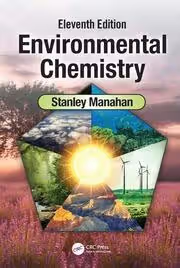
Manahan, S. E. (2022). Environmental Chemistry (11th ed.). CRC Press.
Chapter Summary
The publisher lists 24 chapter titles, in the order below, without section headings (chapter numbers here follow that order). The description says the book follows the format popular in earlier editions: an approach built on the five environmental spheres, linked to sustainability, industrial ecology and green chemistry. The titles bear this out, since the hydrosphere, atmosphere, geosphere, anthrosphere and biosphere each have a chapter that names them.
Chapter 1: Environmental Chemistry: An Essential Discipline in Coping with Challenges Facing Humankind
The opening chapter frames the subject as a discipline needed to address the challenges facing humankind, before the book turns to the individual spheres.
Chapters 2–7: The Hydrosphere and Water Chemistry; Oxidation/Reduction in Aquatic Chemistry; Phase Interactions in Aquatic Chemistry; Aquatic Microbial Biochemistry; Water Pollutants and Water Pollution; World Water Crisis and Climate Change: Water Renovation and Recycling
Six chapters on water. They begin with the hydrosphere and the chemistry of natural waters, then take up redox reactions, phase interactions and the biochemistry of aquatic microorganisms, before moving to pollutants and pollution and ending with the world water crisis, climate change, and the renovation and recycling of water.
Chapters 8–13: The Atmosphere and Atmospheric Chemistry; Particles in the Atmosphere; Gaseous Inorganic Air Pollutants; Organic Air Pollutants; Photochemical Smog; The Endangered Global Atmosphere
The atmosphere receives a block of the same size as the hydrosphere. After a chapter on atmospheric chemistry in general, the sequence runs through particles, inorganic gaseous pollutants, organic pollutants and photochemical smog, and closes with a chapter on the endangered global atmosphere.
Chapters 14–15: The Geosphere and Geochemistry; Soil: Earth's Lifeline
A shorter block on the solid earth: geochemistry in general, and soil.
Chapters 16–20: The Anthrosphere: Industrial Ecology and Green Chemistry; Resources and Sustainable Materials; Sustainable Energy: The Key to Everything; The Nature, Sources, and Environmental Chemistry of Hazardous Wastes; Industrial Ecology for Waste Minimization, Utilization, and Treatment
The titles of this block carry the sustainability, industrial ecology and green chemistry themes that the description names as key concepts. The sequence runs from the anthrosphere (the part of the environment made or modified by people) through materials and energy to hazardous wastes and the industrial-ecology approach to reducing, using and treating them.
Chapters 21–24: The Biosphere: Environmental Biochemistry; Toxicological Chemistry; Toxicological Chemistry of Chemical Substances; Chemical Analysis in Environmental and Toxicological Chemistry
The final block deals with living systems: environmental biochemistry, then two chapters on toxicological chemistry (general principles first, then particular substances), and a closing chapter on chemical analysis in environmental and toxicological work. The publisher states that the eleventh edition adds material on diseases and pandemics as an environmental problem linked to other concerns such as climate change, but does not say which chapters carry it.
Key Concepts
Chapters 1–7: Framing and water
- Environmental chemistry as a discipline: the field's role in responding to human challenges (Chapter 1).
- Aquatic chemistry: redox reactions and phase interactions in natural waters (Chapters 3–4).
- Water pollution and renovation: pollutants, pollution, recycling and the world water crisis (Chapters 6–7).
Chapters 8–15: Air and earth
- Atmospheric chemistry: the chemistry of the atmosphere, including particles and photochemical smog (Chapters 8–12).
- Air pollutants: inorganic gases and organic compounds (Chapters 10–11).
- Geochemistry and soil: the chemistry of the geosphere and of soil (Chapters 14–15).
Chapters 16–24: Sustainability, wastes and the living world
- Industrial ecology and green chemistry: the anthrosphere and the reduction of waste (Chapters 16 and 20).
- Sustainable materials and energy: resources and energy as sustainability topics (Chapters 17–18).
- Hazardous wastes: their nature, sources and environmental chemistry (Chapter 19).
- Toxicological chemistry and chemical analysis: effects of chemical substances on organisms and the analytical methods used to detect them (Chapters 22–24).
Critical Analysis
Strengths
- Wide coverage in a single volume. The 24 chapters span water, air, earth, the human-made environment and living systems, with sustainability, industrial ecology, hazardous wastes and toxicology as well. A student who needs the whole field in one place can find it here.
- A long-running standard text. The author biography states that the book was first published in 1972 and that this is its eleventh edition, which makes it a long-established title.
- Includes the analytical side. The last chapter is devoted to chemical analysis in environmental and toxicological chemistry, a subject close to the author's own training: his biography gives a Ph.D. in analytical chemistry.
- Current topical material. The publisher highlights new material on pathogens and disease and on past and recent pandemics as an environmental issue, and a new companion website with additional ancillary material.
Limitations
- Breadth over depth. At 764 pages and 24 chapters the book surveys many subjects; readers who need detailed treatment of one sphere, such as quantitative atmospheric modelling, will need a specialist text.
- Practice material is not described. The publisher's description mentions explanations, examples and ancillary material, but does not describe problem sets or worked examples. Check a copy or the companion website to see how much practice a course can draw on.
- Audience is broad. The publisher says the book appeals to a wide audience and is suitable for graduate students whose degrees are in other disciplines, so the level is set by the general-chemistry background expected of all readers rather than by deep prerequisites in any one area.
Where It Fits in the Course
Manahan is the broadest survey among the environmental and green chemistry books on this list, covering all five spheres and the sustainability topics together. Raff and Hites's Elements of Environmental Chemistry is described as a short, quantitative introduction built around problem solving with unit conversions, mass balance and kinetics; it suits a reader who wants to calculate concentrations, lifetimes and fluxes, and can accompany the descriptive coverage in Manahan. Chemistry in Context, developed under the American Chemical Society, teaches chemistry through societal and environmental questions and is an easier point of entry for readers with limited chemistry.
For depth, Seinfeld and Pandis's Atmospheric Chemistry and Physics is a graduate text on the atmosphere that extends Chapters 8–13, and Schwarzenbach, Gschwend and Imboden's Environmental Organic Chemistry is a graduate treatment of how organic compounds partition and are transformed in the environment. Lancaster's Green Chemistry: An Introductory Text develops the design principles that Manahan treats in the anthrosphere and industrial-ecology chapters.
How to Use This Book
The book suits students who have completed general chemistry and want a broad view of environmental systems and their pollution. The publisher describes an audience wider than chemistry majors, which suggests it is meant for environmental science students as well as chemists.
A practical plan:
- Core: Chapter 1 for the framing, then the sphere that matches the course: water in Chapters 2–7 or air in Chapters 8–13. Most readers will want both, together with the soil chapter (Chapter 15).
- Sustainability and wastes: Chapters 16–20 for green chemistry, industrial ecology, resources and energy; this block is where the book overlaps with Lancaster.
- Health and methods: Chapters 21–24 for toxicology and analysis; Chapter 24 is also useful as a reference on analytical methods when planning a project.
- Optional: the geosphere chapter (Chapter 14) and the aquatic microbial biochemistry chapter (Chapter 5) can be shortened in a chemistry-focused course.
Because the book is a survey, pair it with a quantitative text when a course requires calculations, and use the companion website for the additional material the publisher mentions.