01 / Reading Guide
Reading Guide
Citation
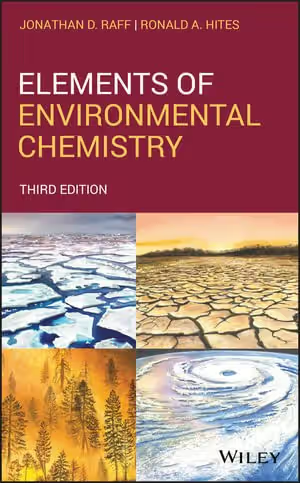
Raff, J. D., & Hites, R. A. (2020). Elements of Environmental Chemistry (3rd ed.). Wiley.
Chapter Summary
The third edition is a short book, about 290 pages in seven chapters, and the publisher describes it as concise and hands-on, giving the fundamentals of environmental chemistry together with a toolbox for applying them. The first six chapters each end with a problem set, and the publisher counts more than 130 problems in all, some of which can be solved with Excel; answers to the problem sets for Chapters 1–6 are in an appendix. The sample chapter shows the style: short explanations followed by worked examples that state a strategy before calculating, written in an informal voice. The appendices add a primer on organic structures and names, a periodic table and a table of constants. For this edition the authors completely revised and rearranged the book: the tool-skills chapter gained thermodynamics and measurement, the chapter on partitioning was expanded into one on the fates of organic compounds, and the material on toxic substances was combined into the last chapter.
Chapter 1: Simple Tool Skills
The tasks an environmental scientist meets repeatedly: unit conversions, estimating, the ideal gas law, stoichiometry, thermodynamic considerations (enthalpy, entropy, Gibbs free energy) and measurement issues. The worked examples insist on writing unit conversions out in full and on reporting results with sensible significant figures (in most environmental cases, the authors say, two will do). The measurement section discusses accuracy, precision and the trade-off between speed and quality of an analysis.
Chapter 2: Mass Balance and Kinetics
The core quantitative chapter. Steady-state mass balance is built from flows, stocks and residence times, including the addition of multiple flows and the distinction that "fluxes are not flows". Nonsteady-state mass balance follows, with up-going and down-going curves and work with real data, then first-order, second-order and Michaelis–Menten kinetics.
Chapter 3: Atmospheric Chemistry
Atmospheric structure, light and photochemistry, atmospheric oxidants, and the kinetics of atmospheric reactions through a pseudo-steady-state example and the Arrhenius equation. Stratospheric ozone is treated through its formation and loss mechanisms and the kinetics of the Chapman reactions, and the chapter ends with smog.
Chapter 4: Climate Change
A historical perspective, then blackbody radiation and Earth's temperature, infrared absorption and the greenhouse effect. Earth's radiative balance is broken down into greenhouse gases, albedo, the solar constant and their combined effects, followed by aerosols and clouds, radiative forcing and global warming potentials.
Chapter 5: Carbon Dioxide Equilibria
pH and equilibrium constants applied to carbon dioxide in water: the pH of pure and polluted rain, further acid-rain chemistry and its implications, surface water and ocean acidification.
Chapter 6: Fates of Organic Compounds
The longest of the problem-based chapters. It starts from molecular interactions (electronegativity, dipoles and quadrupoles, types of weak interactions) and uses them to explain vapour pressure, the aqueous solubility of liquids, solids and gases, partitioning into organic phases and into biota (bioconcentration, bioaccumulation, biomagnification), adsorption and water–air transfer. It closes with the reactive fates of organic pollutants and a section that puts partitioning and persistence together. The publisher says the emphasis is on developing "chemical intuition" for predicting a chemical's fate from its structure.
Chapter 7: Toxic Stuff: Mercury, Lead, Pesticides, Polychlorinated Biphenyls, Dioxins, and Flame Retardants
A largely descriptive chapter built on substances and cases: mercury; lead; the history of pesticides, legacy pesticides and current-use herbicides, insecticides, fumigants and fungicides; PCB nomenclature, production and use, with case studies of the Hudson River, Bloomington (Indiana) and the Yusho and Yu-Cheng poisonings; dioxin nomenclature with chick edema disease, Agent Orange, Times Beach, Seveso, combustion sources and the US dioxin reassessment; and brominated and other flame retardants. It ends with "Lessons Learned" and, unlike the other chapters, has no problem set.
Key Concepts
Chapters 1–2: Tools
- Estimating: making quick order-of-magnitude calculations to check whether a result is plausible.
- Residence time: the stock of a substance in a reservoir divided by the flow through it.
- Flux versus flow: a flux is a flow per unit area; the book stresses that the two must not be confused.
- Nonsteady-state mass balance: describing how the amount in a reservoir rises or falls with time when inputs and outputs are unequal.
Chapters 3–4: Atmosphere and climate
- Pseudo-steady-state approximation: treating a short-lived species as if its concentration were constant to simplify kinetics.
- Chapman reactions: the basic reaction scheme for the formation and loss of stratospheric ozone.
- Radiative forcing: the change in Earth's energy balance caused by a change such as added greenhouse gas.
- Global warming potential: a comparison of the warming effect of a gas with that of carbon dioxide.
Chapter 5: Carbon dioxide equilibria
- Carbonate equilibria: the reactions of dissolved carbon dioxide that set the pH of rain and natural waters.
- Ocean acidification: the lowering of seawater pH as the ocean absorbs carbon dioxide.
Chapters 6–7: Organic compounds and toxic substances
- Partitioning: the distribution of a compound between air, water, organic phases and organisms.
- Biomagnification: increasing concentration of a pollutant at higher levels of a food chain.
- Persistence: how long a compound survives in the environment before being transformed.
- Congener nomenclature: the systems for naming individual PCBs and dioxins.
Critical Analysis
Strengths
- Quantitative from the first page. The book teaches environmental chemistry as calculation: Chapters 1 and 2 build a small set of tools (unit conversion, estimation, mass balance, kinetics) that are then applied to the atmosphere, climate and water. The emphasis on writing out unit conversions and on realistic significant figures is practical training that carries beyond the course.
- Problems with answers. More than 130 problems, some suited to Excel, with answers to the problem sets for Chapters 1–6 at the back, make the book workable for independent study.
- Short and focused. At under 300 pages it can be covered in a single term, and the third edition's reorganisation gives each chapter a clear job.
- Case-based treatment of toxic substances. Chapter 7 grounds pesticides, PCBs, dioxins and flame retardants in named incidents and places, and the publisher notes that this material now carries more references to the literature.
Limitations
- Selective coverage. There are no chapters on soil chemistry, water treatment or green chemistry, so the book is an introduction to selected tools and problems rather than a survey of the field.
- Chapter 7 is not quantitative. The final chapter has no problem set and stands apart from the calculation-based approach of the rest of the book.
- Some chemistry assumed. The organic chemistry needed for Chapters 6 and 7 is condensed into a short appendix primer, and the thermodynamics in Chapter 1 is a brief review; students without general chemistry will find the pace quick.
Where It Fits in the Course
Raff and Hites is the course's quantitative introduction for science students. Chemistry in Context, the American Chemical Society's book for non-science majors, introduces the same issues (air, climate, water, energy) with little calculation and can come first for readers without a chemistry background. Stanley Manahan's Environmental Chemistry is a much broader textbook covering the atmosphere, water, soil, living systems and green chemistry; it works as a companion for the topics Raff and Hites leave out, while Raff and Hites supplies the problem-solving practice. Mike Lancaster's Green Chemistry: An Introductory Text covers the design of cleaner chemical processes, a subject this book does not address.
The two graduate texts deepen particular chapters. Schwarzenbach, Gschwend and Imboden's Environmental Organic Chemistry develops the partitioning and transformation processes of Chapter 6 in full quantitative detail, and Seinfeld and Pandis's Atmospheric Chemistry and Physics does the same for the atmospheric kinetics, ozone and climate material of Chapters 3–4. Raff and Hites is good preparation for either.
How to Use This Book
The book is written for students and professionals in the chemical and environmental sciences. General chemistry and comfort with algebra are the expected background; the thermodynamics and kinetics needed are reviewed in Chapters 1–2, and Appendix A covers the organic structures and names used later.
A practical plan for one term:
- Do not skip Chapters 1 and 2. Every later chapter uses unit conversions, mass balance and kinetics; the problem sets for these chapters are the best preparation for the rest.
- Atmosphere and climate: Chapters 3 and 4, in order; the atmospheric kinetics of Chapter 3 draws directly on Chapter 2.
- Water: Chapter 5, which applies equilibrium constants to rain, surface water and the ocean.
- Organic pollutants: Chapter 6, then Chapter 7 as reading on specific substances and cases; read Appendix A first if organic nomenclature is unfamiliar.
Work through the worked examples by covering the solution and following the stated strategy, then attempt the problem sets and check them against Appendix D. Try the problems that suit Excel in a spreadsheet; fitting real data, as in Section 2.2.3 on nonsteady-state mass balance, is a natural place to start. Students continuing in environmental chemistry can move on to Schwarzenbach and colleagues for organic compounds or Seinfeld and Pandis for the atmosphere.