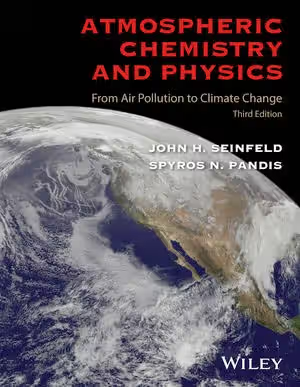
01 / Reading Guide
Reading Guide
Citation
Seinfeld, J. H., & Pandis, S. N. (2016). Atmospheric Chemistry and Physics: From Air Pollution to Climate Change (3rd ed.). Wiley.
Chapter Summary
The third edition runs to about 1,150 pages in seven parts and 26 chapters, with appendices of units and constants, rate constants of atmospheric reactions, and abbreviations. Most chapters end with problems. The publisher says each topic is developed from the fundamental science up to its application to real-world problems, and that this edition adds a chapter on global climate, a chapter on atmospheric organic aerosols and a treatment of positive matrix factorization.
Part I, Chapters 1–2: The Atmosphere; Atmospheric Trace Constituents
Chapter 1 sets the stage: the history of Earth's atmosphere, climate, the layers of the atmosphere, pressure and temperature profiles, ways of expressing amounts of a substance, airborne particles, and the spatial and temporal scales of atmospheric processes. Chapter 2 introduces atmospheric lifetime and then surveys sulfur-, nitrogen-, carbon- and halogen-containing compounds, ozone, particulate matter, mercury and emission inventories. Its two appendices summarize US air pollution legislation and hazardous air pollutants.
Part II, Chapters 3–7: Chemical Kinetics; Atmospheric Radiation and Photochemistry; Chemistry of the Stratosphere; Chemistry of the Troposphere; Chemistry of the Atmospheric Aqueous Phase
Chapter 3 supplies the kinetics needed later: reaction order, collision and transition state theories, the pseudo-steady-state approximation, excited species, termolecular reactions, chemical families and gas-surface reactions. Chapter 4 covers radiation, the Beer-Lambert law, actinic flux, photolysis rates and the photodissociation of O3 and NO2. Chapter 5 treats stratospheric chemistry, from the Chapman mechanism through the NOx, HOx and halogen cycles to the ozone hole, polar stratospheric clouds, heterogeneous chemistry and ozone depletion potential. Chapter 6, the longest in this part, covers tropospheric hydroxyl radicals, the NO2-NO-O3 cycle, CO and methane oxidation, the roles of VOC and NOx in ozone formation, the chemistry of alkanes, alkenes, aromatics and biogenic hydrocarbons such as isoprene and pinene, and sulfur, nitrogen, halogen and mercury species. Chapter 7 turns to liquid water in the atmosphere: Henry's law, aqueous equilibria, and S(IV) to S(VI) oxidation paths.
Part III, Chapters 8–15: Aerosols
Chapters 8 and 9 describe aerosol size distributions (including the lognormal distribution), ambient aerosols of different environments, composition, and the dynamics of single particles (mean free path, Stokes' law, settling, Brownian motion). Chapter 10 applies thermodynamics to aerosols, covering water content, deliquescence, the Kelvin effect and inorganic aerosol systems. Chapter 11 covers nucleation, from classical homogeneous theory to ion-induced nucleation and atmospheric new-particle formation. Chapter 12 addresses mass transfer and its limits in aqueous-phase chemistry. Chapter 13 covers condensation, coagulation and the general dynamic equation for aerosol populations. Chapter 14, new in this edition, treats secondary organic aerosol formation, volatility, gas-particle partitioning, models and the global budget of organic aerosol. Chapter 15 covers light scattering and absorption by particles and visibility.
Part IV, Chapters 16–18: Physical and Dynamic Meteorology; Cloud Physics; Atmospheric Diffusion
Chapter 16 provides the meteorology the later chapters need: lower-atmosphere temperature, stability, the moist atmosphere, surface-layer conservation equations and wind profiles. Chapter 17 covers droplet equilibrium, cloud and fog formation, droplet growth, cloud condensation nuclei and cloud processing of aerosols. Chapter 18 develops Eulerian and Lagrangian descriptions of turbulent diffusion, the statistical theory, Gaussian plume solutions, dispersion parameters and plume rise.
Part V, Chapters 19–20: Dry Deposition; Wet Deposition
Chapter 19 builds a resistance model for dry deposition (aerodynamic, quasilaminar and surface resistance) and discusses measurement. Chapter 20 covers wet removal: below-cloud scavenging of gases, precipitation scavenging of particles, in-cloud scavenging and acid deposition.
Part VI, Chapters 21–24: General Circulation of the Atmosphere; Global Cycles: Sulfur and Carbon; Global Climate; Aerosols and Climate
Chapter 21 introduces the Hadley, Ferrel and polar cells, the Coriolis force, geostrophic wind and the hydrologic cycle. Chapter 22 treats the atmospheric sulfur cycle and the global carbon cycle. Chapter 23, new in this edition, covers Earth's energy balance, radiative forcing, the greenhouse effect, climate-forcing agents, climate sensitivity and feedbacks. Chapter 24 analyzes how aerosol layers scatter and absorb radiation and their direct and indirect effects on climate.
Part VII, Chapters 25–26: Atmospheric Chemical Transport Models; Statistical Models
Chapter 25 covers box models, three-dimensional chemical transport models, one-dimensional Lagrangian models, numerical solution methods and model evaluation. Chapter 26 covers receptor modeling (chemical mass balance, factor analysis, methods using wind information) and statistical treatment of air-quality data, including probability distributions, exceedances and air-quality standards.
Key Concepts
Parts I and II
- Atmospheric lifetime: the characteristic time a trace species persists, which links emissions to concentrations.
- Photolysis and the hydroxyl radical: sunlight drives radical chemistry that oxidizes most trace gases.
- Ozone chemistry: stratospheric catalytic cycles that destroy ozone, and the VOC/NOx dependence of tropospheric ozone formation.
Part III
- Size distribution: the description of an aerosol population by number, surface, volume or mass over particle diameter.
- Nucleation, condensation and coagulation: the processes that form and grow particles.
- Secondary organic aerosol: particles formed from the oxidation products of organic vapors.
Parts IV to VII
- Deposition: removal of gases and particles by dry resistance pathways and by precipitation.
- Radiative forcing and climate sensitivity: measures of how composition changes alter Earth's energy balance.
- Chemical transport models: numerical models that combine emissions, chemistry and transport.
Critical Analysis
Strengths
- Full chain from chemistry to policy-relevant outcomes. The seven parts move from trace gases and gas-phase chemistry through aerosols, clouds, meteorology, deposition and climate to models, so a reader can follow a pollutant from emission to removal and to its climate effects in one book.
- Aerosol depth. Part III alone has eight chapters, covering size distributions, particle dynamics, thermodynamics, nucleation, mass transfer, population dynamics, organic aerosols and optics.
- Updated for the third edition. The publisher highlights the new global climate chapter (described as a self-contained treatment of climate forcing, feedbacks and climate sensitivity), the new organic aerosol chapter, positive matrix factorization, and updated treatments of physical meteorology, nucleation, aerosol-cloud relationships and biogenic hydrocarbon chemistry.
- Practice material and reference value. Chapters end with problems (the publisher adds new introductory-level ones), and the appendices collect constants and tabulated rate constants.
Limitations
- Size and pace. At roughly 1,150 pages the book is more than a single course can cover; courses must select parts, and the chapters on nucleation, mass transfer and statistical models are specialist material.
- Mathematical and physical-chemistry demands. Kinetics, thermodynamics, transport equations and numerical methods appear throughout, so the book is hard going without that background.
Where It Fits in the Course
In this course on environmental and green chemistry the book is the most specialized treatment of the atmosphere. Chemistry in Context introduces chemistry through societal issues such as air quality and climate, Raff and Hites's Elements of Environmental Chemistry is a short, quantitative introduction built around estimating concentrations, lifetimes and fluxes, and Manahan's Environmental Chemistry is a broad text that applies chemical principles to the atmosphere, water, soil and living systems. Any of these is a sensible first step before Seinfeld and Pandis. Lancaster's Green Chemistry addresses the design of safer chemical products and processes, a different question from atmospheric science.
The closest companion is Schwarzenbach, Gschwend and Imboden's Environmental Organic Chemistry, a graduate-level text on how organic chemicals partition between air, water, soils and organisms and how they are transformed. That book follows chemicals through all environmental compartments; Seinfeld and Pandis concentrate on the atmosphere, its gases and particles, and its role in climate. Readers working on air quality may find the two complementary, for example when studying semivolatile organic compounds and aerosol-air partitioning.
How to Use This Book
The book suits graduate students and researchers in atmospheric science, environmental engineering and chemistry, and well-prepared advanced undergraduates. Physical chemistry (kinetics and thermodynamics), calculus and differential equations are the working prerequisites.
A practical plan:
- Core for a first course: Chapters 1–2 for orientation, Chapter 3 for kinetics, Chapter 4 for photochemistry, Chapters 5–6 for stratospheric and tropospheric chemistry, and Chapter 23 for the climate framework.
- Aerosol track: Chapters 8, 9, 10 and 13, then Chapters 11, 14 and 15 according to interest; Chapter 17 links aerosols to clouds.
- Removal and transport: Chapters 16, 18, 19 and 20 for meteorology, dispersion and deposition.
- Modeling and data analysis: Chapters 25 and 26 once the earlier chemistry is familiar.
Work the end-of-chapter problems, especially in Chapters 3–6 and 8–10, where the calculations carry the argument, and keep the rate-constant appendix at hand when examining reaction mechanisms.