01 / Reading Guide
Reading Guide
Citation
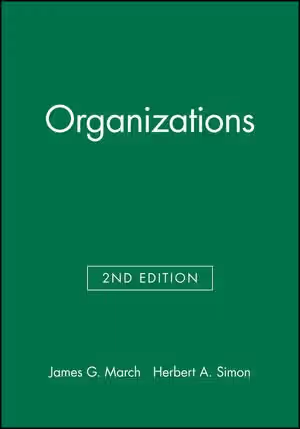
March, J. G., & Simon, H. A. (1993). Organizations (2nd ed.). Wiley-Blackwell.
Chapter Summary
The second edition has seven chapters, a short postscript, a long bibliography and a "Numerical Index to Variables", preceded by an introduction written for this edition. Each chapter is divided into short numbered sections that end with a conclusion, which makes the contents easy to survey. The book states its purpose at the outset: it deals with the theory of formal organizations, and it tries to restate existing hypotheses in a form that can be tested and to build a common language for a literature that, in the authors' view, says the same things in many different vocabularies.
Chapter 1: Organizational Behavior
The opening chapter explains why formal organizations matter as social institutions and surveys the literature of organization theory. It then sets out how the book is organised: propositions about organizational behavior rest on assumptions about human beings, and the authors group these into three classes. In the first, members are passive instruments that perform tasks and accept direction. In the second, members bring attitudes, values and goals, so they must be motivated or induced to participate. In the third, members are decision makers and problem solvers, for whom perception and thought are central. The chapter closes with "some types of propositions" and "some psychological postulates".
Chapter 2: "Classical" Organization Theory
This chapter reviews Taylor's scientific management and theories of departmentalization, and then the operational and empirical problems of classical administrative science. It is the book's account of the older, instrument-centred view of the organization.
Chapter 3: Motivational Constraints: Intraorganizational Decisions
Sections on influence processes, theories of bureaucracy, satisfaction and productivity, and motivation to produce deal with influence within the organization and with the motivation to produce; it is the first of two chapters on motivational constraints.
Chapter 4: Motivational Constraints: The Decision to Participate
The chapter is built around the theory of organizational equilibrium: who the participants are, the participation criterion, a general model of employee participation, and the factors affecting the perceived desirability and ease of leaving. It also extends the analysis to other participants and to opportunism and organizational survival.
Chapter 5: Conflict in Organizations
Individual conflict comes first, followed by organizational conflict, both individual conflict within an organization and intergroup conflict within it. The chapter then turns to how organizations react to conflict and to interorganizational conflict.
Chapter 6: Cognitive Limits on Rationality
The chapter covers the concept of rationality, performance programs, perception and identifications, the division of work, communication, and the relation between organization structure and the boundaries of rationality. It is the chapter on the limits of rationality that the book's best-known concepts attach to.
Chapter 7: Planning and Innovation in Organizations
The last chapter treats the concept of initiation, the process and occasions of innovation, the elaboration of programs, organization level and innovation, and the planning process.
Key Concepts
Chapters 1–2
- Three classes of assumptions: members as passive instruments, as bearers of attitudes and goals, and as decision makers.
- Propositions: statements about organizational behavior restated so that they can be tested.
- Classical organization theory: scientific management and theories of departmentalization.
Chapters 3–5
- Inducements and contributions: the balance behind the theory of organizational equilibrium and the decision to participate.
- Participation criterion: the test used to decide whether a person stays in an organization.
- Conflict: individual, intergroup and interorganizational.
Chapters 6–7
- Bounded rationality: the cognitive limits on rational choice.
- Performance programs: the programs that govern how performance is organised.
- Initiation, innovation and planning: how organizations start change.
Critical Analysis
Strengths
- Systematic structure. Every chapter is divided into short numbered sections with a conclusion, and the volume ends with a numerical index to the variables, so the book can be used as a reference as well as read straight through.
- A stated method. The authors say they aim to restate hypotheses in testable form and to attend to the operational definition of variables, so each chapter is organised around propositions that can be examined against evidence.
- Breadth of the literature. The first chapter lists the contributions of sociologists, social psychologists, political scientists and economists to organization theory, and the book draws them together under a common language.
- Standing. The publisher presents it as a classic of organizational management and names bounded rationality, satisficing, the inducement/contribution balance, attention focus and uncertainty absorption among its topics.
Limitations
- A dated literature. The second edition adds an introduction and a postscript to chapters whose literature reaches back to the mid-twentieth century (Chapter 1 cites a handbook of 1954), so later research is not part of the chapters themselves.
- Propositional format. A numerical index of variables shows that the book is organised around numbered propositions about variables; this suits close study better than quick reading.
- Not an introduction. It does not review the field in textbook fashion; students without an organizational behavior course will lack the context for its arguments.
Where It Fits in the Course
Among the course books, Robbins and Judge's Organizational Behavior, Buchanan and Huczynski's Organizational Behaviour and Mullins and Rees's Management and Organisational Behaviour are introductory textbooks that survey individuals, groups and organizations. March and Simon is a different kind of book: a single integrative framework, built on decision-making, that also serves as a source for the ideas the textbooks present in modern form. It belongs after one of the introductions.
Miner's Organizational Behavior 1 reviews specific theories of motivation and leadership one by one, and the two books complement each other: Miner tests particular theories against the evidence, whereas March and Simon offer an earlier and broader framework. Hatch's Organizations: A Very Short Introduction is a brief orientation that can be read first to see where the book's questions sit in the wider field.
How to Use This Book
The book is for students who have finished an organizational behavior textbook and want a founding source: graduate students and advanced undergraduates in management, organizational psychology, sociology and public administration.
- Read Chapter 1 carefully. It explains the three classes of assumptions and the aim of the book, and the rest is easier to follow with that frame in mind.
- Core: Chapters 3, 4 and 6 contain the ideas most associated with the book, the participation decision and the cognitive limits on rationality.
- Chapters 2, 5 and 7 can be read selectively: Chapter 2 as background on classical theory, Chapter 5 on conflict, Chapter 7 on planning and innovation.
- Pace. Read slowly, a chapter at a time, using the section conclusions as checkpoints, and keep a modern textbook beside it to see how later work developed the same topics.