01 / Reading Guide
Reading Guide
Citation
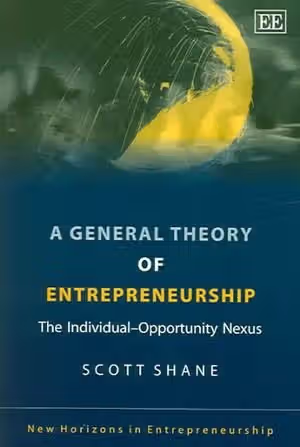
Shane, S. (2004). A General Theory of Entrepreneurship: The Individual-Opportunity Nexus. Edward Elgar.
Chapter Summary
The book is a research monograph in Edward Elgar's New Horizons in Entrepreneurship series, with a foreword by Sankaran Venkataraman and eleven chapters. Its organizing idea is that entrepreneurship is best understood at the point where enterprising individuals meet valuable opportunities. The chapters follow the sequence of the entrepreneurial process, from the existence of opportunities to their discovery, the decision to exploit them, the assembly of resources and the organizing of the venture.
Chapter 1: Introduction
Sets out the aim of building an overarching conceptual framework for the field and introduces the individual-opportunity nexus that the later chapters develop.
Chapter 2: The Role of Opportunities
Examines opportunities as a starting point for the study of entrepreneurship, before attention turns to the people who act on them.
Chapter 3: The Discovery of Entrepreneurial Opportunities
Addresses how opportunities come to be discovered, the first of the two processes (discovery and exploitation) that the publisher's description places at the centre of the book.
Chapters 4–5: Individual Differences and the Decision to Exploit; Psychological Factors and the Decision to Exploit
Two chapters on the individual side of the nexus: why some people, and not others, decide to exploit an opportunity once it exists. The first is framed around individual differences, the second around psychological factors.
Chapters 6–7: Industry Differences in Entrepreneurial Activity; The Environmental Context of Entrepreneurship
These chapters widen the view from the individual to the conditions in which entrepreneurial activity is more or less likely: differences between industries, and the broader environment.
Chapters 8–10: Resource Acquisition; Entrepreneurial Strategy; The Organizing Process
The final analytical chapters follow the venture after the decision to proceed: acquiring resources, choosing a strategy and organizing the firm. These match the publisher's description of the skills and strategies used to organize and exploit opportunities.
Chapter 11: Conclusions
Draws the argument together. The book ends with a reference list and an index.
Key Concepts
Chapters 1–3: Framework and Opportunities
- Individual-opportunity nexus: the book's central idea, that entrepreneurship arises from the combination of enterprising individuals and valuable opportunities.
- Opportunities: treated as something with its own role in the theory, separate from the person who recognises them.
- Discovery: the process by which an opportunity is recognised in the first place.
Chapters 4–7: Who Exploits and Where
- Decision to exploit: the choice to act on a discovered opportunity, examined through individual differences and psychological factors.
- Industry differences: variation in how much entrepreneurial activity occurs across sectors.
- Environmental context: the external conditions that favour or discourage entrepreneurial activity.
Chapters 8–10: Building the Venture
- Resource acquisition: how entrepreneurs obtain the means to pursue an opportunity.
- Entrepreneurial strategy: the strategic choices open to a new venture.
- Organizing process: how the firm is structured to exploit the opportunity.
Critical Analysis
Strengths
- A single framework for a scattered field. The publisher presents the book as an overarching conceptual framework that explains the different parts of the entrepreneurial process in a coherent way. The chapter sequence mirrors that claim: opportunities, discovery, exploitation, context, resources, strategy and organization are treated as one process.
- Breadth of research brought together. The endorsements printed by the publisher describe a comprehensive compilation of knowledge; Arnold Cooper of Purdue notes its use of a wide variety of literature, and Ed McMullan of Calgary reports using it with PhD, MBA and undergraduate students.
- Opportunities treated as a subject in their own right. Two early chapters are devoted to opportunities and their discovery before any chapter on the entrepreneur, which separates this book from texts that begin with personality or motivation alone. Venkataraman's foreword, as quoted by the publisher, stresses that the book looks at the nexus rather than at individuals or opportunities in isolation.
- Clear division of labour among chapters. Individual-level chapters (4–5), industry and environment chapters (6–7) and venture-building chapters (8–10) can be read as three blocks.
Limitations
- Not a practitioner's guide. The chapter titles are about theory and research evidence; the table of contents lists no chapters on business plans, financing instruments or start-up tools. Readers wanting step-by-step advice on launching a firm need a textbook of the process-oriented kind.
- Audience assumed to be academic. The publisher lists the audience as professional and scholarly, and the book is a monograph, not a classroom text; it is not organized around exercises or cases.
- Dated as an evidence base. The book was first published in 2003 (paperback 2004), so later research on topics such as digital ventures, crowdfunding or platform markets is outside it.
Where It Fits in the Course
Within the entrepreneurship and innovation list, this is the theoretical and research-oriented title. Two books lead into it from a practical side: The Lean Startup is a practitioner's account of testing ideas quickly with customers, and the OpenStax Entrepreneurship and Barringer and Ireland's Entrepreneurship are textbooks that follow the process of starting a business step by step. Shane is best read after one of these, when the reader wants to know what research says about why opportunities exist, who acts on them, and why ventures differ.
Alongside it, Clayton Christensen's The Innovator's Dilemma addresses how established firms lose ground to new entrants, which is a complementary view of opportunities from the incumbent's side, and Tidd and Bessant's Managing Innovation is a research-based textbook on innovation inside organizations. Shane is the book to choose when the question is about entrepreneurship as a field of scholarship rather than about managing a firm or a product.
How to Use This Book
The book suits graduate students, doctoral students and researchers who already have a first course in entrepreneurship or innovation and can read empirical work. Advanced undergraduates with that background can use selected chapters.
A practical plan:
- Core: Chapters 1–3, to learn the framework and the treatment of opportunities, then Chapter 11 to see how the argument is summarised.
- Individual side: Chapters 4–5 for the decision to exploit; read these together, since they approach the same question from two angles.
- Context and venture: Chapters 6–7 for industries and environments, and Chapters 8–10 for resources, strategy and organizing. Readers with a particular interest, such as strategy or organization design, can go to the relevant chapter directly once Chapter 1 is read.
- Alongside: use the reference list as a map to the underlying studies, and pair the book with a case-based or process-oriented text if concrete examples are needed.