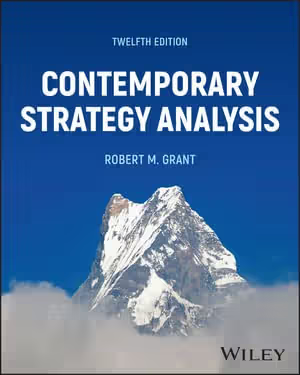
01 / Reading Guide
Reading Guide
Citation
Grant, R. M. (2024). Contemporary Strategy Analysis (12th ed.). Wiley.
Chapter Summary
The book has 14 chapters in four parts, followed by 14 case studies and a glossary. The publisher describes it as a textbook for upper-level undergraduate, MBA and executive courses, built on the fundamentals of value creation and appropriation. Each chapter opens with an introduction and objectives and ends with a summary and self-study questions.
Part I: Introduction
Chapter 1: The Concept of Strategy. Defines strategy and why firms need it, and sets out a basic framework for strategy analysis that connects the firm's goals and resources with its industry environment. Sections cover the role of strategy in success, locating and describing a company's strategy (with examples of corporate statements of strategy), the difference between designed and emergent strategy, and strategic management in not-for-profit organizations.
Part II: The Tools of Strategy Analysis
Chapter 2: Goals, Values, and Performance. Treats strategy as a quest for value: profit, cash flow and enterprise value, putting performance analysis into practice, and then what lies beyond profit, namely values, sustainability and social responsibility, and real options.
Chapter 3: Industry Analysis: The Fundamentals. Moves from environmental analysis to industry analysis. It covers industry attractiveness, forecasting industry profitability, using the analysis to develop strategy, where to draw industry boundaries, and key success factors as an external source of competitive advantage.
Chapter 4: Industry Analysis: Dynamics of Industry and Competition. Examines the limits of industry analysis and goes beyond the five forces to complements, ecosystems and business models, then to competitive interaction through game theory and competitor analysis.
Chapter 5: Analyzing Resources and Capabilities. Presents the role of resources and capabilities in strategy formulation, how to identify and appraise them, and how to draw strategy implications.
Chapter 6: Organization Structure and Management Systems: The Fundamentals of Strategy Implementation. Links formulation and implementation, covers specialization, cooperation and coordination, developing organizational capability, and organization design.
Part III: Business Strategy and the Quest for Competitive Advantage
Chapter 7: The Sources and Dimensions of Competitive Advantage. Covers how competitive advantage is established and sustained, then cost advantage and differentiation advantage and whether a firm can pursue both.
Chapter 8: Industry Evolution and Strategic Change. Takes the industry life cycle, the challenge of organizational adaptation and strategic change, and how to manage strategic change.
Chapter 9: Technology-Based Industries and the Management of Innovation. Covers competitive advantage in technology-intensive industries, strategies to exploit innovation, standards, platforms and network externalities, and implementing technology strategies.
Part IV: Corporate Strategy
Chapter 10: Vertical Integration and the Scope of the Firm. Uses transaction costs to discuss the scope of the firm, the benefits and costs of vertical integration, and the design of vertical relationships.
Chapter 11: Global Strategy and the Multinational Corporation. Considers international competition and industry analysis, competitive advantage in an international context, locating production, entering foreign markets, global integration versus national differentiation, and organizing the multinational.
Chapter 12: Diversification Strategy. Examines the motives for diversification, competitive advantage from it, its relation to performance, and the meaning of relatedness.
Chapter 13: Implementing Corporate Strategy: Managing the Multibusiness Firm. Covers the role of corporate management, managing the portfolio, linkages across businesses and individual businesses, change, and corporate governance. An appendix, External Growth Strategies: Mergers, Acquisitions, Alliances, follows the chapter.
Chapter 14: Current Trends in Strategic Management. A short closing chapter on technological change, political, social and environmental challenges, the new science of strategic decision making, and leadership competencies.
Cases
Fourteen cases accompany the chapters, including SpaceX, Kering and LVMH, the US legal marijuana industry, the lithium-ion battery industry, Netflix and Disney, BP, Starbucks, Eastman Kodak, Nvidia, Zara, City Football Group, Alphabet, Amazon and Haier.
Key Concepts
Part I–II: Tools of analysis
- Strategy as fit: the match between a firm's goals and resources and its environment.
- Enterprise value and real options: ways of judging strategic performance beyond annual profit.
- Five forces and beyond: industry analysis, extended to ecosystems, complements and business models.
- Resources and capabilities: the internal basis of competitive advantage.
Part III: Business strategy
- Cost advantage and differentiation advantage: the two routes to competitive advantage.
- Industry life cycle: the stages through which industries evolve and the demands each makes on strategy.
- Network externalities and platforms: the economics of technology-based competition.
Part IV: Corporate strategy
- Vertical integration: the choice of how much of the value chain to own, framed by transaction costs.
- Diversification and relatedness: why firms expand into other businesses and when it pays.
- Corporate governance: how the multibusiness firm is directed and controlled.
Critical Analysis
Strengths
- Clear architecture. The sequence runs from tools (goals, industry, resources, structure) to business strategy to corporate strategy, so each part uses what came before. The publisher stresses clarity of exposition and practicality.
- Integrated cases. Fourteen cases are matched to chapters through a "Matching Cases to Chapters" guide, so the concepts can be applied immediately.
- Updated for the current environment. The twelfth edition adds material on profound uncertainty and theorizing, business ecosystems, network externalities and platforms, artificial intelligence in strategic decision making, and ESG issues.
- Digital study aids. The e-text includes videos, review videos for each learning objective and self-scoring quizzes.
Limitations
- Brief final chapter. Chapter 14 runs to about seven pages for four themes (technological change, political, social and environmental challenges, strategic decision making, leadership), so these current topics are introduced rather than developed at length.
- Breadth over depth. One book covers goals, industry analysis, resources, structure, business strategy and corporate strategy in 14 chapters, so each tool is presented at textbook length; readers who want the economics behind a tool will need a more specialized text.
- Cases are a large share of the page count. Of the roughly 512 pages, the cases occupy the section from page 319 to the glossary, so the chapter text is shorter than the page count suggests.
Where It Fits in the Course
Grant is a core analytical text for a strategy course, positioned between the shorter conceptual readings and the more specialized economics treatments. Good Strategy Bad Strategy and Understanding Michael Porter are short, readable books for general readers, the second a guide to Porter's five forces and value chain; Porter's Competitive Strategy is the foundational statement of industry and competitor analysis, the subject of Chapters 3 and 4 here. Exploring Strategy is a textbook of similar scope with a European orientation, organized around strategic position, choices and strategy in action, and is the closest alternative.
Besanko, Dranove, Shanley and Schaefer's Economics of Strategy covers firm boundaries, competition and positioning with microeconomics and game theory in more depth. Read Grant first for the whole of the subject, and Besanko afterwards if the economic reasoning behind industry analysis, competitive advantage and vertical integration deserves a closer look.
How to Use This Book
It is written for MBA and advanced undergraduate courses and for executives; an introductory management or strategy course, basic microeconomics and financial accounting are helpful background.
- Core: Chapters 1–3 and 5 for the logic of analysis, Chapter 7 for the central idea of competitive advantage, and Chapters 10 and 12 for corporate strategy.
- As needed: Chapter 4 for game theory and ecosystems, Chapter 6 for implementation, Chapter 8 and 9 for dynamic and technology-driven industries, Chapter 11 for international strategy, Chapter 13 and its appendix for the multibusiness firm and acquisitions.
- With the cases: pair each chapter with the case matched to it in the book's guide and work out the analysis (industry, resources, strategy) yourself. Use the self-study questions at the end of each chapter to check understanding.