01 / Reading Guide
Reading Guide
Citation
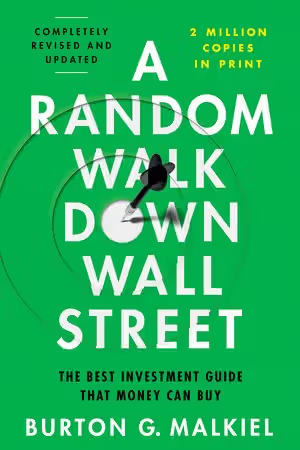
Malkiel, B. G. (2024). A Random Walk Down Wall Street: The Best Investment Guide That Money Can Buy (13th ed.). W. W. Norton.
Chapter Summary
First published in 1973, the book reached its thirteenth edition in 2023 as a fiftieth-anniversary revision; the paperback runs to about 480 pages. It opens with an introduction to the fiftieth-anniversary edition and has four parts and fifteen chapters, followed by an epilogue and a reference guide to mutual funds and exchange-traded funds. The argument moves from history (how markets have mispriced assets) to evidence (whether professional analysis beats the market) to theory (portfolio theory, risk and behavioural finance) and finally to practical advice for individual savers. The publisher notes that this edition addresses cryptocurrencies, NFTs and meme stocks, tax-efficient investing, and techniques such as factor investing, risk parity and ESG portfolios.
Part One: Stocks and Their Value (Chapters 1–4)
Chapter 1: Firm Foundations and Castles in the Air. The opening chapter sets up the book's basic contrast between two ways of valuing assets: the firm-foundation view, in which a security has an intrinsic value based on its expected future cash flows, and the castle-in-the-air view, in which prices depend on what other investors can be expected to pay.
Chapters 2–4: The Madness of Crowds; Speculative Bubbles from the Sixties into the Nineties; The Explosive Bubbles in the Early Decades of the 2000s. Three chapters of financial history show what happens when castle-in-the-air thinking takes over, from early manias through the speculative episodes of the later twentieth century to the bubbles of the 2000s. In this edition the last of these chapters is retitled to cover "the early decades of the 2000s", bringing the history up to recent years.
Part Two: How the Pros Play the Biggest Game in Town (Chapters 5–7)
Chapters 5–7: Technical and Fundamental Analysis; Technical Analysis and the Random-Walk Theory; How Good Is Fundamental Analysis? The Efficient-Market Hypothesis. This part examines the two professional approaches to picking securities. Technical analysis, which reads patterns in past prices, is set against the random-walk theory that successive price changes are unpredictable. Fundamental analysis, which estimates intrinsic value, is then assessed against the evidence on professional performance, leading to the efficient-market hypothesis that gives the book its title.
Part Three: The New Investment Technology (Chapters 8–11)
Chapters 8–9: A New Walking Shoe: Modern Portfolio Theory; Reaping Reward by Increasing Risk. These chapters explain diversification and modern portfolio theory, and then the relationship between risk and expected return.
Chapters 10–11: Behavioral Finance; New Methods of Portfolio Construction (Smart Beta). Chapter 10 presents the psychological biases that behavioural finance uses to challenge market efficiency, and considers what they mean for investors. Chapter 11 evaluates "smart beta" and related rules-based techniques for building portfolios; in the twelfth edition its title named smart beta and risk parity, and the publisher's description of this edition adds factor investing and ESG portfolios to the techniques discussed.
Part Four: A Practical Guide for Random Walkers and Other Investors (Chapters 12–15)
Chapter 12: A Fitness Manual for Random Walkers and Other Investors; Chapter 13: Handicapping the Financial Race: A Primer in Understanding and Projecting Returns from Stocks and Bonds. The practical part begins with groundwork for personal investing (understanding one's own objectives and circumstances) and with how to form reasonable expectations of the returns from stocks and bonds.
Chapter 14: A Life-Cycle Guide to Investing; Chapter 15: Three Giant Steps Down Wall Street. Chapter 14 shows how asset allocation should change with age and circumstances. Chapter 15 sets out the author's recommended approaches to buying stocks, centred on his case that a saver who invests consistently in a diversified set of low-cost index funds can achieve above-average results. An epilogue and a reference guide to mutual funds and ETFs close the book.
Key Concepts
Part One: Stocks and Their Value
- Firm-foundation theory: an asset has an intrinsic value derived from its expected future income.
- Castle-in-the-air theory: prices are driven by investors' expectations of what others will pay, which can detach them from fundamentals.
- Speculative bubble: a self-reinforcing rise in prices well beyond fundamental value, followed by collapse.
Part Two: How the Pros Play the Biggest Game in Town
- Technical analysis: forecasting prices from charts and patterns in past price and volume data.
- Random walk: the hypothesis that future price changes cannot be predicted from past ones.
- Efficient-market hypothesis: the claim that prices reflect available information so fully that consistently beating the market is very difficult.
Part Three: The New Investment Technology
- Diversification and modern portfolio theory: combining assets so as to reduce risk for a given expected return.
- Risk and return: higher expected returns come only with bearing more risk.
- Behavioural finance: the study of systematic psychological errors in investors' decisions and their effect on prices.
- Smart beta: rules-based portfolios tilted towards particular factors rather than simple market weights.
Part Four: A Practical Guide
- Life-cycle asset allocation: adjusting the mix of stocks, bonds and other assets according to age, goals and capacity for risk.
- Index investing: holding a low-cost fund that tracks a broad market index instead of picking securities.
Critical Analysis
Strengths
- Theory, evidence and history in one readable book. It covers the efficient-market hypothesis, portfolio theory and behavioural finance without equations, and anchors them in a long history of bubbles. A Chicago Tribune review quoted by the publisher calls it "a lucid mix of the theoretical and the pragmatic".
- Updated over fifty years. Thirteen editions have kept the examples current. This edition adds material on recent fads such as cryptocurrencies, NFTs and meme stocks and on newer portfolio techniques, so students can see a classic argument tested against recent events.
- Engages its critics. Part Three gives behavioural finance and smart-beta strategies their own chapters, so the case for efficient markets is presented alongside the main challenges to it rather than in isolation.
- Directly useful. Part Four turns the argument into concrete guidance on expected returns, asset allocation over the life cycle and how to invest, which few course texts attempt.
Limitations
- An argument, not a neutral survey. The book is written to make a case for low-cost index investing. Students should read the efficient-market chapters as one side of a continuing academic debate.
- Written for individual investors, not as a textbook. It has no problems, formal models or derivations; portfolio theory and asset pricing are described in words, and readers who need the mathematics must turn to a course textbook.
- US-centred practical advice. The publisher's description refers to 401(k) contributions and tax-smart investing; the practical chapters are written for American savers and need translating to other tax and pension systems.
Where It Fits in the Course
In the investments and financial markets course this is the accessible starting point and the book to read for the big picture. Bradford Jordan and colleagues' Fundamentals of Investments is the introductory textbook counterpart: it covers similar ground (how securities are traded and valued, risk and return, diversification, market efficiency) with worked examples, data and problems. Reading Malkiel first gives students the argument and the history that make that textbook's chapters on efficiency and portfolio choice more meaningful; reading it alongside gives a second, non-technical explanation of each topic.
Mishkin and Eakins's Financial Markets and Institutions supplies the institutional background on markets, banks and other intermediaries that Malkiel takes for granted. Bodie, Kane and Marcus's Investments is the rigorous, graduate-level treatment of portfolio theory, equilibrium pricing and portfolio management, built on the same premise that markets are nearly efficient. The specialised books in the course, on fixed income, derivatives, risk-neutral valuation and credit risk, lie well beyond Malkiel's scope; his book is useful there only as background.
How to Use This Book
No background in finance is needed; comfort with percentages and averages is enough. The book suits first-year students, students from other disciplines, and anyone starting an investments course.
- Core: Chapter 1 and Parts Two and Three (Chapters 5–11). These carry the central argument about valuation, market efficiency, risk and behavioural finance, and map directly onto the theory taught in an investments course.
- Context: Chapters 2–4 on bubbles can be read quickly; they are memorable and help with discussions of market efficiency and of recent episodes such as crypto.
- Practical: Part Four (Chapters 12–15) is optional for the course but valuable for students' own finances; the life-cycle chapter is a good introduction to asset allocation.
While reading, keep a list of the claims Malkiel makes about efficiency and performance and look up how the course textbook formalises them (the random walk, the capital asset pricing model, factor models). Pair Chapter 10 with a lecture or textbook chapter on behavioural finance and decide where the evidence leaves the efficient-market hypothesis. A useful exercise is to apply the firm-foundation approach to one recent bubble: estimate what future cash flows would have been needed to justify the peak price.