01 / Reading Guide
Reading Guide
Citation
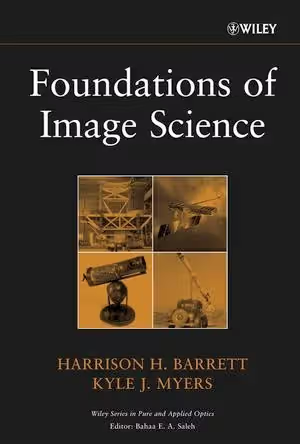
Barrett, H. H., & Myers, K. J. (2003). Foundations of Image Science. Wiley.
Chapter Summary
The book is a very large graduate treatment of the mathematics, physics and statistics needed to describe imaging systems and to judge the images they produce. It has nineteen chapters, an epilogue ("Frontiers in Image Science") and three appendices (matrix algebra, complex variables and probability), and runs to more than 1,500 pages. The publisher describes four strands: mathematical foundations; image formation, with models and mechanisms; image quality, assessed objectively and by task; and applications with detailed case studies. The chapters below follow that order, and the publisher names the continuous-to-discrete (CD) model of digital imaging and the use of singular-value decomposition (SVD) as distinctive features. The book received the 2006 Joseph W. Goodman Book Writing Award.
Chapters 1–3: Vectors and Operators; The Dirac Delta and Other Generalized Functions; Fourier Analysis
The mathematical foundation begins with linear vector spaces and Hilbert space, types of operators (including continuous-to-discrete mappings), eigenanalysis, singular-value decomposition, the Moore-Penrose pseudoinverse and its use for linear equations, and reproducing-kernel Hilbert spaces. Chapter 2 treats the theory of distributions, the one-dimensional delta function, other generalized functions and multidimensional delta functions. Chapter 3 covers sines, cosines and complex exponentials, Fourier series, one- and multidimensional Fourier transforms, sampling theory and the discrete Fourier transform.
Chapters 4–6: Series Expansions and Integral Transforms; Mixed Representations; Group Theory
Chapter 4 covers expansions in orthogonal functions and classical integral transforms, including Fresnel and Radon transforms. Chapter 5, "Mixed Representations", takes up local spectral analysis, bilinear transforms and wavelets. Chapter 6 introduces group theory (basic concepts, subgroups, representations, finite and continuous groups, groups of operators on a Hilbert space), with a section on quantum mechanics and image science and one on functions and transforms on groups.
Chapters 7–8: Deterministic Descriptions of Imaging Systems; Stochastic Descriptions of Objects and Images
The imaging chapters begin by describing objects and images and then treating linear systems in three forms: continuous-to-continuous, continuous-to-discrete and discrete-to-discrete, plus nonlinear systems. Chapter 8 turns to randomness: random vectors and processes, normal random vectors and processes, and stochastic models for objects and for images.
Chapters 9–10: Diffraction Theory and Imaging; Energy Transport and Photons
Chapter 9 develops wave equations, plane and spherical waves, Green's functions, diffraction by a planar aperture and in the frequency domain, and the imaging of point and extended objects. Chapter 10 addresses electromagnetic energy flow and detection, radiometric quantities and units, and the Boltzmann transport equation and its use in imaging.
Chapters 11–12: Poisson Statistics and Photon Counting; Noise in Detectors
Chapter 11 covers Poisson random variables and vectors, random point processes, random amplification and the quantum mechanics of photon counting. Chapter 12 treats photon and shot noise in photodiodes, other noise mechanisms and X-ray and gamma-ray detectors.
Chapters 13–14: Statistical Decision Theory; Image Quality
Chapter 13 sets out the decision-theory background: basic concepts, classification tasks and estimation theory. Chapter 14 applies it to image quality, surveying approaches and covering human observers and model observers for classification tasks, estimation tasks and sources of images.
Chapter 15: Inverse Problems
Basic concepts of inverse problems, linear reconstruction operators, implicit estimates and iterative algorithms.
Chapters 16–19: Planar Imaging with X Rays and Gamma Rays; Emission Computed Tomography; Speckle; Imaging in Fourier Space
The application chapters work through specific systems. Chapter 16 covers digital radiography and planar nuclear medicine. Chapter 17 treats emission computed tomography through forward problems, inverse problems, and noise and image quality. Chapter 18 covers speckle in nonimaging and imaging systems, noise and image quality, point-scattering models and coherent ranging. Chapter 19 treats Fourier modulators and interferometers. The epilogue looks at frontiers in image science, and the appendices review matrix algebra, complex variables and probability.
Key Concepts
Chapters 1–6: Mathematical Foundations
- Continuous-to-discrete mapping: the operator that takes a continuous object to a finite set of measurements, the basis of the book's treatment of digital imaging.
- Singular-value decomposition and pseudoinverse: tools for analysing and inverting linear imaging operators.
- Generalized functions and Fourier analysis: delta functions, sampling theory and transforms.
- Mixed representations and groups: wavelets and group-theoretic methods.
Chapters 7–12: Image Formation
- Linear systems in three forms: continuous-to-continuous, continuous-to-discrete and discrete-to-discrete.
- Stochastic descriptions: random vectors and processes as models for objects and images.
- Diffraction and transport: wave and transport-theory descriptions of how energy reaches a detector.
- Poisson statistics and detector noise: photon counting and the noise of detectors.
Chapters 13–15: Image Quality
- Task-based assessment: image quality defined by how well an observer can perform a specified task.
- Human and model observers: two ways to measure performance on classification tasks.
- Inverse problems: reconstruction from measured data.
Chapters 16–19: Applications
- Case studies of specific systems: radiography, nuclear medicine, emission tomography, speckle and Fourier-space imaging.
Critical Analysis
Strengths
- Objective image quality. The publisher says the book emphasises meaningful, objective assessment of image quality and provides the tools for it; the contents bear this out with chapters on decision theory and a chapter on image quality built on human and model observers.
- A consistent mathematical framework. The continuous-to-discrete model and the SVD methods are introduced early and used in the imaging chapters, so the physics and the statistics rest on a common formalism.
- Self-contained preparation. The publisher notes that appendices cover the prerequisite material in matrix algebra, complex variables and probability theory, and that the book is meant to be accessible to graduate students and practitioners, and to well-motivated undergraduates.
- Recognised. The book received the 2006 Joseph W. Goodman Book Writing Award.
Limitations
- Very large and demanding. More than 1,500 pages with six chapters of mathematics before the first imaging chapter; the book is not a first course in medical imaging.
- Modality coverage is selective. The application chapters cover planar X-ray and gamma-ray imaging, emission tomography, speckle and Fourier-space imaging. The contents list shows no chapters devoted to X-ray CT, ultrasound or MRI as clinical modalities, so a reader will need a modality-based text for those.
- Date. The book is from 2003, so later developments in reconstruction and observer studies are outside it.
Where It Fits in the Course
In the medical imaging course, this is the graduate-level theoretical treatment. Medical Imaging: Essentials for Physicians is a conceptual introduction for those who will use images rather than build scanners, and Introduction to Medical Imaging by Smith and Webb and Fundamentals of Medical Imaging by Suetens are compact course texts that explain the physics and instrumentation of the main modalities. Medical Imaging Signals and Systems by Prince and Links presents the major modalities on a signals-and-systems framework and is a natural preparation for Barrett and Myers, and The Essential Physics of Medical Imaging is a comprehensive reference on the physics of diagnostic imaging.
Foundations of Image Science comes after those. It is the book to read when the question is how to model an imaging system rigorously, treat noise statistically and compare imaging systems by task performance.
How to Use This Book
The book is for graduate students and researchers in medical imaging, medical physics and optics who design, simulate or evaluate imaging systems and reconstruction methods, and for practitioners who must justify claims about system performance. Preparation in linear algebra, Fourier analysis and probability is needed; the appendices recap the matrix algebra, complex variables and probability.
A practical plan:
- Core path for image quality: Chapters 1 and 3 (operators and Fourier analysis), Chapters 7 and 8 (deterministic and stochastic descriptions), then Chapters 13 and 14 (decision theory and image quality).
- For reconstruction work: add the pseudoinverse and SVD sections of Chapter 1, Chapter 15 and Chapter 17.
- For detector and noise work: Chapters 10 to 12.
- Optional: Chapters 2, 4 to 6 as reference for distributions, expansions, wavelets and groups; Chapters 18 and 19 for coherent imaging.
Read the application chapters only after the relevant theory chapters, and use them to see how the tools work on concrete systems.