01 / Reading Guide
Reading Guide
Citation
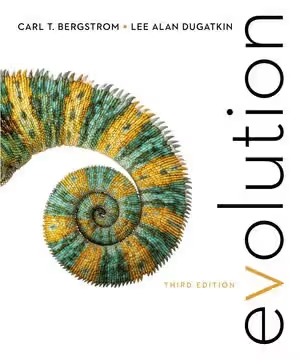
Bergstrom, C. T., & Dugatkin, L. A. (2023). Evolution (3rd ed.). W. W. Norton & Company.
Chapter Summary
The book has 20 chapters in four parts and about 780 pages. Its publisher describes the third edition as a current introduction that emphasizes data literacy, contemporary research and the effects of human activity on evolution, and as giving particular weight to phylogenetics and population genetics. The part and chapter titles below are the publisher's.
Part I: Foundations of Evolutionary Biology (Chapters 1–5)
The opening chapters are An Overview of Evolutionary Biology; Early Evolutionary Ideas and Darwin's Insight; Natural Selection; Phylogeny and Evolutionary History; and Inferring Phylogeny. They move from a general overview and the history of evolutionary thought to the central mechanism of natural selection, and then give two chapters to evolutionary trees: what a phylogeny records and how one is inferred.
Part II: Evolutionary Genetics (Chapters 6–10)
This part is the book's genetic core, in five chapters: Transmission Genetics and the Sources of Genetic Variation; The Genetics of Populations; Evolution in Finite Populations; Evolution at Multiple Loci; and Genome Evolution. The sequence runs from inheritance and variation within individuals, through allele-frequency change in populations and the role of population size, to several genes at once and finally whole genomes.
Part III: The History of Life (Chapters 11–15)
The chapters are The Origin and Evolution of Early Life; Major Transitions; Evolution and Development; Species and Speciation; and Extinction and Evolutionary Trends. They turn from mechanism to pattern: early life, the major transitions in biological organization, the relation between development and evolution, the formation of species, and extinction.
Part IV: Evolutionary Interactions (Chapters 16–20)
The last part covers Sex and Sexual Selection; The Evolution of Sociality; Coevolution; Human Evolution; and Evolution and Medicine. The first three concern interactions among individuals and species; the last two apply the earlier material to humans and to health.
Key Concepts
Part I: Chapters 1–5
- Natural selection: the subject of Chapter 3 and the mechanism the later parts build on.
- Phylogeny: the evolutionary history of lineages, the subject of Chapters 4 and 5.
- Inferring phylogeny: the methods for reconstructing trees from data, the subject of Chapter 5.
Part II: Chapters 6–10
- Sources of genetic variation: the starting point of Chapter 6, together with transmission genetics.
- Population genetics: the genetics of populations in Chapter 7.
- Finite populations: why population size matters for evolutionary change (Chapter 8).
- Multiple loci and genome evolution: Chapters 9 and 10.
Parts III and IV: Chapters 11–20
- Major transitions: large changes in the organization of life, the subject of Chapter 12.
- Speciation: the formation of species (Chapter 14).
- Sexual selection and coevolution: Chapters 16 and 18.
- Evolution and medicine: the closing application in Chapter 20.
Critical Analysis
Strengths
- Data literacy built into the text. The publisher says the third edition adds "Experimentation and Data" questions throughout the chapters, with the solutions biologists used explained in the text, plus end-of-chapter questions on interpreting data and experimental design. This helps readers who need practice reasoning from evidence.
- Figures designed for teaching. The authors report analyzing every figure for clarity, and the art program features phylogenetic trees, research-style data graphics and diagrams of experimental design.
- Clear division of labour in the structure. The four parts separate foundations, genetics, history and interactions, so a reader can find the population-genetics material in one place (Chapters 6–10) and the phylogenetic material in another (Chapters 4–5).
- Authors with relevant research. Bergstrom works with mathematical models of biological and social processes, including the spread of emerging infectious diseases, and Dugatkin studies the evolution of social behaviour and cooperation. Both specialisms match the content of Parts II and IV.
Limitations
- Size. At 20 chapters and roughly 780 pages, the book is more than a single course can cover, so most readers will pick parts.
- Genetics before history. The population-genetics chapters (Part II) precede the history of life (Part III), so a reader mainly interested in speciation, extinction or human evolution still has to decide how much of Part II to take on first.
- Digital features sit outside the book. The adaptive InQuizitive exercises and the nine animations are Norton digital products rather than part of the printed text.
Where It Fits in the Course
Bergstrom and Dugatkin is a full-length undergraduate textbook and is a natural main text for a first or second evolution course taken after introductory biology. Zimmer's The Tangled Bank is described as a richly illustrated introduction for readers meeting evolution for the first time and needing no mathematics beyond simple graphs, so it works as a gentler start or as a companion for the same topics. Charlesworth and Charlesworth's Evolution: A Very Short Introduction is a concise account of the evidence for common ancestry and the processes of change, suitable as a quick orientation.
Futuyma and Kirkpatrick's Evolution is described as a subject-focused account intended to deepen an introductory course and covering patterns from genomes to ecological communities, so it is the closest alternative as a main text and a reference to consult beside this book. Charlesworth and Charlesworth's Elements of Evolutionary Genetics develops the theory of mutation, selection, drift and recombination at graduate level and is the natural next step from Part II. Darwin's On the Origin of Species is the primary source behind Chapter 2.
How to Use This Book
The book is meant for undergraduates who have taken introductory biology, including basic Mendelian genetics. A practical plan:
- Core: Chapters 1 and 3 for the overview and natural selection; 4 and 5 for phylogeny; 6 to 8 for genetics and populations. These chapters supply the vocabulary the rest of the book uses.
- Next: Chapters 9 and 10 (multiple loci and genomes) and 14 (species and speciation) for a fuller course.
- Choose by interest: Chapters 11–13 and 15 for the history of life; 16–18 for sex, sociality and coevolution; 19–20 for human evolution and medicine. Chapter 2 can be read quickly if the history of ideas is covered elsewhere.
Work the "Experimentation and Data" questions as the chapters go, rather than saving them for review, and redraw any phylogeny encountered in the text from memory. Pair Chapters 6–8 with practice on small numerical examples of allele-frequency change.