01 / Reading Guide
Reading Guide
Citation
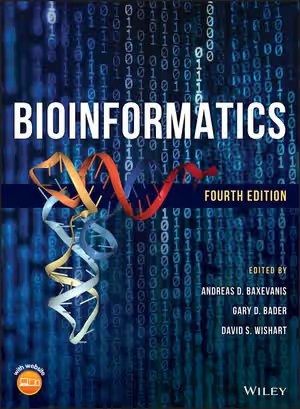
Baxevanis, A. D., Bader, G. D., & Wishart, D. S. (Eds.). (2020). Bioinformatics (4th ed.). Wiley.
Chapter Summary
The fourth edition is an edited volume of 18 chapters and about 656 pages, followed by appendices and a glossary. Each chapter is written by specialists in the area, and the editors themselves wrote several: Baxevanis the first three, Bader the networks chapter, Wishart the chapters on genome annotation, protein structure and metabolomics. The publisher lists four new chapters in this edition (metabolomics, population genetics, metagenomics and microbial community analysis, and translational bioinformatics) and a thorough treatment of statistical methods as applied to biological data.
Chapters 1–3: Biological Sequence Databases; Information Retrieval from Biological Databases; Assessing Pairwise Sequence Similarity: BLAST and FASTA
The opening trio sets up the data and the first analysis. Chapter 1 traces the history of sequence databases, from Dayhoff's printed Atlas of Protein Sequence and Structure through GenBank, EMBL and DDBJ and their shared exchange in the International Nucleotide Sequence Database Collaboration, to Swiss-Prot, TrEMBL and UniProt. It dissects a nucleotide flatfile record, introduces graphical interfaces and RefSeq, and describes protein sequence databases. Chapter 2 covers retrieval, including the Entrez system, and Chapter 3 pairwise similarity searching with BLAST and FASTA.
Chapters 4–5: Genome Browsers; Genome Annotation
Two chapters on working with whole genomes: genome browsers, and genome annotation.
Chapters 6–7: Predictive Methods Using RNA Sequences; Predictive Methods Using Protein Sequences
Predictive methods that start from sequence, first for RNA and then for protein.
Chapters 8–9: Multiple Sequence Alignments; Molecular Evolution and Phylogenetic Analysis
Aligning many sequences at once, and using alignments to study evolutionary relationships.
Chapters 10–11: Expression Analysis; Proteomics and Protein Identification by Mass Spectrometry
Measuring gene expression, and identifying proteins by mass spectrometry.
Chapters 12–13: Protein Structure Prediction and Analysis; Biological Networks and Pathways
Prediction and analysis of protein structure, then the representation and analysis of biological networks and pathways.
Chapters 14–17: Metabolomics; Population Genetics; Metagenomics and Microbial Community Analysis; Translational Bioinformatics
The four chapters that the publisher marks as new, spanning the chemical, population, community and clinical scales.
Chapter 18: Statistical Methods for Biologists
The closing chapter, by Hunter Moseley, treats statistics as applied to biological data. The book ends with appendices, a glossary and an index.
Key Concepts
Chapters 1–3: Databases and Searching
- INSDC: the collaboration through which DDBJ, EMBL's ENA and GenBank exchange nucleotide sequence records.
- Flatfile: the text format underlying database records, with FASTA as its simplest form.
- UniProt: the consortium resource that unites Swiss-Prot, TrEMBL and PIR.
- BLAST and FASTA: tools for finding similar sequences in a database.
Chapters 4–13: Genomes, Sequences, Structures and Networks
- Genome annotation: marking genes and other features on genome sequence.
- Multiple sequence alignment and phylogenetic analysis: comparing sequences to infer relationships.
- Protein identification by mass spectrometry: matching measured spectra to proteins.
- Biological networks and pathways: graph-based representations of interactions.
Chapters 14–18: Omics at Larger Scales and Statistics
- Metabolomics, metagenomics, translational bioinformatics: the new topics.
- Statistical methods for biologists: the closing chapter, relevant to expression analysis.
Critical Analysis
Strengths
- Specialist authorship. Each chapter is written by experts in its field, and the publisher describes the volume as giving students and professionals a comprehensive survey of the current field. Wiley prints praise for the third edition from Briefings in Bioinformatics, ChemBioChem, ASM News and The Quarterly Review of Biology; those remarks concern the previous edition, but the fourth keeps its format.
- Breadth of scale. The chapters run from sequence databases through genomes, proteins, expression, networks and metabolites to populations, microbial communities and clinical use.
- A practical orientation. The publisher describes practical instruction on gathering, analysing and interpreting data, together with explanations of the algorithms behind the tools. Chapter 1's tour of a database record, field by field, shows the hands-on style.
- Reference apparatus. The book includes annotated reference lists, lists of web resources, special topic boxes, appendices and an extensive glossary.
Limitations
- Uneven voice. Because the chapters have different authors, style and depth will vary; the book works better as a set of reference treatments than as a single continuous argument.
- Web resources change. Chapter 1 ends with lists of internet resources, and much of the book revolves around databases and web tools, which are revised more often than a print edition.
- Not a programming text. The contents list no chapter on programming or on implementing algorithms, so readers who want to write code should pair it with a more computational course book.
- Statistics comes last. The statistics chapter sits at the end, although it is relevant to earlier chapters such as expression analysis.
Where It Fits in the Course
Baxevanis, Bader and Wishart is the broad, tool-oriented reference among the bioinformatics books on this site. Arthur Lesk's Introduction to Bioinformatics is a gentler first book that explains databases, algorithms and methods in plain language without assuming programming; it suits a first course before this book. Compeau and Pevzner's Bioinformatics Algorithms takes a problem-driven, code-based route, in which each chapter starts from a biological question and develops the algorithm needed, so it complements Baxevanis' emphasis on using established tools.
Marketa Zvelebil and Jeremy Baum's Understanding Bioinformatics and Uri Alon's An Introduction to Systems Biology are more advanced and more quantitative, the latter focused on the design principles of biological circuits rather than sequence analysis. Baxevanis is the natural source for the database and annotation chapters and for the applied chapters on metagenomics and translational work.
How to Use This Book
The book assumes undergraduate molecular biology and genetics, basic statistics and comfort with web-based tools; programming helps but is not required. It suits advanced undergraduates, graduate students and working biologists.
A practical plan:
- Core: Chapters 1–3 (databases, retrieval and similarity searching), then Chapters 4–5 on genome browsers and annotation.
- By interest: Chapters 6–9 for sequence-based prediction and phylogenetics, Chapters 10–13 for expression, proteomics, structure and networks.
- Newer topics: Chapters 14–17 for metabolomics, population genetics, metagenomics and translational work.
- Statistics: read Chapter 18 early, alongside Chapter 10, even though it is printed last.
Practise each chapter's methods with the live databases and tools it names, and treat the glossary and annotated reference lists as the route to further reading.