01 / Reading Guide
Reading Guide
Citation
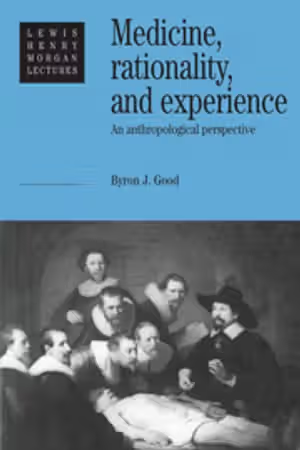
Good, B. J. (1994). Medicine, Rationality and Experience: An Anthropological Perspective (Lewis Henry Morgan Lectures 1990). Cambridge University Press.
Chapter Summary
The book consists of the Lewis Henry Morgan Lectures given at the University of Rochester in March 1990 and, as the preface says, substantially revised and expanded over the following two years. It has a foreword by Anthony T. Carter, a preface, seven chapters, notes, references and two indexes, in about 240 pages. The publisher's account is that biomedicine is often taken to give a scientific account of the body and illness, with non-Western and folk systems discounted as systems of "belief"; Good, drawing on research in several American and Middle Eastern medical settings, offers a critical anthropological account of medical knowledge and practice instead. The summaries follow the publicly visible chapter openings and the publisher's description.
Chapter 1: Medical anthropology and the problem of belief
The opening chapter begins from Lewis Henry Morgan, after whom the lectures are named, whose scholarship was linked to activism for the Seneca and whose work on kinship as an analytic domain posed conceptual problems that Good finds similar to those of medical anthropology. The chapter takes up the problem in its title: the habit of treating other peoples' medical knowledge as belief.
Chapter 2: Illness representations in medical anthropology: a reading of the field
This chapter reads the field of medical anthropology as it has represented illness. It opens with Marcus and Fischer's argument that a loss of faith in totalising theories has produced a "crisis in representation", and with the discipline's discomfort about past representations that now seem ethnocentric, colonial, gendered or racist. The concern with ethnographic representation frames the review of approaches that follows.
Chapter 3: How medicine constructs its objects
The chapter examines how medicine constructs its objects, drawing on the experience of medical students. It opens with a conversation among second-year Harvard medical students, one of whom describes medical school as a "forced emotional experience" that changes how she thinks, through the handling of cadavers and contact with patients.
Chapter 4: Semiotics and the study of medical reality
The chapter brings semiotic thought to the study of medical reality. It opens with Ernst Cassirer's view that symbolic forms are "organs of reality" that shape what people can apprehend as real.
Chapter 5: The body, illness experience, and the lifeworld: a phenomenological account of chronic pain
A phenomenological account of chronic pain, linking the body, illness experience and the lifeworld. The chapter opens with Karl Popper's "three worlds" distinction among physical states, states of consciousness and objective contents of thought.
Chapter 6: The narrative representation of illness
This chapter draws on research Good and his wife carried out in Turkey in 1988 within an epidemiological study of epilepsy, where people identified as having seizure disorders, and their families, were invited to tell stories of their illness: their seizures, search for treatment, community responses and the effects on their lives. The aim was anthropological case studies based on a community sample rather than a clinical one. The publisher says the chapter explores how illness narratives are joined with bodily experience in shaping and responding to suffering.
Chapter 7: Aesthetics, rationality, and medical anthropology
The final chapter looks ahead. Good recalls describing the book as a theory of culture and illness from the perspective of aesthetics, admits that the book hardly addresses aesthetics apart from literature on narrativity, and suggests that studies of narrative, storytelling and art may have more to offer comparative studies of illness and healing than is obvious. The publisher adds that moral and aesthetic considerations are present in routine medical practice as in other healing.
Key Concepts
Chapters 1–2
- The problem of belief: the tendency to treat non-Western and folk medicine as belief while biomedicine counts as knowledge.
- Crisis in representation: the discipline's worry about the adequacy and politics of its representations of others.
Chapters 3–5
- Construction of medical objects: how medicine, and medical training, produce the things it studies and treats.
- Symbolic forms as "organs of reality": the Cassirer idea that symbols shape what counts as real.
- Lifeworld and phenomenology of chronic pain: the experience of illness as lived by the body in a world of meaning.
Chapters 6–7
- Illness narratives: stories through which suffering and bodily experience are expressed and made sense of.
- Aesthetics and rationality in medicine: the moral and aesthetic dimensions of routine medical practice.
Critical Analysis
Strengths
- A clear central argument. The publisher presents the book as a challenge to the "belief" framing of non-Western medicine, with the argument that this obscures the kinship between biomedicine and other healing traditions and neglects aspects of Western medical practice.
- Biomedicine as a subject of anthropology. Chapter 3 examines medical students themselves, so the book turns the anthropological gaze on Western medicine, not only on "other" systems.
- Grounded in fieldwork. The narrative chapter is built on interviews in Turkey and the publisher refers to research in several American and Middle Eastern medical settings.
- Candid about its limits. In the last chapter Good acknowledges how little of the book addresses aesthetics, and presents it as a starting point for future work.
Limitations
- Demanding theoretical sources. Chapters open with Cassirer, Popper and a review of the field's debates about representation, so readers without some social theory may find the argument heavy.
- Programmatic ending. The final chapter points to future directions, on aesthetics in particular, that the book itself does not develop.
- Dated in its references. The lectures were given in 1990 and the book published in 1994, so it does not engage with later work on global health, biotechnology or digital medicine.
Where It Fits in the Course
In the medical anthropology course, Good's book is the most theoretically ambitious. Joralemon and Sundal's Exploring Medical Anthropology is a concise introduction that presents the main perspectives evenhandedly, and Wiley and Allen's Medical Anthropology: A Biocultural Approach is a textbook combining biology and culture; either is a good place to start before Good. Brown and Closser's Understanding and Applying Medical Anthropology is a course reader. Kleinman's The Illness Narratives draws on stories of patients with chronic illness and is the natural companion to Good's chapter on narrative. Lock and Nguyen's An Anthropology of Biomedicine is an advanced analysis of how medical technologies shape bodies and societies; its subject, biomedicine as a cultural and social object, overlaps with Good's Chapter 3.
A good order is an introduction first, then Kleinman for illness experience, then Good for the philosophical and theoretical framework, then Lock and Nguyen for more recent work.
How to Use This Book
The book is for upper-level undergraduates and graduate students in anthropology, and for students of medicine, nursing, psychology or public health interested in the meanings of illness. An introductory medical anthropology course is a sensible prerequisite, with some acquaintance with social theory.
Read the preface, then Chapters 1 and 2 for the argument and the review of the field. Chapter 3 is the most accessible entry point for medical readers. Chapters 4 and 5 are the theoretical core and are best read slowly, with attention to the semiotic and phenomenological sources they draw on. Chapter 6 on narrative can be read on its own and together with Kleinman. Chapter 7 is short and works as a conclusion. Useful exercises are to find an example of an explanation of illness described as "belief" and ask what Good's argument would change, and to write a short account of an illness narrative using the concepts of Chapter 6.