01 / Reading Guide
Reading Guide
Citation
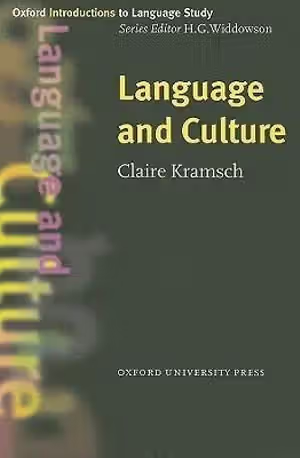
Kramsch, C. (1998). Language and Culture. Oxford University Press. (Oxford Introductions to Language Study, series editor H. G. Widdowson.)
Chapter Summary
The book is a very short introduction, x + 134 pages, in the Oxford Introductions to Language Study series. It is divided into four sections. Section 1, the survey, has seven short chapters running from page 3 to page 84; Section 2 (from page 85) is a set of readings; Section 3 (from page 115) holds references; Section 4 (from page 125) is a glossary. A reader review notes that the survey is followed by readings, references and a glossary, and later scholarship cites the book as a survey accompanied by selected readings, study questions and annotated references. The publisher presents it as an accessible survey of key concepts such as social context and cultural authenticity, drawing on linguistics, sociology and anthropology, written at a time when social and political changes had sharpened debate about the relation between language and culture. The terms most often used in the book, as listed in its Google Books record, include linguistic relativity and the Sapir–Whorf hypothesis, the linguistic sign, contextualisation cues, facework, conversational style, discourse community, literacy event, code-switching, language crossing, cultural identity, the native speaker, the spread of English and linguistic imperialism, with names such as Malinowski, Goffman, Gumperz, Tannen, Lakoff and Wierzbicka.
Chapter 1: The relationship of language and culture
The opening chapter, about twelve pages long, frames the question the whole book addresses, announced in its title: how language and culture are related. Its place at the head of the survey makes it the reference point for the chapters that follow.
Chapters 2–3: Meaning as sign; Meaning as action
Two chapters on meaning. The first treats meaning through the linguistic sign, the relation between words and what they refer to; the second treats meaning as something people do in interaction, the pragmatic side of language. Read together, the two titles suggest that cultural meaning is located both in what language represents and in how it is used.
Chapters 4–5: Spoken language, oral culture; Print language, literate culture
A matched pair contrasting speech and writing: the cultures associated with oral communication and with print literacy. Chapter 4, at about sixteen pages, is the longest chapter of the survey.
Chapter 6: Language and cultural identity
How language marks membership of social and cultural groups, and how identity is claimed and contested through it.
Chapter 7: Current issues
A short closing chapter (about six pages) on debates current when the book appeared; the publisher's description and the book's recurring terms point to cultural authenticity, the spread of English and linguistic imperialism among them.
Sections 2–4: Readings, References, Glossary
The remaining sections of the series format: extracts from other writers for close study, annotated references for further reading, and a glossary of terms. Together they take up about a third of the book.
Key Concepts
Chapters 1–3: Language, meaning and culture
- Language and culture: the relationship named in the title of Chapter 1 and of the book.
- Meaning as sign: meaning approached through the relation between linguistic signs and what they stand for.
- Meaning as action: meaning approached through what speakers do with language in context.
Chapters 4–7: Speech, writing, identity and debate
- Oral and literate culture: the different social worlds associated with spoken language and with print.
- Cultural identity: group membership as expressed and negotiated in language.
- Cultural authenticity: a key concept named by the publisher, central to debates about who owns a language and its culture.
Terms that recur across the survey
- Linguistic relativity (Sapir–Whorf hypothesis): the idea that the structure of a language influences the thought of its speakers.
- Discourse community: a group that shares ways of using language.
- Code-switching and language crossing: moving between languages or varieties, including into those of other groups.
- Linguistic imperialism: the dominance of one language, notably English, over others.
Critical Analysis
Strengths
- Brief and well organised. The seven survey chapters take about eighty pages, so the whole argument can be read in an evening, and the series format adds readings, references and a glossary for further study.
- Interdisciplinary. The publisher stresses that the book draws on linguistics, sociology and anthropology, and the recurring names, from Sapir, Whorf and Malinowski to Goffman, Gumperz and Tannen, show the range of traditions brought together.
- A clear conceptual sequence. The chapter titles move logically from meaning (sign, then action) to medium (speech, then print) to identity and current debate, which gives students a framework for organising the field.
- Built for further reading. The readings section lets students meet primary authors in their own words, and the references are annotated, according to later citations of the book.
Limitations
- Dense for its size. A reader comparing it with Bernard Spolsky's Sociolinguistics found Kramsch somewhat less accessible, though still a good introduction; another reader found the short chapters packed with concepts.
- Dated. The book dates from 1998. Digital communication and social media, and the research on them since, are outside its scope, and the debates of Chapter 7 have moved on.
- Applied-linguistics orientation. The book belongs to an Oxford series for language study that the publisher lists under English language teaching, and Google Books classes it under English as a second language as well as linguistics and anthropology. Students of linguistic anthropology will need fuller anthropological treatments of language as social action.
Where It Fits in the Course
In the linguistic anthropology list, Kramsch is the shortest introduction and a good first orientation to how language and culture relate. Laura Ahearn's Living Language is the fuller introductory textbook for the field, treating language as social action and organising it around concepts such as multifunctionality, language ideologies, practice and indexicality; James Stanlaw and Nobuko Adachi's Language, Culture, and Society is a comprehensive textbook covering structure, variation, change, identity and thought. Either is the natural main text, with Kramsch as a preliminary overview or a short review.
Alessandro Duranti's Linguistic Anthropology is a graduate-level textbook that defines the field as the study of language as a cultural resource and speaking as a cultural practice, and Asif Agha's Language and Social Relations is a theoretical monograph on how speakers use language to model social life, developing the concepts of register and enregisterment. Both go far beyond Kramsch's overview. Ahearn's Invitations to Love, an ethnography of love letters in Nepal, shows literacy, social change and identity, themes of Kramsch's Chapters 5–6, worked out in a single community.
How to Use This Book
The book requires no previous study of linguistics or anthropology. It suits first-year students in linguistics, anthropology, language teaching and intercultural communication, and anyone wanting a quick map of the field.
- Read the survey (Chapters 1–7) in one or two sittings to get the overall argument.
- Then work through Section 2: read each extract alongside the chapter it supports, using the study questions where they are given.
- Use the glossary as a running vocabulary list; key terms of the book such as linguistic relativity, discourse community and code-switching recur across the course.
- Use the references to choose readings for essays.
Treat the book as a starting map rather than a textbook: follow each chapter with the corresponding chapter of a fuller linguistic anthropology textbook, and bring Chapter 7's debates up to date with recent work on global English and digital communication.