01 / Reading Guide
Reading Guide
Citation
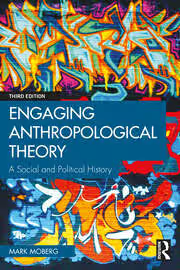
Moberg, M. (2025). Engaging Anthropological Theory: A Social and Political History (3rd ed.). Routledge.
Chapter Summary
The third edition has fifteen chapters, with lists of figures, tables and boxes, a reference list and an index; the publisher gives its length as 486 pages with 84 black-and-white illustrations. Its stated aim is to examine the historical context of anthropological ideas and the contested nature of anthropology itself. The chapter notes below stay close to the published titles and the publisher's description.
Chapters 1–2: Of politics and paradigms; Claims and critiques of anthropological knowledge
The two opening chapters frame the book. Their titles show an interest in the links between politics and paradigms, and in how anthropological claims to knowledge have been made and criticised. The publisher describes the book's premise as the idea that anthropological ideas about human diversity are rooted in historical conditions, including the West's relationship with colonized societies and the politics of scholarly inquiry itself.
Chapters 3–4: Anthropology before anthropologists; Theory and practice to change the world
Chapter 3 goes back to what came before the discipline, and Chapter 4, by its title, concerns the relation of theory and practice to efforts at changing the world. Together they set the intellectual and political background that the later schools respond to.
Chapters 5–6: Heirs to order and progress; Spencer, Darwin, and evolutionary tales for our time
These chapters cover the nineteenth-century setting named in their titles: ideas of order and progress, and the evolutionary thought associated with Spencer and Darwin. The phrase "evolutionary tales for our time" suggests a link to present-day uses of evolutionary ideas.
Chapters 7–8: The Boasian revolution; Culture and psychology
Chapter 7 deals with the Boasian turn in American anthropology, and Chapter 8 with the relationship between culture and psychology.
Chapters 9–10: Functionalism, the pure and the hyphenated; Anti-structure and the collapse of empire
Chapter 9 takes up functionalism in its pure and hybrid forms. Chapter 10, by its title, ties "anti-structure" to the collapse of empire, placing the theories of the decolonising period in their political setting.
Chapters 11–12: Evolution redux; Contemporary materialist and ecological approaches
The book returns to evolution in a later form in Chapter 11, and Chapter 12 surveys current materialist and ecological approaches.
Chapters 13–14: Symbols, structures, and the "web of significance"; Postmodern political economy and sensibilities
Chapter 13 addresses symbolic and structuralist approaches, including the interpretive tradition indicated by the phrase "web of significance". Chapter 14 covers political-economic work and postmodern sensibilities.
Chapter 15: The contemporary anthropological moment
The last chapter looks at the present state of the discipline. The publisher notes that this edition pays close attention to non-canonical figures and scholars of color whose contributions are often left out of disciplinary histories.
Key Concepts
Chapters 1–4
- Paradigms and politics: the book's organising idea that theoretical frameworks cannot be separated from the political settings in which they arise.
- Anthropological knowledge claims: the question of how claims about other societies are made and criticised.
Chapters 5–10
- Order and progress; evolutionary thought: the nineteenth-century ideas the early theories drew on.
- The Boasian revolution: the shift in American anthropology that Chapter 7 names.
- Functionalism: treated in "pure" and "hyphenated" forms.
Chapters 11–15
- Materialist and ecological approaches: the contemporary strand discussed in Chapter 12.
- Web of significance: the interpretive approach to culture as meaning.
- Postmodern political economy: the late twentieth-century turn discussed in Chapter 14.
Critical Analysis
Strengths
- Context as the organising principle. The publisher stresses that the book looks at the historical context of ideas, rather than reciting past viewpoints, and that it shows how they relate to society and history.
- Wider cast of figures. The third edition gives attention to non-canonical figures and scholars of color, which broadens a story that standard disciplinary histories often tell narrowly.
- Study aids. Each chapter has open-ended review questions meant to prompt discussion, and the book is illustrated throughout.
- Reader response to earlier editions. Reviewers quoted on the publisher's page for the previous editions (Julie Adkins, University of Texas at Arlington; William L. Alexander, University of North Carolina Wilmington) describe the style as engaging and the focus on the socio-political influences behind theories as distinctive.
Limitations
- Length. At nearly 500 pages the book is a full-length treatment, much longer than the concise histories of anthropological theory, and it demands more time.
- Organised by context, not by theorist. Chapters follow historical settings and paradigms rather than offering a school-by-school digest, so a reader after a quick reference to one theorist's ideas may find a compact survey more convenient.
Where It Fits in the Course
Within the anthropological theory course, Moberg's book is a full-length, context-driven history. Erickson and Murphy's A History of Anthropological Theory is a concise student history meant to be read with a companion volume of primary readings, and Eriksen and Nielsen's A History of Anthropology is a short, readable account linking each shift to its institutional and intellectual setting; either is a quicker first pass. The other three books are primary works or critique rather than histories: Geertz's The Interpretation of Cultures (interpretive anthropology and thick description), Bourdieu's Outline of a Theory of Practice (practice theory and habitus), and Marcus and Fischer's Anthropology as Cultural Critique (experimental writing and critique).
A good sequence is to use Moberg, or one of the shorter histories, to map the field, and then to read Geertz, Bourdieu and Marcus and Fischer with the corresponding chapters (13 and 14 in particular) at hand to see them placed in context.
How to Use This Book
The book is for upper-level undergraduates and beginning graduate students who have taken an introductory course in cultural or social anthropology. It does not require prior reading of the theorists. Read the first two chapters closely, since they set out the paradigm-and-politics framework for everything that follows. The remaining chapters run roughly in historical order and can be assigned one at a time alongside primary readings. Use the end-of-chapter review questions as seminar prompts or revision exercises. If time is short, combine a quick pass through the chronology with a closer reading of the chapters on your syllabus's key schools, and finish with Chapter 15 for the current debates.