01 / Reading Guide
Reading Guide
Citation
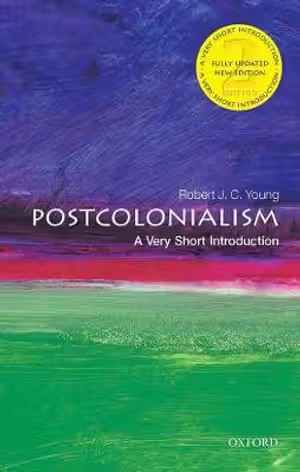
Young, R. J. C. (2020). Postcolonialism: A Very Short Introduction (2nd ed.). Oxford University Press.
Chapter Summary
The second edition is a small book in Oxford's Very Short Introductions series: about 174 numbered pages plus front matter, followed by references, further reading and an index. Oxford's page for the book states that the new edition includes updated material on race, slavery, decoloniality and the postcolonial politics of gender and sexualities. The contents show an opening section called "montage" and eleven chapters; only the titles and page positions are publicly listed, so the notes below stay close to those titles. Oxford's listing numbers the chapters; Chapter 1 is "Subaltern knowledges", Chapter 8 is on gender, queering and feminism, and Chapter 9 is on globalization, and the remaining chapters follow in the order of the page positions.
Introduction: Montage
An opening section of about a dozen pages, titled "montage", which precedes the numbered chapters and introduces the subject before the thematic chapters begin. Its content is not described publicly beyond the title.
Chapter 1: Subaltern knowledges
The first thematic chapter takes up knowledges associated with the subaltern, and so, judging by the title, starts from perspectives that stood outside dominant accounts.
Chapter 2: Colonialisms, decolonization, decoloniality
Names three related terms together. It is the chapter in which the vocabulary of colonial rule, its ending and the decolonial critique of its continuing effects is set out.
Chapter 3: Slavery, race, caste
Groups slavery, race and caste, three systems of hierarchy, in a single chapter, in line with the publisher's note that race and slavery were updated in this edition.
Chapter 4: History and power from below and above
Concerned with history and power, with the title pointing to accounts told both from the standpoint of the powerful and from that of the dominated.
Chapter 5: Nomads, nation-states, borders
Takes up mobility and settlement: nomadic peoples, the nation-state and the borders that divide territories.
Chapter 6: Hybridity
A chapter on hybridity, the concept of mixture and cultural blending that is a recognised term in postcolonial theory.
Chapter 7: The ambivalence of the veil
A chapter built around the veil. The title signals an account that treats it as carrying more than one meaning.
Chapter 8: Gender, queering, and feminism in a postcolonial context
Turns to gender and sexuality in postcolonial settings, the area the publisher identifies as updated in this edition.
Chapter 9: Globalization from a postcolonial perspective
Looks at globalization as seen through postcolonial thinking.
Chapters 10–11: Ecology and indigeneity; Translation
The closing chapters take up ecology and indigeneity, then translation: environmental and indigenous questions, and the question of moving meaning between languages and cultures, going by the titles.
Key Concepts
Introduction and Chapters 1–4
- Subaltern knowledges: knowledge held by groups outside the dominant order (Chapter 1).
- Decolonization and decoloniality: the ending of colonial rule and the critique of its continuing structures (Chapter 2).
- Slavery, race and caste: forms of social hierarchy treated together (Chapter 3).
- History from below and above: the standpoints from which history and power are told (Chapter 4).
Chapters 5–9
- Nation-states and borders: territorial organisation as seen alongside nomadism (Chapter 5).
- Hybridity: cultural mixture (Chapter 6).
- The veil: its ambivalence as a subject of analysis (Chapter 7).
- Queering and feminism: gender and sexual politics in postcolonial contexts (Chapter 8).
- Globalization: viewed from a postcolonial position (Chapter 9).
Chapters 10–11
- Ecology and indigeneity: environmental and indigenous questions.
- Translation: moving meaning across languages and cultures.
Critical Analysis
Strengths
- Short, thematic structure. Eleven chapters of roughly ten to twenty pages each make the book easy to enter and to dip into by theme, rather than by a single historical sequence.
- Updated edition. The publisher says the second edition adds material on race, slavery, decoloniality and gender and sexualities, reflecting how the field has broadened.
- Wide span of topics. The contents move from knowledge and history to borders, hybridity, the veil, gender, globalization, ecology and translation, giving a broad map of the field in under two hundred pages.
- Senior author. The book is by Robert J. C. Young, a literary and cultural theorist, and sits in a series designed as brief introductions for newcomers to a subject.
Limitations
- Brevity. A book of this length can only give a map of each theme; readers who want sustained argument on any one topic, such as subaltern studies or decoloniality, need the longer works.
- Little visible detail. Only chapter titles are public. Whether a chapter relies on case studies, particular authors or regions cannot be established from the publisher's page.
Where It Fits in the Course
In the postcolonial and decolonial course, this is the broadest and shortest introduction. Frantz Fanon's Black Skin, White Masks is a primary text on the psychological effects of colonialism on Black people in white-dominated societies, and can be read alongside Chapters 2–3. Gurminder K. Bhambra and John Holmwood's Colonialism and Modern Social Theory rereads the classical canon of social theory in light of colonialism and empire, and is the natural sociological next step; Bhambra's Rethinking Modernity extends this argument about how colonial histories shape modernity.
Linda Tuhiwai Smith's Decolonizing Methodologies turns to research and Indigenous peoples and proposes decolonized research approaches, which connects with the book's closing chapter on ecology and indigeneity. Folúkẹ́ Adébísí's Decolonisation and Legal Knowledge and Faye V. Harrison's edited Decolonizing Anthropology apply decolonial thinking to law and anthropology, and suit readers who have a discipline in mind after this overview.
How to Use This Book
No previous reading in postcolonial or decolonial theory is assumed. The book suits first-year undergraduates, readers from other disciplines and general readers who want an overview of the field.
A practical plan:
- Start with the introduction and Chapter 2. Together they establish the vocabulary of colonialism, decolonization and decoloniality used elsewhere.
- Read thematically. Each chapter is separate enough to be read alone: Chapters 3–5 for slavery, race, history and borders; Chapters 6–8 for hybridity, the veil and gender; Chapters 9–11 for globalization, ecology and translation.
- Use the further reading. The book ends with references and a further reading section; these are the route to primary texts and to the longer works in the course.
- Check the edition. The second edition (2020) replaces earlier versions, and the publisher lists the updated topics (race, slavery, decoloniality, gender and sexualities) as new to it.