01 / Reading Guide
Reading Guide
Citation
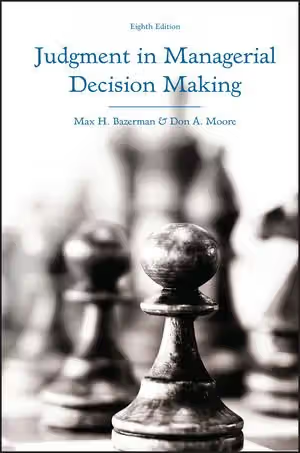
Bazerman, M. H., & Moore, D. A. (2012). Judgment in Managerial Decision Making (8th ed.). Wiley.
Chapter Summary
The eighth edition is a compact book of twelve chapters (288 pages in Wiley's listing, with the main text ending at page 230 before the references). It moves from the foundations of judgment (Chapters 1–4) through choice, motivation and commitment (Chapters 5–8) to three applied domains, investing and negotiation (Chapters 9–11), and closes with strategies for better decisions (Chapter 12). Wiley states that this edition adds new discussion of "blind spots", overconfidence and ethical decision making, and new material on recent controversies in the field.
Chapter 1: Introduction to Managerial Decision Making
The opening chapter sets out the anatomy of a decision, introduces the distinction between System 1 and System 2 thinking, discusses the bounds of human attention and rationality, and introduces judgmental heuristics before outlining the rest of the book.
Chapter 2: Overconfidence
Overconfidence comes early and is presented as "the mother of all biases". The chapter separates three forms, overprecision, overestimation and overplacement, and ends with a section in favour of well-calibrated decision making.
Chapter 3: Common Biases
The longest chapter in the first part groups common biases by the heuristic that produces them: the availability heuristic, the representativeness heuristic and the confirmation heuristic, followed by an integration and commentary.
Chapter 4: Bounded Awareness
The chapter turns from how information is processed to which information is noticed at all. Its sections cover inattentional blindness, change blindness, focalism and the focusing illusion, and bounded awareness in groups and in strategic settings.
Chapter 5: Framing and the Reversal of Preferences
A chapter on how the description of a choice changes the choice: the irrationality of the sum of choices, preference for certainty and pseudocertainty, the overselling of insurance, valuation and the value placed on what one owns, mental accounting, rebate and bonus framing, and preference reversals between joint and separate evaluation.
Chapter 6: Motivational and Emotional Influences on Decision Making
The chapter covers conflicts between emotion and cognition, self-serving reasoning, and other emotional influences on decisions.
Chapter 7: The Escalation of Commitment
Escalation is examined in two paradigms, unilateral and competitive, followed by a section on why escalation occurs.
Chapter 8: Fairness and Ethics in Decision Making
The first half deals with perceptions of fairness, including resistance to "unfair" ultimatums and concern for others' outcomes, and why fairness judgments matter. The second half develops the idea of bounded ethicality through overclaiming credit, in-group favouritism, implicit attitudes, indirectly unethical behaviour, sacred values and the psychology of conflicts of interest.
Chapter 9: Common Investment Mistakes
A short applied chapter on the psychology of poor investment decisions and active trading, ending with action steps for investors.
Chapters 10–11: Making Rational Decisions in Negotiations; Negotiator Cognition
Chapter 10 presents a decision-analytic approach to negotiation, distinguishing claiming value from creating value and setting out the tools of value creation, and ends with a summary and critique. Chapter 11 applies the earlier biases to negotiators: the mythical fixed pie, framing, escalation of conflict, overestimating one's own value, self-serving biases and anchoring.
Chapter 12: Improving Decision Making
The final chapter is organised as seven strategies: use decision-analysis tools, acquire expertise, debias judgment, reason analogically, take an outsider's view, understand biases in others, and nudge wiser and more ethical decisions.
Key Concepts
Chapters 1–4: Foundations of judgment
- System 1 and System 2: fast, intuitive thinking contrasted with slower, deliberate reasoning.
- Overprecision, overestimation, overplacement: three distinct forms of overconfidence: excessive certainty in one's beliefs, overrating one's own ability or performance, and believing oneself better than others.
- Availability, representativeness, confirmation: the three heuristics under which the book groups common biases.
- Bounded awareness: systematic failure to notice relevant information, as in inattentional and change blindness or the focusing illusion.
Chapters 5–8: Choice, motivation and ethics
- Framing and preference reversals: choices that change with how options are described or whether they are evaluated jointly or separately.
- Mental accounting: treating money differently according to the mental category it is placed in.
- Escalation of commitment: continuing to invest in a failing course of action, studied in unilateral and competitive forms.
- Bounded ethicality: unethical behaviour that arises without conscious intent, for example through overclaiming credit, in-group favouritism or conflicts of interest.
Chapters 9–12: Applications and improvement
- Claiming versus creating value: the decision-analytic distinction between dividing a fixed outcome and enlarging it in negotiation.
- Mythical fixed pie: the assumption that one side's gain must be the other's loss.
- Outsider's view: judging a case by the base rates of similar cases rather than by its particulars.
- Nudging: designing choices so that wiser and more ethical decisions become more likely.
Critical Analysis
Strengths
- Compact and well ordered. In about 230 pages of text the book covers the main findings of behavioural decision research and arranges them so that the applied chapters can reuse earlier ideas: the escalation chapter feeds the section on escalation of conflict in negotiation, and the framing material of Chapter 5 returns in Chapter 11's section on the framing of negotiator judgment.
- Strong treatment of overconfidence. Chapter 2 separates overprecision, overestimation and overplacement rather than treating overconfidence as a single bias, and closes with a section in favour of well-calibrated judgment.
- Ethics as a judgment problem. Chapter 8 treats ethical failures as products of the same bounded cognition as other errors (bounded ethicality, implicit attitudes, conflicts of interest) rather than only as failures of character. Wiley identifies ethical decision making as one of the areas expanded in this edition.
- Practical orientation. Wiley describes hands-on exercises and examples derived from the authors' executive teaching, and the book ends with seven named improvement strategies instead of a list of biases alone.
Limitations
- Dated edition. The eighth edition was published in late 2012. Research on decision making since then, including the later debate about which findings replicate, is not covered beyond what Wiley calls the "recent controversies" of that time.
- Brief applied chapters. The investment chapter is about fifteen pages, and the two negotiation chapters together about thirty; they are introductions rather than full treatments.
- One research tradition at the centre. The chapter plan is organised around biases and their correction. Readers who want the argument that simple heuristics can be well adapted to their environments need to look elsewhere for it.
- Managerial framing. Examples are drawn from organisational contexts by design; students of psychology looking for experimental detail or theory may find the treatment of individual studies short.
Where It Fits in the Course
Within the judgment and decision-making course, this is the applied, organisation-focused textbook. Reid Hastie and Robyn Dawes's Rational Choice in an Uncertain World is a gentler introduction to the same field that compares intuitive judgment with rational standards, and can be read first or in parallel. Jonathan Evans's Thinking and Reasoning: A Very Short Introduction gives a short overview of reasoning and dual-process theories that matches the System 1 and System 2 material in Chapter 1. Daniel Kahneman's Thinking, Fast and Slow is the general-audience account of the heuristics-and-biases programme on which Chapters 1–5 draw; reading it alongside Bazerman and Moore supplies the narrative behind many of the findings.
Jonathan Baron's Thinking and Deciding is a broader and more theoretical text built around normative, descriptive and prescriptive models; it is the natural next step for readers who want the philosophical and mathematical foundations that this book keeps brief. Gerd Gigerenzer, Peter Todd and the ABC Research Group's Simple Heuristics That Make Us Smart argues that fast and frugal heuristics can perform well in the right environments, a useful counterweight to the bias-focused framing of Chapters 3–5. Thaler and Sunstein's Nudge expands the idea behind Chapter 12's final strategy into a full account of choice architecture.
How to Use This Book
The book assumes no formal background: general reading ability and a basic sense of probability are enough for the early chapters. It suits business and management students, psychology students taking an applied decision-making module, and professionals who want an organised overview of the biases that affect judgment.
A practical plan:
- Core (read in order): Chapters 1–5. These provide the vocabulary (heuristics, overconfidence, bounded awareness, framing) that the rest of the book uses.
- Second block: Chapters 6–8 on motivation, escalation and ethics. Chapter 8 can stand alone for a session on organisational ethics.
- Applications, by interest: Chapter 9 for finance students; Chapters 10–11 as a pair for negotiation. Read Chapter 10 before Chapter 11, since the second applies the first's framework.
- Finish with Chapter 12, and return to the earlier chapter that matches each strategy (for example, the outsider's view with the base-rate material in Chapter 3).
Work through the problems and exercises when they appear rather than skipping ahead to the explanation: much of the value of this kind of book lies in noticing one's own answers before learning where they go wrong. Keep a short decision journal while reading, noting one real decision per chapter and which bias or strategy applies to it. Because the edition dates from 2012, check whether any study that matters for an essay has been replicated or revised since.