01 / Reading Guide
Reading Guide
Citation
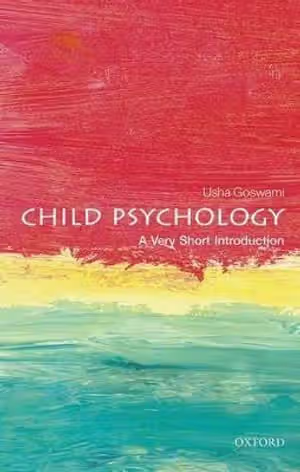
Goswami, U. (2014). Child Psychology: A Very Short Introduction. Oxford University Press.
Chapter Summary
The book is a short Oxford "Very Short Introduction" of about 144 pages: an introduction followed by seven numbered chapters. The publisher describes it as tracing child psychology from birth to early adolescence, with attachment, early learning and language, relationships, schooling and theory as its main threads. The chapter summaries below follow the publisher's chapter abstracts.
Introduction
Surveys recent developments in the field, including brain imaging and genetics and research on cognitive and social-emotional development, and argues that the two kinds of development are closely linked. A recurring point is that the child is an active learner and that stable, responsive, language-rich environments give the developing brain its best chance.
Chapter 1: Babies and what they know
Covers development before birth and in the first stage of childhood, with interaction as the central theme. Babies learn from facial cues and the sound of language, and the chapter links an early interest in faces and eyes to language acquisition. Studies of imitation, joint attention and socio-moral expectations show psychological understanding emerging early.
Chapter 2: Learning about the outside world
Takes up the nature versus nurture debate by asking how infants and toddlers learn about their world. Babies' observations are organised into kinds of knowledge: "naive psychology" (how people behave), "naive physics" (how objects work) and "naive biology" (the natural world). The chapter also notes that memory and attention function from an early age.
Chapter 3: Learning language
Looks at how babies and toddlers acquire language: infant-directed speech ("Parentese"), sound cues and gesture. It asks why a growth spurt in word learning appears around 18 months, why language development looks similar across cultures, and how conceptual expectations help children learn words quickly.
Chapter 4: Friendships, families, pretend play, and the imagination
Examines how the people around a child, and imaginative games, shape cognitive and social-emotional development. Research on siblings (including the role of sibling disputes), the effect of parents' handling of their own emotions, and pretend play as a window onto the development of mental states are the main topics.
Chapter 5: Learning and remembering, reading and number
Moves to the school years and children's growing knowledge of their own thinking (metacognition). It distinguishes semantic, episodic and implicit or procedural memory, and then asks how children learn to read and write and how early they think in terms of number.
Chapter 6: The learning brain
Considers how personal experience affects logical reasoning and how children learn to detach logic from their own experience. Schooling is presented as helping children become reflective learners, and executive function is introduced as the strategic control of one's own mental processes, with links to success in school.
Chapter 7: Theories and neurobiology of development
Defines what a theory is and uses Piaget (growth of logical thinking) and Vygotsky (culture and language) to show how theory has shaped understanding of development. The chapter then turns to neurobiology, brain imaging and genetics, while arguing that neuroscience will not replace psychological-level understanding.
Key Concepts
Introduction and Chapters 1–3
- Active learner: the view that children contribute to their own development rather than absorbing input passively.
- Joint attention and imitation: early social behaviours that studies use to show infants' emerging psychological understanding.
- Naive psychology, physics and biology: the three kinds of everyday knowledge into which babies' observations are organised.
- Infant-directed speech: the speech style adults use with babies, studied as a support for language learning.
Chapters 4–7
- Pretend play: a way of observing how children come to understand mental states.
- Semantic, episodic and implicit memory: the three memory categories used in the chapter on learning in school.
- Metacognition and executive function: children's knowledge of their own thinking and their control over mental processes.
- Piaget and Vygotsky: the two theorists used to illustrate classical theories of development.
Critical Analysis
Strengths
- Compact and organised by developmental questions. The seven chapters follow children from before birth through infancy, language, family and play, and school learning, ending with theory. A reader can finish it in a few sittings.
- Links behaviour to the brain without overclaiming. The introduction and final chapter place brain imaging and genetics alongside behavioural research, and the closing chapter states that neuroscience cannot replace understanding at the psychological level.
- Attention to learning environments. Language exposure, siblings, parental emotion handling and pretend play are treated as parts of the story, so the book is as much about the settings children grow up in as about milestones.
Limitations
- Brief by design. At roughly 144 pages the book surveys rather than reviews; it has no chapter dedicated to clinical or atypical development or to adolescence, even though the publisher's description mentions the adolescent years.
- Theory comes last. Piaget and Vygotsky appear only in the final chapter, so readers wanting a theory-first treatment, or a systematic comparison of developmental theories, need another book.
Where It Fits in the Course
This is the gentlest entry point among the developmental psychology books listed: a short, readable overview for someone with no background. The full-length textbooks, such as Shaffer and Kipp's Developmental Psychology: Childhood and Adolescence and Siegler, Saffran and Gershoff's How Children Develop, cover the same ground at much greater length and are the usual next step for a course. The OpenStax Lifespan Development is a free introduction that continues past childhood to the end of life, so it suits readers who want the whole life course.
For theory, Patricia Miller's Theories of Developmental Psychology is a critical survey of the major frameworks, and it expands what Chapter 7 can only sketch. Erikson's Childhood and Society and Piaget's The Origin of Intelligence in the Child are classic primary works, best read after a general introduction like this one.
How to Use This Book
The book assumes no psychology background and is suited to first-year students, teachers, parents and general readers. Reading it straight through in order is sensible, since the chapters follow the child's age and later chapters build on earlier ones.
A practical plan: read the Introduction and Chapters 1–3 first for the core account of infant knowledge and language; then Chapters 4–6 for social context and school learning; and Chapter 7 last, using it as a bridge to a fuller textbook. When a topic grabs attention (language, memory, executive function), follow it into a longer text. Readers using it alongside a course should treat it as an orientation rather than a source for detailed findings.