01 / Reading Guide
Reading Guide
Citation
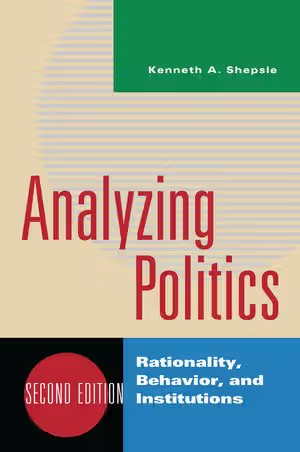
Shepsle, K. A. (2010). Analyzing Politics: Rationality, Behavior, and Institutions (2nd ed.). W. W. Norton & Company.
Chapter Summary
The book runs to about 550 pages in seventeen chapters grouped into four parts. Its aim, in the publisher's words, is to make the fundamentals of rational-choice theory accessible to undergraduates in clear, nontechnical language, using case studies, illustrations and examples to show how to analyze a wide variety of political situations. The second edition adds updated cases and examples, new problem sets and discussion questions, and "Experimental Corner" sections at the end of many chapters that describe experiments from the social science literature.
Part I: Introduction (Chapters 1–2)
Chapter 1, "It Isn't Rocket Science, but...", sets out the project and the style of reasoning the book teaches. Chapter 2, "Rationality: The Model of Choice", introduces the model of individual choice on which everything else is built.
Part II: Group Choice (Chapters 3–7)
These five chapters move from individuals to groups: "Getting Started with Group Choice Analysis"; "Group Choice and Majority Rule"; "Spatial Models of Majority Rule"; "Strategic Behavior: Sophistication, Misrepresentation, and Manipulation"; and "Voting Methods and Electoral Systems". Together they examine how individual preferences are combined by voting rules, what majority rule does in a spatial setting, and how participants behave strategically within such procedures.
Part III: Cooperation, Collective Action, and Public Goods (Chapters 8–10)
Chapter 8, "Cooperation", Chapter 9, "Collective Action", and Chapter 10, "Public Goods, Externalities, and the Commons" take up cooperation, collective action, and then public goods, externalities and the commons, moving from the general problem of joint action to specific cases.
Part IV: Institutions (Chapters 11–17)
The last part turns to institutions. Chapter 11, "Institutions: General Remarks", sets the frame. The next chapters take particular settings in turn: "Legislatures", "Bureaucracy and Intergovernmental Relations", "Leadership", "Courts and Judges", and "Cabinet Government and Parliamentary Democracy". Chapter 17, "Final Lessons", closes the book.
Key Concepts
Part I: Rationality
- Rational choice: the model of an individual who chooses among options in line with consistent preferences, the starting point of Chapter 2.
Part II: Group Choice
- Majority rule: the group decision rule examined in Chapters 4 and 5, including its spatial representation.
- Strategic behavior: the sophistication, misrepresentation and manipulation that Chapter 6 treats as part of group choice.
- Voting methods and electoral systems: the procedures by which preferences are turned into collective outcomes, the subject of Chapter 7.
Part III: Cooperation and Collective Action
- Cooperation and collective action: the topics of Chapters 8 and 9, which extend the analysis from choosing within a group to acting together.
- Public goods, externalities and the commons: the subjects of Chapter 10, which follows the general discussion of cooperation and collective action.
Part IV: Institutions
- Institutions: the rules and arrangements, treated in general in Chapter 11 and then in legislatures, bureaucracy, leadership, courts and cabinet government.
Critical Analysis
Strengths
- Written for non-specialists. Norton presents the book as a way into rational-choice theory in clear, nontechnical language, built on case studies, illustrations and examples rather than on formal mathematics.
- A sequence that builds. The four parts move from the individual to the group, from group choice to cooperation, and finally to institutions, so each part supplies tools for the next.
- Breadth across institutions. Part IV covers legislatures, bureaucracy and intergovernmental relations, leadership, courts and judges, and cabinet government and parliamentary democracy, so the same method is shown at work well beyond the American Congress.
- Support for active learning. The second edition provides problem sets and discussion questions, and its Experimental Corner sections link the theory to experimental evidence.
Limitations
- A single approach. The book teaches one way of studying politics, rational choice and formal theory. Readers who want to compare approaches, or learn how to design and test a study, will need other books.
- Length. At about 550 pages the book is long for a nontechnical introduction, and a course will usually select among its parts.
- Not a methods text in the usual sense. Despite its place in a research-methods group, the table of contents shows a book about theory and models of politics, with no chapters on data collection, measurement or statistical inference.
Where It Fits in the Course
Most of the other books in this course teach how to do research. Kellstedt and Whitten's The Fundamentals of Political Science Research moves from causal theories and research design to descriptive statistics, hypothesis testing and regression. Shively and Endersby's The Craft of Political Research is a short, nontechnical introduction to design and analysis. Halperin and Heath's Political Research: Methods and Practical Skills covers the philosophy of social science, project design and the practical collection and analysis of data. King, Keohane and Verba's Designing Social Inquiry and Gerring's Social Science Methodology are more demanding treatments of inference and standards for qualitative and quantitative work.
Shepsle's book supplies something different: an introduction to the formal theory of politics. It is the book to read for how models of choice, voting and institutions are built and what they predict, and it pairs well with a research-design text such as Kellstedt and Whitten's, which also starts from theory. It is also a useful companion to Mayhew's Congress: The Electoral Connection and Aldrich's Why Parties?, which apply a rational-choice logic to American politics.
How to Use This Book
The book is aimed at undergraduates and at anyone who wants to learn the rational-choice approach without a mathematical background. Comfort with simple algebraic notation and patience with abstract reasoning are the main requirements.
A practical plan:
- Core: Read Parts I and II first. Chapters 2 through 5 give the basic model of choice and majority rule on which the rest depends.
- Selective: Choose among Chapters 6 and 7 (strategy and electoral systems) and Part III (cooperation and collective action) according to your interest. Part III is a natural preparation for the commons and collective-action literature.
- Application: Read the institutional chapters in Part IV that match your field, such as Chapter 12 for legislatures or Chapter 15 for courts, and Chapter 17 to see the lessons gathered.
- Practice: Work the problem sets and discussion questions, and read the Experimental Corner sections to see how the models fare against evidence.