01 / Reading Guide
Reading Guide
Citation
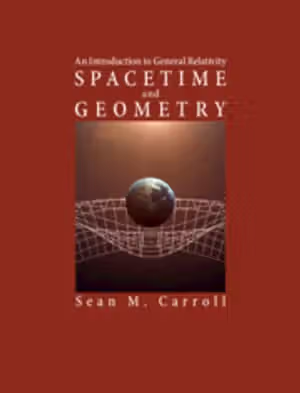
Carroll, S. M. (2019). Spacetime and Geometry: An Introduction to General Relativity. Cambridge University Press.
Chapter Summary
The book has nine chapters and ten appendices (A to J) in about 500 pages, with exercises at the end of Chapters 1 to 8. The preface gives the structure: Chapter 1 reviews special relativity and tensor algebra, Chapters 2 and 3 build the mathematics of manifolds and curvature, Chapter 4 introduces general relativity itself, Chapters 5 to 8 treat three major applications (black holes in two chapters, perturbation theory and gravitational waves, cosmology), and Chapter 9 is a brief introduction to quantum field theory in curved spacetime.
Chapter 1: Special Relativity and Flat Spacetime
A prelude, then space and time separately and together, Lorentz transformations, vectors, dual vectors (one-forms), tensors and how to manipulate them, Maxwell's equations, energy and momentum, and classical field theory. The preface says the purpose is to review the basics and introduce notation, not to give a self-contained introduction to special relativity.
Chapter 2: Manifolds
Starts from gravity as geometry and asks what a manifold is. It then revisits vectors and tensors on manifolds, introduces the metric, uses an expanding universe as an example, and covers causality, tensor densities, differential forms and integration.
Chapter 3: Curvature
An overview, covariant derivatives, parallel transport and geodesics, properties of geodesics, and a first return to the expanding universe. The chapter then defines the Riemann curvature tensor and its properties, symmetries and Killing vectors, maximally symmetric spaces, and geodesic deviation.
Chapter 4: Gravitation
Physics in curved spacetime, Einstein's equation, its Lagrangian formulation and its properties, the cosmological constant, energy conditions, the equivalence principle revisited, and alternative theories. The preface identifies this as the chapter where general relativity proper is introduced.
Chapter 5: The Schwarzschild Solution
The Schwarzschild metric, Birkhoff's theorem, singularities, geodesics, experimental tests, Schwarzschild black holes, the maximally extended Schwarzschild solution, and stars and black holes.
Chapter 6: More General Black Holes
The black hole "zoo", event horizons, Killing horizons, mass, charge and spin, charged (Reissner–Nordström) and rotating (Kerr) black holes, and the Penrose process and black-hole thermodynamics.
Chapter 7: Perturbation Theory and Gravitational Radiation
Linearized gravity and gauge transformations, degrees of freedom, Newtonian fields and photon trajectories, gravitational-wave solutions, the production of gravitational waves, energy loss due to gravitational radiation, and the detection of gravitational waves.
Chapter 8: Cosmology
Maximally symmetric universes, Robertson–Walker metrics, the Friedmann equation, the evolution of the scale factor, redshifts and distances, gravitational lensing, our universe, and inflation.
Chapter 9: Quantum Field Theory in Curved Spacetime
An introduction, a review of quantum mechanics, quantum field theory in flat and then in curved spacetime, the Unruh effect, and the Hawking effect and black hole evaporation. The preface says this chapter is not a necessary part of a first look at general relativity.
Appendices A–J
Maps between manifolds, diffeomorphisms and Lie derivatives, submanifolds, hypersurfaces, Stokes's theorem, geodesic congruences, conformal transformations, conformal diagrams, the parallel propagator, and noncoordinate bases.
Key Concepts
Chapters 1–3: Mathematical framework
- Tensors and one-forms: the objects in which relativity is formulated, introduced first in flat spacetime.
- Manifold and metric: the geometric setting in which gravity is described.
- Geodesics and parallel transport: how freely falling matter moves.
- Riemann curvature tensor: the measure of curvature, with Killing vectors expressing symmetry.
Chapter 4: Gravitation
- Einstein's equation: how matter curves spacetime, with a Lagrangian formulation.
- Energy conditions: restrictions on the matter that sources gravity.
- Equivalence principle: revisited after the geometric machinery is in place.
Chapters 5–6: Black holes
- Schwarzschild solution and Birkhoff's theorem: the spherically symmetric vacuum.
- Event horizon: the boundary of a black hole, treated generally via Killing horizons.
- Kerr and Reissner–Nordström solutions: rotating and charged black holes.
Chapters 7–9: Waves, cosmology and quantum effects
- Linearized gravity: the weak-field route to gravitational waves.
- Friedmann equation: dynamics of Robertson–Walker universes.
- Hawking effect: black hole evaporation from quantum fields in curved spacetime.
Critical Analysis
Strengths
- A stated pedagogical purpose. The preface describes the book's single purpose as teaching general relativity clearly to graduate students or advanced undergraduates, with enough material for a one-semester introductory course and an explicit decision not to be a comprehensive reference.
- Conventional presentation. The preface says the author preferred the conventional over the idiosyncratic, with the one bias being a field-theory point of view that connects general relativity with particle physics and string theory.
- Mathematics built as needed. The preface states that very few formal prerequisites are assumed, no prior Riemannian geometry is needed, and most of the material is developed along the way; the most technical mathematics is placed in the appendices, with signposts in the main text.
- Modular applications. The three applications (black holes, gravitational waves, cosmology) can, according to the preface, be covered in any order, although the text highlights interdependencies, and experimental tests are included within the chapters.
- Companion notes and exercises. The preface notes that the book grew from lecture notes that remain free on the web, and that a wealth of exercises came from Neil Cornish.
Limitations
- Some topics are deliberately omitted. The preface says that the initial-value problem and cosmological perturbation theory are "scandalously neglected", and that the book leans on other texts, with Wald's as a primary reference, for more advanced material.
- Chapter 9 is an extra. The quantum field theory chapter is described as brief and not a necessary part of a first look at general relativity, so it will not carry a reader far into the subject.
- Heavy formalism before gravity arrives. The preface describes Chapters 2 and 3 as building a mathematical framework with only some motivating physics; Einstein's equation therefore appears only in Chapter 4, after two chapters devoted mainly to mathematics.
- Reissued text. The copyright page states that the book was previously published by Pearson and reissued by Cambridge in 2019, so later developments in gravitational physics are not part of the main text.
Where It Fits in the Course
This is the graduate-level general relativity text in the modern-physics and relativity list. Taylor and Wheeler's Spacetime Physics introduces special relativity through the spacetime interval, and Carroll's Chapter 1 assumes that background; Krane's Modern Physics, Thornton, Rex and Hood's Modern Physics for Scientists and Engineers and OpenStax's University Physics Volume 3 cover special relativity within a broader modern physics course. Schutz's A First Course in General Relativity is the closer undergraduate alternative, aimed at advanced undergraduates with classical mechanics, calculus and linear algebra, and is the natural step before this book or a gentler substitute for it.
A reasonable sequence is special relativity first, Schutz or a similar text for a first look at curved spacetime, then Carroll for a mathematically careful treatment that reaches research-level topics.
How to Use This Book
The book is for graduate students and strong advanced undergraduates with special relativity, classical mechanics, electromagnetism, linear algebra and multivariable calculus; the preface says no prior differential geometry is assumed.
A practical plan:
- Core: Chapters 1 to 4 in order, using the exercises to become fluent with tensors and curvature; Chapter 5 for Schwarzschild.
- Applications: Chapter 6 for further black holes, Chapter 7 for gravitational waves, Chapter 8 for cosmology; the preface says these can be taken in any order.
- Optional: Chapter 9, and the appendices (on Lie derivatives, Stokes's theorem, geodesic congruences, conformal diagrams and others) as the main text calls for them (the preface notes that conformal diagrams are integral to the course).
- Afterwards: a more advanced text such as Wald's, which the preface names as a primary resource, for further depth.