01 / Reading Guide
Reading Guide
Citation
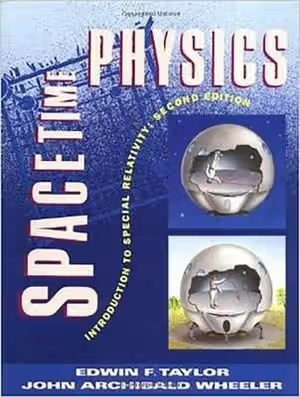
Taylor, E. F., & Wheeler, J. A. (1992). Spacetime Physics: Introduction to Special Relativity (2nd ed.). W. H. Freeman. Free official edition: https://www.eftaylor.com/spacetimephysics/
Chapter Summary
Chapter 1: Spacetime: Overview
The book opens with the Parable of the Surveyors: two surveyors who orient north differently disagree on northward and eastward separations but agree on distance, once both separations are measured in the same unit. The chapter carries this over to physics, where observers in relative motion disagree on time and space separations between events but agree on the spacetime interval. It argues for measuring time and space in the same unit (meters of light-travel time, or seconds, minutes and years of distance), introduces proper (wristwatch) time and the distinction between timelike and spacelike intervals, and presents events and intervals as enough to describe the physical world without any reference frame.
Chapter 2: Floating Free
This chapter defines the free-float (inertial, Lorentz) frame through the image of jumping off a roof or riding Jules Verne's projectile to the Moon: inside such a frame, free particles move in straight lines at constant speed. Tidal effects limit the frame's size in space and time, which is what makes special relativity "special". The chapter then builds the measuring apparatus used throughout the book—a latticework of synchronised recording clocks, an observer defined as the whole lattice rather than a person, and the laboratory and rocket frames—and shows how particle speeds are measured.
Chapter 3: Same Laws for All
Here the Principle of Relativity is stated: the laws of physics are the same in every free-float frame. The chapter sorts what differs between frames (time and space separations, simultaneity, measured lengths along the motion) from what does not (transverse dimensions, the speed of light, the interval). It derives relativity of simultaneity and Lorentz contraction, then proves invariance of the interval with a light flash reflected in a moving rocket, first for one pair of frames and then for all free-float frames. Boxes discuss why nothing travels faster than light and whether a moving clock "really" runs slow, and a sample problem extracts a particle's half-life from the interval.
Special Topic: Lorentz Transformation
Placed between Chapters 3 and 4, this special topic presents the Lorentz transformation as one useful way to translate event coordinates between lattice frames, contrasted with the "lean and spare" description by intervals alone. It examines the faster-than-light question, derives the transformation equations and their inverse from invariance of the interval and symmetry arguments, and obtains the relativistic law of addition of velocities, with sample problems such as a meson firing a particle.
Chapter 4: Trip to Canopus
A narrative chapter: asked to visit the star Canopus, about 99 light-years away, within a human lifetime, the reader discovers through the invariance of the interval that a fast rocket makes this possible in rocket time. The chapter reduces the lattice to a single line of Earth-linked lookout clocks, resolves the apparent paradox of covering 8 light-years in 6 years of rocket time, works out a flight plan and the twin paradox, and revisits Lorentz contraction and relativity of simultaneity. It ends with experimental evidence, including atomic clocks flown on airliners.
Chapter 5: Trekking through Spacetime
This chapter introduces spacetime maps (diagrams) for one space dimension, showing the same events plotted in different frames and the invariant hyperbola on which an event lies for all observers. It defines the worldline, its length as the wristwatch time along it, and shows that the straight worldline between two events has the greatest proper time (the principle of maximal aging). Kinked worldlines, the stretch factor 1/(1 − v²)^½ and a closing section on describing worldlines without any reference frame complete the chapter.
Chapter 6: Regions of Spacetime
Starting from the question of whether a signal could reach us from an exploding Sun faster than light, the chapter shows that light speed limits causality. Pairs of events are classified as timelike, spacelike or lightlike according to the sign of the squared interval, and the light cone is presented as the partition of spacetime into the future, the past and the region that can neither influence nor be influenced by a given event.
Chapter 7: Momenergy
The book's second great unity: momentum and energy are combined into a single 4-vector, momenergy, defined as mass times spacetime displacement divided by proper time. The chapter shows that total momenergy is conserved in collisions, that its magnitude is the particle's mass and is the same for all observers, and that its space and time components in a given frame are the relativistic momentum and energy. Energy is split into rest energy and kinetic energy, and the Newtonian limits are recovered.
Chapter 8: Collide. Create. Annihilate.
Applying momenergy conservation to systems of particles, the chapter defines the mass of a system (which can exceed the sum of its parts' masses), treats the photon as energy without mass, and works through the creation of particles by photons and by material particles. It applies these ideas to fission, fusion and annihilation, including an estimate of how much mass the Sun converts to radiation each second, and ends with a dialogue on the use and abuse of the concept of mass that also serves as the chapter summary.
Chapter 9: Gravity: Curved Spacetime in Action
The final chapter is an introduction to general relativity without its mathematics. It contrasts the views of Galileo, Newton and Einstein, states that spacetime tells mass how to move and mass tells spacetime how to curve, and uses a parable of two travelers on a globe to show how curvature produces apparent attraction. Sections on gravity waves, black holes (with a box on compact stellar objects) and cosmology bring the book to a close.
Key Concepts
Chapter 1: Spacetime: Overview
- Spacetime interval: the quantity (time separation)² − (space separation)² between two events, which has the same value in every free-float frame.
- Same units for space and time: measuring time in meters of light-travel time makes the speed of light a simple conversion factor.
- Proper (wristwatch) time: the time between two events read on a clock present at both.
Chapter 2: Floating Free
- Free-float (inertial) frame: a frame in which free particles move uniformly, obtained by falling freely; limited in size by tidal effects.
- Latticework of clocks: an imagined grid of synchronised recording clocks that assigns a place and time to every event.
- Observer: in this book, the entire recording lattice of a frame, not a person looking from one point.
Chapter 3: Same Laws for All
- Principle of Relativity: the laws of physics take the same form in every free-float frame.
- Relativity of simultaneity: events separated along the direction of relative motion cannot be simultaneous in both frames.
- Lorentz contraction: an object is measured shorter along its motion than its proper length, while transverse dimensions are unchanged.
Special Topic: Lorentz Transformation
- Lorentz transformation: the equations that convert an event's coordinates from one free-float frame to another in uniform relative motion.
- Addition of velocities: the relativistic rule for combining speeds, which never gives a result above light speed.
Chapter 4: Trip to Canopus
- Time dilation in travel: a traveler moving close to light speed can cover great distances in little proper time.
- Twin paradox: the traveler who changes frames returns younger than the twin who stays in one free-float frame.
Chapter 5: Trekking through Spacetime
- Spacetime map: a diagram with distance horizontal and time vertical on which events and worldlines are plotted.
- Invariant hyperbola: the curve of constant interval from a reference event, the same on every observer's map.
- Principle of maximal aging: among all worldlines between two events, the straight one has the greatest wristwatch time.
Chapter 6: Regions of Spacetime
- Timelike, spacelike and lightlike separation: the three possible relations between events, according to whether time separation exceeds, falls short of or equals space separation.
- Light cone: the boundary separating events that can be causally connected to a given event from those that cannot.
Chapter 7: Momenergy
- Momenergy 4-vector: mass times the spacetime displacement per unit proper time, uniting momentum and energy.
- Mass as invariant magnitude: E² − p² = m² in any frame, so mass is the same for all observers.
- Conservation of momenergy: the total momenergy of an isolated system is unchanged by a collision.
Chapter 8: Collide. Create. Annihilate.
- Mass of a system: the magnitude of the system's total momenergy, which need not equal the sum of the masses of its parts.
- Photon: a particle with energy and momentum but zero mass.
- Conversion of mass and energy: fission, fusion and annihilation as rearrangements that conserve total momenergy.
Chapter 9: Gravity: Curved Spacetime in Action
- Gravity as curvature: gravitation is not a force acting across space but the curvature of spacetime where the mass is.
- Local free-float frames: special relativity holds only locally; tidal effects reveal curvature on larger scales.
- Black hole: a region so compact that nothing, not even light, escapes from inside its horizon.
Critical Analysis
Strengths
- Built on invariants. As the back-cover statement of the book's aims explains, the text emphasises quantities that are the same for all observers—the interval, proper time, mass—over quantities that differ between frames. The surveyor parable in Chapter 1 makes this idea concrete before any formula, and the same idea returns in the treatment of momenergy, where mass is the invariant magnitude.
- Physical, not algebraic, foundations. The Lorentz transformation is deliberately placed in a separate special topic, so the main line of argument runs through events, intervals and spacetime maps. Concepts such as the observer as a whole lattice of clocks and the free-float frame defined by falling freely address common misunderstandings head-on.
- Exercises designed for intuition. The introduction to the exercises lists paradoxes, puzzles, estimates, technical applications and experimental results, and advises guessing an answer before every calculation. Many chapters split exercises into Practice and Problems, and answers to odd-numbered exercises are provided.
- Engaging narrative chapters. Chapter 4's trip to Canopus and the dialogue at the end of Chapter 8 turn standard results (time dilation, the twin paradox, mass and energy) into stories that students remember, while sample problems keep the arithmetic concrete.
Limitations
- Little formal machinery. Tensor notation, four-vector index calculus and electromagnetism in relativistic form are not developed; the book stays with one space dimension on most spacetime maps. Students heading for graduate relativity will need a more formal text.
- Dated in places. The text is from 1992: the cosmology section speaks of an age between ten and twenty billion years and leaves open whether the universe will recollapse, and gravity waves are described before their direct detection. The chapter on general relativity is a qualitative survey rather than a working introduction.
- A scanned book. The free edition consists of scanned pages of the printed book; it is readable but not searchable in a clean way, and some figures and equations are harder to read on screen than in print.
- Idiosyncratic vocabulary. Terms such as "momenergy", "wristwatch time" and "stretch factor" aid understanding but differ from those in other textbooks (four-momentum, proper time, Lorentz factor γ), so students must translate when switching books.
Where It Fits in the Course
In the Modern Physics and Relativity list, Spacetime Physics is the dedicated special-relativity text. University Physics Volume 3 covers relativity in a single chapter alongside optics and quantum physics; reading Taylor and Wheeler after or instead of that chapter gives a much fuller conceptual treatment. Krane's Modern Physics and Thornton, Rex and Hood's Modern Physics for Scientists and Engineers are broad modern-physics texts that also treat atomic, nuclear and quantum topics; this book can serve as the relativity companion to either.
For students going on to general relativity, Schutz's A First Course in General Relativity and Carroll's Spacetime and Geometry begin with special relativity in tensor form. Taylor and Wheeler's emphasis on intervals, worldlines, maximal aging and the qualitative picture in Chapter 9 provides physical intuition that makes those books easier, so it is best read before them rather than alongside.
How to Use This Book
The book suits first- and second-year students who know school algebra and basic mechanics; only a little calculus appears (for example in defining momenergy components). A one-term relativity module can cover Chapters 1–3, the Special Topic, and Chapters 5–8 as the core, with Chapter 4 as enjoyable reading that consolidates time dilation and the twin paradox, and Chapter 6 as a short but essential chapter on causality. Chapter 9 is an optional qualitative bridge to general relativity.
Read each chapter's sample problems carefully, then follow the authors' advice: estimate before calculating and attempt the paradoxes before looking for the trick. Use the answers to odd-numbered exercises, downloadable as a separate file, to check work. Because chapters are posted as separate PDFs on the official site, it is easy to work through the book a chapter at a time; students who prefer standard notation should keep a list translating the book's terms (momenergy, stretch factor) into those of their main course text.
Edition and Sources
This guide is based on the second edition (W. H. Freeman, 1992; ISBN 0-7167-2327-1), read from the chapter PDFs of the scanned eleventh printing that the authors post under a Creative Commons Attribution 4.0 licence at https://www.eftaylor.com/spacetimephysics/. It draws on the title pages and contents, the back-cover description of the book, the introduction to the exercises, and for all nine chapters and the Special Topic the opening sections, every section heading, the chapter summaries (where provided), sample problems and boxes, and selected exercises.