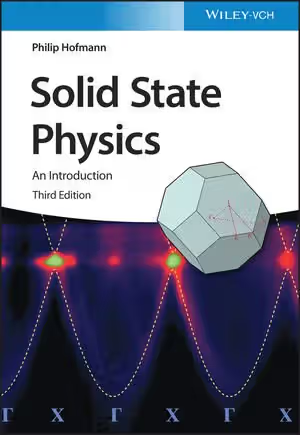
01 / Reading Guide
Reading Guide
Citation
Hofmann, P. (2022). Solid State Physics: An Introduction (3rd ed.). Wiley-VCH.
Chapter Summary
The third edition has eleven chapters and two short appendices in 288 pages. Each chapter ends with a further-reading list and a "Discussion and Problems" section, which in the contents is divided into Discussion, Basic Concepts and Problems. Appendix A collects vector operations and the Maxwell equations, and Appendix B gives solutions to the Basic Concepts questions.
Chapter 1: Crystal Structures
The opening chapter introduces the lattice, the primitive unit cell, the Wigner–Seitz cell and the basis, mostly with two-dimensional examples, before turning to common cubic, close-packed and covalent structures. Its third part is a longer treatment of structure determination by X-ray diffraction: Bragg theory, Miller indices, general diffraction theory, the reciprocal lattice and the Ewald construction, followed by short sections on other methods and on inelastic scattering.
Chapter 2: Bonding in Solids
Attractive and repulsive forces come first, then ionic, covalent, metallic, hydrogen and van der Waals bonding. The chapter runs to about fourteen pages.
Chapter 3: Mechanical Properties
The chapter separates elastic deformation (elastic constants and Poisson's ratio in a macroscopic picture, then a microscopic one), plastic deformation (an estimate of the yield stress, point defects, dislocations and their role) and fracture.
Chapter 4: Thermal Properties of the Lattice
Lattice vibrations are built up from a simple harmonic oscillator through infinite and finite chains of atoms, the first Brillouin zone and phonons to three-dimensional solids. The chapter then covers the heat capacity of the lattice (classical theory, Einstein and Debye models), thermal conductivity, thermal expansion, and allotropic phase transitions and melting.
Chapter 5: Electronic Properties of Metals: Classical Approach
The Drude model is stated and used to treat DC conductivity, the Hall effect, optical reflectivity and the Wiedemann–Franz law, and the chapter closes with the model's shortcomings, which motivate the quantum treatment.
Chapter 6: Electronic Properties of Solids: Quantum Mechanical Approach
The longest chapter (pages 99 to 144) begins with the idea of energy bands and the free electron model, including electronic heat capacity and screening. It then develops the general form of electronic states (Bloch's theorem), the nearly-free electron model and band formation, the tight-binding model, bands in real solids and transport, and ends with a short review of key ideas.
Chapter 7: Semiconductors
Intrinsic and doped semiconductors, carrier densities and their temperature dependence, conductivity, and then devices: the pn junction, transistors and optoelectronic devices.
Chapter 8: Magnetism
After macroscopic and quantum-mechanical descriptions, the chapter treats paramagnetism and diamagnetism in atoms and in solids (Curie and Pauli paramagnetism) and magnetic ordering: the exchange interaction, localized spins, the band picture, ferromagnetic domains and hysteresis.
Chapter 9: Dielectrics
Macroscopic description, microscopic polarization, the local field and the frequency dependence of the dielectric constant (lattice vibrations and electronic transitions), followed by impurities, ferroelectricity, piezoelectricity and dielectric breakdown.
Chapter 10: Superconductivity
Zero resistivity, the Meissner effect and the isotope effect are presented as experimental facts, followed by phenomenological and BCS theory, experimental detection of the gap, coherence of the superconducting state, type-I and type-II superconductors and high-temperature superconductivity.
Chapter 11: Finite Solids and Nanostructures
The final chapter is short: quantum confinement, surfaces and interfaces, and magnetism on the nanoscale.
Key Concepts
Chapters 1–4: Structure, bonding and the lattice
- Bravais lattice, unit cell and basis: the contents and chapter opening name these as the language for describing any crystal.
- Reciprocal lattice: introduced in the X-ray diffraction section together with the Ewald construction.
- Phonons and the first Brillouin zone: quantized lattice vibrations, reached through chains of atoms.
- Einstein and Debye models: two approximations for the heat capacity of the lattice.
Chapters 5–7: Electrons in solids
- Drude model: the classical picture of conduction and its stated shortcomings.
- Bloch's theorem and energy bands: the general form of electronic states, with the nearly-free electron and tight-binding models as two routes to bands.
- Doping and the pn junction: the starting points for semiconductor devices.
Chapters 8–11: Collective and finite-size phenomena
- Exchange interaction and magnetic ordering: the basis of ferromagnetism in the chapter on magnetism.
- BCS theory and the superconducting gap: the microscopic account of superconductivity.
- Quantum confinement: the opening topic of the nanostructures chapter.
Critical Analysis
Strengths
- Compact and paced for newcomers. At 288 pages the book is short, and the publisher says each chapter starts from basic principles and moves gradually to more advanced ideas with the mathematical formalism kept to a minimum. Chapter 1 follows this by introducing lattices in two dimensions first.
- Classical-then-quantum order for electrons. The Drude model (Chapter 5) comes before the quantum treatment (Chapter 6), so the reasons for moving to bands are visible.
- Built-in self-study material. The publisher counts more than 100 discussion questions and 70 problems, including problems that train computational solution skills, and multiple-choice questions at the end of each chapter, with solutions in the book. Every chapter's structure (Discussion, Basic Concepts, Problems) is visible in the contents.
- Third-edition revisions. The publisher lists easier descriptions of metallic and covalent bonding, a more direct proof of Bloch's theorem and a simpler approach to the nearly-free electron model.
Limitations
- Short by design. Superconductivity occupies about 28 pages and nanostructures about ten, so these chapters are overviews. The contents list no sections on topics such as the quantum Hall effect or topological phases; readers who need them must go to a later text.
- Assumes a first course in quantum mechanics. The frontmatter's prerequisites and the free-electron, Bloch and BCS material in the contents indicate that the quantum treatment relies on prior study.
Where It Fits in the Course
Hofmann is one of several first-course texts in the condensed-matter list. Hook and Hall's Solid State Physics is also written for a first course, in the Manchester Physics Series, and is a longer treatment with starred optional sections; Hofmann is the briefer, more modular choice. Steven Simon's The Oxford Solid State Basics is a compact one-term introduction that explains the historical models before the quantum treatment, and is the nearest to Hofmann in purpose. Kittel's Introduction to Solid State Physics is the long-established reference that covers similar topics at a more demanding level, and Ibach and Lüth's Solid-State Physics adds panels on measurement techniques and a materials focus. Girvin and Yang's Modern Condensed Matter Physics is a graduate textbook for topological phases, quantum Hall physics and related topics, and is where a reader would go after this book.
How to Use This Book
The book suits students meeting solid state physics for the first time in physics, materials science, engineering or chemistry programmes, with introductory physics, a first quantum mechanics course, calculus and linear algebra behind them.
A practical plan: read Chapters 1, 4, 5, 6 and 7 as the core path, which takes a reader from crystal structure through phonons to band theory and semiconductors. In Chapter 1, the sections on lattices and common structures matter more on a first pass than the full diffraction theory, which can be read alongside Chapter 4. Chapters 2 and 3 are short and can be read quickly or used as background; Chapters 8, 9 and 10 can be taken in any order after Chapter 6; Chapter 11 is a brief closing overview. Appendix A is a useful reminder of the Maxwell equations before the dielectrics and superconductivity chapters.
For practice, work through the Discussion questions to test understanding, then the Basic Concepts multiple-choice questions and check them against Appendix B, and then the Problems, including the computational ones.