01 / Reading Guide
Reading Guide
Citation
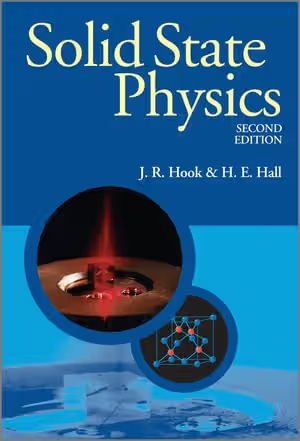
Hook, J. R., & Hall, H. E. (1991). Solid State Physics (2nd ed.). Wiley.
Chapter Summary
The book belongs to the Manchester Physics Series and is a first course in solid state physics. The Library of Congress catalogue lists fourteen chapters, followed by appendices, a bibliography, solutions to problems and an index; the publisher gives about 490 pages. The summaries below follow the order and exact titles of that catalogue contents list and go no further than the titles and the publisher's description allow.
Crystal Structure
The opening chapter describes how atoms are arranged in crystals. The publisher says that the book introduces wave propagation in crystals using one- and two-dimensional geometries first, and only afterwards generalises to three dimensions and the reciprocal lattice.
Crystal Dynamics
Vibrations of the crystal lattice and their consequences. The title places this chapter second, directly after structure, so lattice vibrations come before electrons.
Free Electrons in Metals
The free-electron picture of conduction electrons in metals.
The Effect of the Periodic Lattice Potential: Energy Bands
The step from free electrons to electrons moving in the periodic potential of the lattice, which gives energy bands.
Semiconductors and Semiconductor Devices
Two consecutive chapters: Semiconductors, then Semiconductor Devices. The publisher lists the devices material as new or expanded in the second edition.
Diamagnetism and Paramagnetism; Magnetic Order
Two chapters on magnetism, the first on weak magnetic response and the second on ordered magnetic states.
Electric Properties of Insulators
The publisher describes a chapter on dielectrics and ferroelectrics as added in the second edition; the catalogue entry for this chapter is the closest match among the titles.
Superconductivity
A chapter on superconductivity; the second edition adds high-temperature superconductors, according to the publisher.
Waves in Crystals; Scattering of Neutrons and Electrons from Solids
Two chapters on wave propagation in crystals and on how neutrons and electrons are used to probe solids.
Real Metals; Low-Dimensional Systems
The last two chapters treat metals beyond the free-electron model and low-dimensional systems. The publisher mentions the quantum Hall effect, quasicrystals and techniques for studying the surfaces of solids among the second edition's new or expanded material.
Key Concepts
Structure, vibrations and electrons
- Reciprocal lattice: named by the publisher as the framework reached after one- and two-dimensional wave ideas.
- Energy bands: the subject of the chapter on the periodic lattice potential.
- Free electrons in metals: the starting model for metallic conduction.
Properties and applications
- Semiconductor devices: the subject of its own chapter.
- Magnetic order: distinguished in the contents from diamagnetism and paramagnetism.
- Superconductivity and low-dimensional systems: two later chapters.
Critical Analysis
Strengths
- Gradual route to three dimensions. The publisher states that basic ideas are introduced in easily accessible one- and two-dimensional settings, with the move to three dimensions and the reciprocal lattice made only afterwards.
- Flexible structure. The publisher highlights a flow diagram allowing topics to be studied in different orders or omitted, and optional starred and highlighted sections with more advanced material.
- Problems with solutions. Problems come at the end of each chapter and solutions are provided at the end of the book.
- Broad scope for a first course. The contents run from structure and dynamics through bands, semiconductors, magnetism, dielectrics and superconductivity to low-dimensional systems.
Limitations
- Dated in places. This is a 1991 text; its newest topics, as the publisher lists them, are the quantum Hall effect, quasicrystals and high-temperature superconductors, so later developments are not covered.
- Length. At roughly 470 to 500 pages (catalogues differ) it is considerably longer than the briefest introductions on the list, which matters for a single-term course; the flow diagram is the intended remedy.
- No published review was located, so these points rest on the publisher's description and the catalogue contents.
Where It Fits in the Course
Hook and Hall is a first-course text, like Hofmann's Solid State Physics: An Introduction and Simon's The Oxford Solid State Basics. Hofmann's book is shorter (288 pages) and newer, and Simon's is newer and written from a one-term lecture course; Hook and Hall is the one whose publisher stresses a modular reading plan with optional starred sections, which suits a reader who wants to select topics and go deeper in places. Kittel's Introduction to Solid State Physics is the long-established reference at a more demanding level, and Ibach and Lüth's Solid-State Physics is a materials- and experiment-oriented textbook. Girvin and Yang's Modern Condensed Matter Physics is the graduate text for later material such as topological phases.
How to Use This Book
The book is aimed at students taking a first course in solid state physics, and the publisher notes it may also interest professional physicists and electronic engineers who need the fundamentals. It assumes introductory quantum mechanics, thermal physics and electromagnetism.
The edition history matters when choosing between this and the newer first-course books: Wiley lists the second edition as a July 1995 paperback printing, while the Library of Congress record dates the book 1991, so a reader should expect a text from the early 1990s whichever copy is used.
A practical plan: use the flow diagram first to decide a path. A core path is structure, crystal dynamics, free electrons, energy bands and semiconductors; magnetism, insulators and superconductivity can follow in any order; the starred sections can be skipped on a first reading. Readers who find the one- and two-dimensional treatment of waves helpful can also use it as preparation for a more formal text later. Work the problems at the end of each chapter and check them against the solutions in the back; because the book dates from 1991, pair the final chapters with a recent text for current research directions.