01 / Reading Guide
Reading Guide
Citation
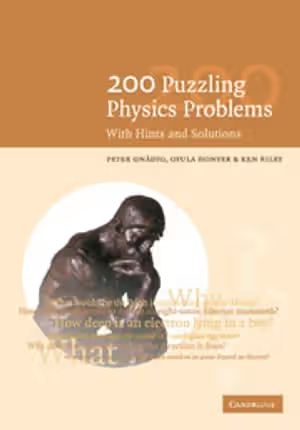
Gnädig, P., Honyek, G., & Riley, K. F. (2001). 200 Puzzling Physics Problems: With Hints and Solutions. Cambridge University Press.
Chapter Summary
This is a problem book rather than a textbook, and it has no chapters of exposition. After a preface, a note on how to use the book, a thematic index of the problems and a table of physical constants, it has three parts: Problems (starting on page 1), Hints (page 50) and Solutions (page 69). The problems are numbered P1 to P200 and are, according to the authors, arranged roughly by difficulty or in groups needing similar methods, not by topic.
Preface and How to Use This Book
The authors explain that the problems are meant to be solved by a well-chosen variable, an unusual way of thinking or a clever analogy rather than by long calculations. The problems are taken almost entirely from classical, non-quantum physics and are posed in accessible non-technical language, so the reader must decide which branches of physics are involved. The guidance for use is explicit: try each problem alone, turn to the hint if stuck, then check the full solution. Problems needing especially difficult reasoning or complicated mathematics carry one or two asterisks.
Thematic Order of the Problems
A list groups the problems under nineteen headings, and some problems appear under more than one. The headings are kinematics, dynamics, gravitation, mechanical energy, collisions, mechanics of rigid bodies, statics, ropes and chains, liquids and gases, surface tension, thermodynamics, phase transitions, optics, electrostatics, magnetostatics, electric currents, electromagnetism, atoms and particles, and dimensional analysis, scaling and estimations. Dynamics has the longest list, ahead of electrostatics and electromagnetism; phase transitions has the shortest.
Problems (P1–P200)
The opening problems give a sense of the style: three snails each chasing the next around an equilateral triangle, a boatman crossing a river by the shortest path, a carpet pulled back over itself, an iceberg oscillating in the water, a car with one wheel on a pavement, and a sphere of two unequal hemispheres on an incline. Later problems range from planetary orbits and rocket launches to a leaking pendulum bucket, a discharging spherical capacitor and a pulsating charged sphere.
Hints
A short section of about twenty pages gives hints that point the way without completing the solution. The authors say that in most cases a hint is enough to help, and that cross-references to related problems appear in the hints and solutions.
Solutions
The final part gives full solutions. Some end with points worth further thought that the book leaves unanswered, flagged as beyond its scope.
Key Concepts
Preface and Thematic Index
- Insight over brute force: the problems reward choosing a good variable, coordinate or analogy more than long calculation.
- Classical physics: problems are drawn almost exclusively from non-quantum physics, from mechanics and thermodynamics to electromagnetism and optics.
- Dimensional analysis, scaling and estimation: a separate heading in the thematic list, with problems on size and proportion.
Problems, Hints and Solutions
- Graduated support: the problem, then the hint, then the solution, so the reader chooses how much help to take.
- Marked difficulty: one or two asterisks flag problems that require especially hard reasoning or complicated mathematics.
- Cross-references: related problems are linked in the hints and solutions.
Critical Analysis
Strengths
- Stated design. The preface explains the philosophy: problems that yield to intuitive insight and a clever idea, with mathematical demands that do not go beyond elementary calculus.
- Broad subject range. The thematic list spans mechanics, fluids, surface tension, thermodynamics, optics, electromagnetism, atoms and particles and scaling, so a reader can practice crossing branches of physics, which the authors present as part of the task.
- A built-in method for getting unstuck. The separate hints chapter lets a reader get partial help without seeing the solution, and the asterisks warn about the hardest problems.
- Wide range of sources. The authors draw on problems of their own and on Hungarian secondary-school journals, international physics contests and the Cambridge colleges' entrance examination; the authors' backgrounds include running the Hungarian team at the International Physics Olympiad.
Limitations
- Not a teaching text. The book gives no systematic exposition. The authors say they would not encourage anyone to tackle the problems without first having studied the subject in some depth.
- Mixed order. Problems are arranged roughly by difficulty or method, not by topic, so a reader wanting practice on one topic must use the thematic index to find it.
- Classical physics only. The problems are almost entirely non-quantum, so quantum, atomic or statistical topics are barely touched; the thematic list has just one heading for atoms and particles.
- Uneven difficulty. The authors say most problems are not easy and some are definitely difficult; the intended level ranges from the exceptional school student to the competent graduate student.
Where It Fits in the Course
This book is a supplement to an introductory physics course, not a replacement for one. The general introductory textbooks in this course list, such as College Physics 2e, Hewitt's Conceptual Physics, Halliday's Fundamentals of Physics, Tipler and Mosca's Physics for Scientists and Engineers, Serway and Jewett's Principles of Physics and Young's University Physics, supply the exposition and routine exercises. Kleppner and Kolenkow's An Introduction to Mechanics is a demanding mechanics text with problems that need more than substituting into formulas, so it is the closest relative in spirit, though it covers mechanics only. The Feynman Lectures supply physical arguments and intuition of a different kind.
Use this book after, or while finishing, one of the general textbooks, when ordinary end-of-chapter exercises begin to feel routine and the aim is to practise recognizing which law applies.
How to Use This Book
The authors say the level required for most problems is that of the exceptional school student, the good undergraduate or the competent graduate student, with mathematics limited to elementary calculus. It suits strong first- and second-year undergraduates, those preparing for general physics papers, and physics instructors, whom the authors hope will find the more difficult questions challenging.
A practical approach:
- Pick by topic. Use the thematic list to choose a group of problems on a topic just studied, and leave the asterisked ones for later.
- Follow the sequence the authors set. Work alone first and give each problem real time; take the hint only when stuck; read the full solution after reaching an answer, even a correct one, since the solution may show a shorter route.
- Mix topics. Once comfortable, work through problems in book order, where methods rather than topics group them, to practice deciding what kind of problem it is.
- Note the follow-up questions. Some solutions end with points to think about further; these make good starting points for discussion or short projects.
A study group works well, because the value lies in comparing different ways of seeing a problem.