01 / Reading Guide
Reading Guide
Citation
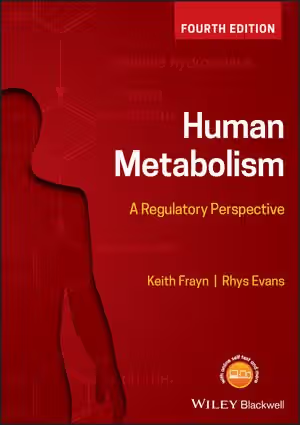
Frayn, K. N., & Evans, R. D. (2019). Human Metabolism: A Regulatory Perspective (4th ed.). Wiley-Blackwell.
Chapter Summary
The fourth edition has 12 chapters in about 400 pages. According to the preface, the book is meant to complement a conventional biochemistry text, giving the regulation and tissue-specificity of pathways rather than every pathway detail. Its first chapter provides overviews of the pathways that later chapters treat in more depth.
Chapter 1: The underlying principles of human metabolism
The chapter opens with key learning points, then sets metabolism in perspective, covers the chemistry of food (polarity, amphipathic molecules, carbohydrates, fats, amino acids and proteins) and gives a general overview of metabolic pathways: carbohydrate, lipid and protein metabolism, the TCA cycle, and the storage and release of energy.
Chapters 2–3: Cellular aspects of metabolic regulation; Coordination of metabolism in the whole body
Chapter 2 deals with regulation inside cells: transport across membranes, enzymes and allosteric control, and the regulation of gene expression by nutrients, including carbohydrate, fatty acids, cholesterol and amino acids. Chapter 3 widens to the whole body, covering circulation, blood and lymph, hormone receptors, signal transduction and the short- and long-term hormonal control of enzyme activity.
Chapters 4–5: Digestion and intestinal absorption; Metabolic specialisation of organs and tissues
Chapter 4 follows food through the mouth, stomach, small intestine and large intestine, including the role of the gut microbiota. Chapter 5 is the tissue-by-tissue chapter: the liver, adipose tissue, skeletal muscle, heart, kidney, brain, the endothelium, the gut and immune cells, each with its own pattern of fuel use.
Chapter 6: Communication systems
The chapter describes how organs coordinate through hormones (insulin, glucagon, growth hormone, thyroid and adrenal hormones, hormones from adipose tissue, kidney and gut) and through the nervous system, including the autonomic nervous system and its effects on metabolism.
Chapter 7: Integration of carbohydrate, fat and protein metabolism in normal daily life
The central integrating chapter follows the three fuel classes through the day: the overnight-fasted state, breakfast and the disposal of a meal's glucose and fat, amino acid metabolism, the control of protein synthesis and breakdown, and the interactions between organs such as the glucose–fatty acid cycle.
Chapters 8–9: Metabolic challenges
Chapter 8 covers extreme physiological situations: exercise (aerobic and anaerobic, training) and growth and development, including foetal metabolism, pregnancy and lactation. Chapter 9 turns to pathological situations: starvation, trauma and sepsis, and cancer metabolism including cachexia.
Chapters 10–12: Lipoprotein metabolism and atherosclerosis; Energy balance and body weight regulation; Diabetes mellitus
The last three chapters apply the earlier material to clinical problems: lipoproteins, their metabolism, raised lipids and atherosclerosis; energy balance, the control of food intake, energy expenditure and obesity; and the types, metabolic alterations, treatment and complications of diabetes.
Key Concepts
Chapters 1–6
- Metabolic regulation: the control of the storage and mobilisation of fuels to match intake with expenditure.
- Polarity and amphipathic molecules: why lipids and water-soluble molecules are handled differently in the body.
- Tissue specificity: organs have characteristic patterns of metabolism, linked by substrate flow in the bloodstream.
- Hormonal and nutrient control of enzymes and genes: signalling in the short term and gene expression in the longer term.
Chapters 7–12
- Fed and fasted states: how fuel handling changes across the day.
- Interorgan cycles: for example the glucose–fatty acid cycle and the glucose–alanine cycle.
- Metabolic adaptation: to exercise, starvation, injury and cancer.
- Dysregulation: lipoprotein disorders, obesity and diabetes as failures of regulation.
Critical Analysis
Strengths
- A stated, specific aim. The preface says the book is a complement to a conventional biochemistry textbook, concentrating on regulation and on the tissue-specific character of pathways, which is what the title promises.
- Physiological framing. Chapter 1 argues that metabolism and its regulation should be put into a physiological context, and the later chapters follow the body through feeding, fasting, exercise and disease.
- Revised for broader use. The preface says that Chapter 1 now provides overviews of pathways so that the book can be used more independently, and that clinical material on cancer, sepsis and trauma was added. The publisher adds more content on metabolic pathways and metabolic diseases, chapter summaries, and a full-colour design.
- Current science. The preface identifies developments the edition takes in, such as nutrient regulation of gene expression and metabolites acting as signals through receptors.
Limitations
- Not a pathway reference. The authors say it is not a repetition of molecular details; readers who need full pathway structures will need a standard biochemistry textbook.
- Integration over introduction. The point of the book is to connect pathways across organs and states, so it works best when the individual pathways are already familiar from a biochemistry course; Chapter 1 offers a refresher, not a full first course.
- Selective clinical scope. Pathology is covered through chosen examples (starvation, trauma, sepsis, cancer, lipid disorders, obesity, diabetes) rather than a systematic treatment of metabolic disease.
- Fast-moving topics. Diabetes treatment and lipid-lowering strategies change, so those parts of a 2019 text need checking against current practice.
Where It Fits in the Course
Human Metabolism: A Regulatory Perspective is the integrating text among the biochemistry and molecular medicine books. Metabolism at a Glance presents pathways as colour-coded charts with brief text, Crash Course Metabolism and Nutrition is a concise clinically oriented review, and Lippincott Illustrated Reviews: Biochemistry is an illustrated outline of protein structure, enzymes, metabolism, nutrition and molecular genetics for rapid learning. Marks' Basic Medical Biochemistry teaches metabolism through patient cases, and Clinical Biochemistry: Metabolic and Clinical Aspects focuses on laboratory tests and the biochemistry of disease.
Read Frayn and Evans after one of these has introduced the pathways. It then explains how the pathways are switched and coordinated in the whole body, which is the part that review books treat briefly.
How to Use This Book
The book is for students of medicine, biochemistry, nutrition, dietetics, sports science and nursing who have met the main metabolic pathways and basic physiology.
- Start with Chapter 1 as a refresher on the pathways, using its key learning points.
- Core reading: Chapters 2–3 for the regulatory machinery, Chapter 5 for tissues and Chapter 7 for integration across the day.
- Choose by interest: Chapter 8 for exercise and pregnancy, Chapter 9 for starvation, trauma and cancer, Chapters 10–12 for clinical application.
- Use Chapter 4 and Chapter 6 as needed for digestion and for hormones and the nervous system.
- Work alongside a pathway text and the companion website, redrawing the day's fuel flows for each state.