01 / Reading Guide
Reading Guide
Citation
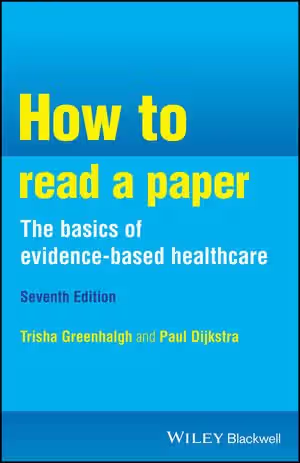
Greenhalgh, T. M., & Dijkstra, P. (2024). How to Read a Paper: The Basics of Evidence-Based Healthcare (7th ed.). Wiley-Blackwell.
Chapter Summary
The seventh edition has 352 pages and twenty chapters, followed by two appendices: a set of checklists for finding, appraising and implementing evidence, and a short appendix on assessing the effects of an intervention. Every chapter ends with exercises and references. The opening chapter sets out the plan: Chapters 1, 2 and 16 cover the broader steps of evidence-based healthcare (asking the question, searching, applying evidence with patients), while Chapters 3–15 deal with critical appraisal, "when you actually have the paper in front of you". New to this edition, according to Wiley, are chapters on consensus methods, mechanistic evidence, and big data and artificial intelligence. Many of the appraisal chapters are built around a numbered list of questions to ask of a given type of paper.
Chapter 1: Why read papers at all?
The sample chapter defines evidence-based medicine within the wider field of evidence-based healthcare, sets out Sackett's five steps (ask, track down, appraise, implement, evaluate) and notes Greenhalgh's extension of them to eight stages that include the patient's perspective. It then examines how far clinical practice is actually evidence-based and the alternatives that are not, such as decision-making by anecdote or by press cutting, drawing on the first author's own clinical experience. It ends with formulating the problem as an answerable question.
Chapter 2: Searching the literature
Levels of evidence and where to look: synthesised sources, pre-appraised synopses, specialised resources, primary studies and federated search engines, with sections on using artificial intelligence to search and on asking for help.
Chapter 3: Getting your bearings: what is this paper about?
Three preliminary questions to orient a reader, then the main study designs: randomised controlled trials, cohort studies, case–control studies, cross-sectional surveys and case reports, and the traditional hierarchy of evidence.
Chapter 4: Assessing methodological quality
Questions of originality, who the study is about, whether the design was sensible, whether bias was avoided or minimised, whether assessment was blind and whether preliminary statistical questions were addressed, with a note on ethics.
Chapter 5: Statistics for the non-statistician
How readers without statistical training can judge whether the right tests were used: setting the scene, paired data, tails and outliers, correlation and causation, probability and confidence, and the "bottom line" of quantifying benefit and harm.
Chapters 6–8: Papers that report clinical trials of simple interventions; trials of complex interventions; diagnostic or screening tests
Chapter 6 covers drug trials and marketing, surrogate endpoints, the CONSORT statement, dealing with pharmaceutical representatives and vaccine trials. Chapter 7 offers ten questions for papers on complex interventions. Chapter 8 covers validation against a gold standard, ten questions for diagnostic and screening studies, likelihood ratios and clinical prediction models.
Chapters 9–11: Papers that summarise other papers; papers that advise you what to do; papers that estimate what things cost
Systematic reviews and meta-analyses (five questions to ask, heterogeneity, newer approaches); clinical guidelines (the guidelines debate, ten questions); and health economic evaluations (costs, quality-adjusted life-years, "choosing wisely", twelve questions).
Chapters 12–15: Qualitative research; questionnaire research; quality improvement case studies; genetic association studies
Chapter 12 explains qualitative research and its synthesis, with nine appraisal questions. Chapters 13 and 14 offer ten questions each for questionnaire studies and quality improvement reports. Chapter 15 covers genome-wide association studies, direct-to-consumer testing, Mendelian randomisation and epigenetics.
Chapter 16: Applying evidence with patients
The patient perspective, patient-reported outcome measures, shared decision-making, option grids and n-of-1 trials.
Chapters 17–19: Papers on artificial intelligence in healthcare; EBM+: the importance of mechanistic evidence; Papers that report consensus exercises
The three chapters new in this edition. Chapter 17 defines AI, big data, machine learning and generative models, discusses ethical principles and the many appraisal checklists, and gives ten questions for AI studies. Chapter 18 argues for combining mechanistic and clinical evidence ("both and", not "either or"), with examples from the COVID-19 pandemic. Chapter 19 explains how experts reach consensus and gives ten questions for consensus statements.
Chapter 20: Criticisms of evidence-based healthcare
What goes wrong when evidence-based healthcare is done badly, what critics object to even when it is done well, and why evidence-based policymaking is hard to achieve.
Key Concepts
Chapters 1–5: Foundations
- Evidence-based healthcare: the explicit use of current best evidence in decisions about care, of which reading papers is only one step.
- Answerable question: a clinical problem turned into a focused question that a search can address.
- Hierarchy of evidence: the traditional ranking of study designs by their vulnerability to bias.
- Bias: systematic error that distorts a study's results.
- Number needed to treat: a way of expressing the chance that an intervention benefits or harms a patient.
Chapters 6–15: Appraising particular kinds of paper
- Surrogate endpoints: measurable markers used in place of outcomes that matter to patients.
- Likelihood ratios: how much a test result changes the probability of a diagnosis.
- Heterogeneity: variation between the studies combined in a meta-analysis.
- Quality-adjusted life-years: a combined measure of survival and quality of life used in economic evaluation.
- Mendelian randomisation: using genetic variants to test causal relationships.
Chapters 16–20: Patients, new evidence types and critique
- Shared decision-making: clinician and patient choosing together in the light of evidence and preferences.
- EBM+: treating mechanistic evidence as a complement to clinical studies.
- Consensus methods: structured ways in which experts reach agreed statements.
Critical Analysis
Strengths
- A question set for every study type. Most appraisal chapters provide a numbered list of questions (five for systematic reviews, nine for qualitative research, ten for diagnostic studies, complex interventions, guidelines, questionnaires, quality improvement, genetic studies, AI and consensus papers, twelve for economic evaluations), and Appendix 1 gathers checklists in one place. This makes the book directly usable at a journal club.
- Breadth of designs. Beyond trials and reviews, it covers qualitative, questionnaire, quality improvement, genetic, economic, consensus and AI studies, the kinds of paper that clinicians increasingly meet.
- Readable and personal. The sample chapter is written in plain, conversational English, with examples from the first author's own practice and pregnancy, and explains why critics "groan" at evidence-based healthcare before defending it. Chapter 20 is given over to criticisms of the field.
- Kept current. The seventh edition adds AI, mechanistic evidence and consensus methods, and the search chapter discusses AI-assisted searching.
Limitations
- Statistics in one chapter. Chapter 5 is written for the non-statistician and aims at judgement rather than calculation; students who need to compute or interpret analyses in depth will need a statistics text.
- Appraisal rather than implementation or teaching. The authors state that the challenges of implementation needed a separate book, How to Implement Evidence-Based Healthcare, and the contents include no section on teaching evidence-based practice.
- UK-oriented resources. Several recommended websites (NICE, the BMJ toolkit) and examples are British; readers elsewhere will want local equivalents.
- Brief chapters on newer designs. Chapters such as those on complex interventions or mechanistic evidence are short, around seven to ten pages, so they introduce the issues rather than treat them fully.
Where It Fits in the Course
This is the main appraisal handbook in the research-articles course. Testing Treatments is a gentler, non-technical starting point, written for a general audience, about why fair tests of treatments are needed and how bias and chance mislead; reading it first gives the motivation for Greenhalgh and Dijkstra's methods. Straus and colleagues' Evidence-Based Medicine: How to Practice and Teach EBM goes further on the clinical cycle of asking, searching, appraising and applying evidence for therapy, diagnosis, prognosis and harm, and adds a part on teaching; it is the natural next step for students who will lead journal clubs or teach.
The course list also includes three research articles: observational studies of intravenous versus oral acetaminophen in cholecystectomy and of variation in inotrope use in cardiac surgery, and a study of the systemic effects of perineural glucocorticoids in hip arthroplasty. They are suitable practice material. Use Chapters 3–5 to identify each design and assess bias and statistics, and Chapter 11's questions for the cost analysis in the acetaminophen paper.
How to Use This Book
Wiley addresses the book to healthcare students and professionals, particularly those preparing for undergraduate and postgraduate examinations and for interviews. No research or statistical training is assumed.
A practical plan:
- Read Chapters 1–5 in order. They set out the evidence-based approach, searching, study designs, methodological quality and statistics, and everything later depends on them.
- Then read by paper type. When a journal club or assignment involves a trial, a diagnostic study, a systematic review or a guideline, read the matching chapter and apply its questions to the paper in hand.
- Add Chapter 16 before any clinical placement where evidence must be discussed with patients.
- Choose among Chapters 12–15 and 17–19 according to the course; they are self-contained.
- Finish with Chapter 20, which places the method in perspective.
- Do the exercises. Each chapter ends with exercises; work through them with a real paper, using the Appendix 1 checklists.