01 / Reading Guide
Reading Guide
Citation
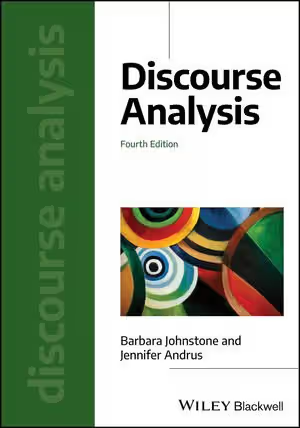
Johnstone, B., & Andrus, J. (2024). Discourse Analysis (4th ed.). Wiley-Blackwell.
Chapter Summary
The book has seven chapters, a glossary and a reference list, in about 320 printed pages. Chapter 1 sets out a method; Chapters 2 to 7 each take up one of the six ways in which, according to the authors, discourse is shaped by its context and in turn shapes it. Every chapter ends with a chapter summary and a further reading list, and the publisher says that the chapters contain discussion questions, research project suggestions and activities.
Chapter 1: Introduction
The opening chapter asks what "discourse" and "analysis" mean, surveys uses of discourse analysis inside and outside linguistics, and introduces the heuristic around which the whole book is organised: six facets of the shaping of texts, each worked through in a short example about advertising for a museum exhibition. The chapter also treats the data of the field (texts, transcripts and corpora), including corpus analysis, the choices involved in transcribing speech, and the difference between "descriptive" and "critical" goals. It closes with sections on locations of meaning, discourse as strategy and as adaptation, "languaging", and the relationship between particularity, theory and method.
Chapter 2: Discourse and World
This chapter looks at how discourse is shaped by, and shapes, the world it refers to. It covers linguistic categories and worldviews, then culture and ideology, with subsections on metaphor and conceptual frames, parallelism and text metricality, and critical discourse analysis. The critical discourse analysis section is broken down into representing actions, actors and events; evaluation; evidentiality; naming and wording; other voices; and collocation and semantic preference. The chapter ends with legitimation and truth, language ideology and silence.
Chapter 3: Intention and Interpretation
The chapter concerns the purposes behind discourse and how hearers and readers interpret it. Its sections are speech acts, conversational implicature and relevance theory; contextualization cues and discourse marking; rhetorical aims, strategies and styles; and verbal art and performance.
Chapter 4: Discourse Structure: Parts and Sequences
Here the focus is on structure and the way language itself constrains and enables discourse. The sections run from words and lines through old and new information and the organization of sentences, cohesion, and paragraphs and episodes, to discourse schemata and narrative structure and the emergent organization of conversation. The chapter closes by discussing structures and rules.
Chapter 5: Participants in Discourse: Relationships, Roles, Identities
This chapter takes up who is speaking and to whom. It deals with audience, politeness and accommodation; power and solidarity; indexicality; social roles and participant frameworks; and performances of identity, with subsections on gender and sexual identity, race and racialization, and place identity. It also covers stance and style, personal identity and the self, and the linguistic individual in discourse.
Chapter 6: Prior Texts, Prior Discourses
The chapter explores how earlier discourse shapes new discourse. Topics are intertextuality and interdiscursivity, repetition in conversation, situational registers, enregisterment, genre as recurrent forms in recurrent actions, and frames, plots and coherence.
Chapter 7: Discourse and Medium
The final chapter considers how media shape discourse. It compares writing and speaking, including early research on orality and literacy and the idea of multiple literacies, then examines mediation through communication technology: medium and discourse form, processing, interpersonal relations, and expertise and knowledge-making. The last part, on multimodal discourse, deals with speech and the body, and with writing and seeing, including what writing looks like, reading images, and words and images.
Key Concepts
Chapter 1: Introduction
- Heuristic: a set of topics for systematic consideration rather than a fixed procedure; the book's six questions can be taken in any order and need not yield a single definitive explanation.
- Entextualization: the analyst's choices about what to treat as a text and where to draw its boundaries, which affect the conclusions drawn.
- Descriptive and critical goals: the two broad aims an analysis may have.
Chapters 2–3: Discourse and World; Intention and Interpretation
- Language ideology: beliefs about language that shape how people talk about and use it.
- Legitimation and truth: the final topic of the critical discourse analysis chapter, concerning how discourse makes claims and positions appear acceptable or true.
- Implicature and relevance theory: accounts of how listeners infer more than what is literally said.
- Contextualization cues: signals that tell participants how to interpret an utterance.
Chapters 4–5: Discourse Structure; Participants in Discourse
- Cohesion: the linguistic links that tie stretches of text together.
- Indexicality: the way linguistic forms point to social meanings, such as identities and relationships.
- Participant frameworks: the roles available to speakers and hearers in an interaction.
- Stance and style: how speakers position themselves and cultivate recognisable ways of speaking.
Chapters 6–7: Prior Texts, Prior Discourses; Discourse and Medium
- Intertextuality and interdiscursivity: relations between a text and other texts or discourses.
- Enregisterment and genre: how ways of speaking and recurrent forms of discourse become recognised and conventional.
- Multimodality: analysing speech with the body and writing with images, not words alone.
Critical Analysis
Strengths
- A flexible organising device. The six-part heuristic gives the book a single frame that students can reapply chapter by chapter. Chapter 1 stresses that the heuristic is not a mechanical sequence and that it is meant to help readers decide which theory a given project needs, instead of starting from a theory and fitting texts to it.
- Built for projects. The publisher highlights discussion questions about research design and research ethics, ideas for research projects, activities, further readings and chapter summaries. Chapter 1 already includes discussion questions that ask readers to compare transcripts and other ways of representing speech.
- Varied data. Chapter 1 draws on English conversation, classroom talk, emergency calls, Danish and Spanish material with English translations, newspaper reports and play scripts, and the publisher notes that exercises use data from many languages and situations, including electronic media.
- Updated for the fourth edition. The publisher lists new discussion questions, project ideas and readings, plus expanded treatment of corpus analysis methods, rhetorical legitimation and social identities.
- Reorderable. According to the publisher, instructors can reorder the chapters to suit their students.
Limitations
- Breadth over depth. A seven-chapter, roughly 320-page book that spans structure, ideology, interaction, identity, genre and media gives each tradition a section or subsection, and critical discourse analysis, for example, occupies one subsection of Chapter 2. Readers wanting extended treatment of one tradition will need the further reading lists or a specialist book.
- No single step-by-step procedure. Because the heuristic is deliberately open, a student who wants a fixed recipe for analysing a text will not find one; the book itself says the heuristic does not guarantee a single explanation.
- Theory is deliberately kept light. Chapter 1 presents the heuristic as a way of grounding analysis in the discourse itself and as a first step that tells the analyst which theory to bring in. Students who want a developed theoretical position will find it in the books they are pointed to rather than in this one.
Where It Fits in the Course
Within the discourse analysis course list, Johnstone and Andrus is a broad, method-oriented textbook in the middle of the range. Rodney Jones's Discourse Analysis: A Resource Book for Students and Brian Paltridge's Discourse Analysis: An Introduction are also introductions that survey approaches, and either can serve as a gentler first book or a companion; Johnstone and Andrus is organised around one heuristic rather than a series of approaches.
James Paul Gee's An Introduction to Discourse Analysis is the closest alternative: it develops a theory of how language builds identities, relationships and social worlds, whereas Johnstone and Andrus offer a wider descriptive toolkit. Deborah Schiffrin's Approaches to Discourse compares six frameworks and Norman Fairclough's Critical Discourse Analysis collects his papers on critical analysis; both are better read after a general introduction like this one.
How to Use This Book
The book suits undergraduates and early graduate students in linguistics, rhetoric and composition, language teaching, communication and related fields. An introductory linguistics course is helpful but not required.
A practical plan: read Chapter 1 closely, including the sections on transcription and on descriptive and critical goals, since the rest of the book assumes its heuristic. Then choose a small text of your own, such as a short conversation, an institutional web page or a social media thread, and work through Chapters 2 to 7 in turn, asking at each chapter what the facet in question reveals about it. The order of Chapters 2 to 7 can be changed to follow your project: Chapters 5 and 6 first for a study of identity, Chapter 7 first for online or multimodal material. Chapter 4 is the most structural and may be skipped or read later if your interest is ideology.
Use the discussion questions and project suggestions to build up to a full analysis, and keep the end-of-chapter further reading for the traditions you decide to pursue. For a critical analysis project, pair Chapter 2 with the sources on critical discourse analysis in the course list.