01 / Reading Guide
Reading Guide
Citation
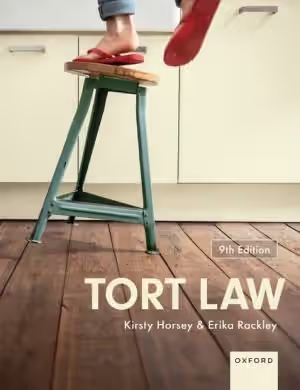
Horsey, K., & Rackley, E. (2025). Tort Law (9th ed.). Oxford University Press.
Chapter Summary
The book has twenty-one chapters and about 830 pages. After a general introduction, nine chapters follow the tort of negligence from its basic principles through the special duty problems, breach, causation and defences. The remaining chapters cover the other main torts, vicarious liability and damages. At the back are annotated problem questions with suggested outline answers, and answers to the end-of-chapter questions. The publisher says that problem questions at the start of chapters set the scene by putting the law in context, and that annotated statutes and judgments explain more difficult points. Only chapter titles are available, so the summaries below describe scope from the titles and the publisher's notes.
Chapters 1–3: Introduction; Introduction to the Tort of Negligence; Duty of Care: Basic Principles
Chapter 1, "Introduction", is a general opening of about 25 pages. Chapters 2 and 3 begin the negligence sequence by introducing the tort and then setting out the basic principles of the duty of care.
Chapters 4–7: Special Duty Problems
Four chapters take the duty of care into the situations where it is contested: "Omissions and acts of third parties" (Chapter 4), "Psychiatric harm" (Chapter 5), "Public bodies" (Chapter 6) and "Economic loss" (Chapter 7). The publisher highlights new treatment of Paul v Royal Wolverhampton NHS Trust, Polmear v Royal Cornwall Hospital NHS Trust and Purchase v Ahmed ([2024] UKSC 1) on psychiatric harm.
Chapters 8–10: Breach, Causation and Defences
Chapter 8 is "Breach of duty: the standard of care", Chapter 9 is "Causation and remoteness of damage" and Chapter 10 is "Defences to negligence". The new-edition notes name McCulloch v Forth Valley Health Board ([2023] UKSC 26) on breach, Holmes v Poeton Holdings Ltd ([2023] EWCA Civ 1377) on causation, and Hassam v Rabot ([2024] UKSC 11) on defences.
Chapters 11–14: Specific Forms of Liability
"Occupiers' liability" (Chapter 11), "Product liability" (Chapter 12), "Employers' liability" (Chapter 13) and "Breach of statutory duty" (Chapter 14) take up four specific forms of liability.
Chapters 15–19: Intentional and Property-Related Torts
Chapter 15, "Intentional interferences with the person", is followed by "Invasion of privacy" (Chapter 16) and "Defamation" (Chapter 17). Chapter 18, "Trespass to land and nuisance", and Chapter 19, "Actions under the rule of Rylands v Fletcher", together run to about seventy pages.
Chapters 20–21: Vicarious Liability; Damages for Death and Personal Injuries
The book closes with "Vicarious liability" (Chapter 20) and "Damages for death and personal injuries" (Chapter 21). The publisher names Trustees of the Barry Congregation of Jehovah's Witnesses v BXB ([2023] UKSC 15) as a new authority on vicarious liability.
Annotated Problem Questions and Answers
The end matter contains "Annotated problem questions and suggested outline answers" (from p. 671) and "Answers to end-of-chapter questions" (from p. 733).
Key Concepts
Negligence
- Duty of care: the opening requirement of the tort, developed in Chapters 3 to 7, including omissions, third parties, psychiatric harm, public bodies and economic loss.
- Standard of care and breach: Chapter 8's test for whether the defendant fell short.
- Causation and remoteness: the link between the breach and the damage, and its limits (Chapter 9).
- Defences: the ways liability may be reduced or excluded (Chapter 10).
Other Torts and Liability
- Occupiers', product and employers' liability; breach of statutory duty: the specialised liabilities of Chapters 11 to 14.
- Intentional interferences, privacy and defamation: torts protecting the person and reputation, in Chapters 15 to 17.
- Trespass, nuisance and the rule in Rylands v Fletcher: land-based liability in Chapters 18 and 19.
Responsibility and Remedies
- Vicarious liability: liability for another's tort (Chapter 20).
- Damages for death and personal injuries: the measure of compensation (Chapter 21).
Critical Analysis
Strengths
- Built for a first course. The publisher presents the book as taking students "from zero knowledge to engaged and critical thinkers", and the order of chapters follows the usual teaching sequence: negligence first, then the other torts, then vicarious liability and damages.
- Problem questions throughout. Problem questions open chapters, outline answers are provided, and an annotated version points out issues and cases to consider. This is directly useful for exam preparation.
- Prompts for critical thinking. "Counterpoint" and "pause for reflection" boxes ask readers to engage with controversy and reform, and annotated statutes and judgments model the skills of reading and analysing primary sources.
- Digital supports. The e-book and Law Trove add author videos in every chapter, multiple-choice self-test questions and interactive decision trees for key torts.
Limitations
- Length. At about 830 pages, it is a long book for a first course, so selective reading by chapter is likely.
- Negligence takes the largest share. Nine of the twenty-one chapters are on negligence in the narrow sense, and nuisance, trespass to land and Rylands v Fletcher together get about seventy pages, so courses with a heavier land-based emphasis may need extra reading.
- Several supports are digital only. The videos, multiple-choice questions and decision trees are available only on Law Trove and in the e-book, so print readers do not have them.
Where It Fits in the Course
Horsey and Rackley is the accessible, student-focused textbook in this tort list, and it is a sensible main text for a first course. McBride and Bagshaw's Tort Law is another general course textbook. Lunney, Nolan and Oliphant's Tort Law: Text and Materials adds extracts from cases and articles for students who want more of the source material. Markesinis and Deakin's Tort Law is a comprehensive textbook, and Street on Torts and Winfield and Jolowicz on Tort are larger works to consult for further reading and detailed authority.
Two of the course mates do something different. Cane and Goudkamp's Atiyah's Accidents, Compensation and the Law sets tort beside insurance and compensation schemes, and is useful once the doctrine is understood. Stevens's Torts and Rights is a monograph arguing that tort is the law of rights, and suits essay work on theory.
How to Use This Book
The book assumes no earlier study of tort law and is designed for students in their first course on the subject, particularly those who value problem-solving practice and signposts for critical discussion.
A practical plan:
- Core: Chapters 2 to 10 on negligence, in order, since each builds on the duty and breach framework introduced early on. Chapter 20 on vicarious liability and Chapter 21 on damages complete the core.
- According to the syllabus: Chapters 11 to 19 can be read in whatever order the course takes the other torts. Nuisance, trespass to land and Rylands v Fletcher share Chapters 18 and 19.
- Practice: attempt the problem question at the start of each chapter before reading the chapter, then compare with the outline answer. Use the end-of-chapter questions and the annotated problem questions at the back for revision, and use the recent Supreme Court cases named by the publisher as a checklist of current authority.