01 / Reading Guide
Reading Guide
Citation
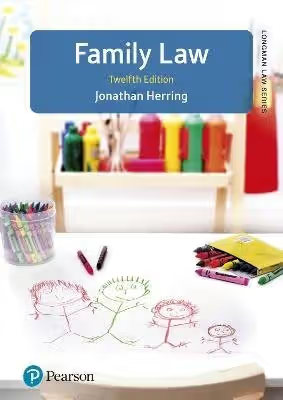
Herring, J. (2025). Family Law (12th ed.). Pearson. Longman Law Series.
Chapter Summary
The contents list has twelve chapters, introduced by a preface and tables of cases, statutes, statutory instruments and European and international legislation, and followed by an index. The chapter titles are given here in their printed order. The sequence runs from the subject and its courts, through adult relationships and their breakdown, to the law on children and the family beyond the couple. Pearson describes the book as guiding the reader through the theories, debates, and political and ethical dilemmas surrounding the subject, so that readers can criticise existing law and evaluate options for reform.
What is family law?; Family justice
The first two chapters introduce the subject and then turn to family justice, the machinery through which family disputes reach the courts.
Marriage, civil partnership and cohabitation; Divorce
These chapters cover the legal forms of adult relationships, including couples who live together without marrying or registering a partnership, and the ending of a marriage or civil partnership. Pearson lists the impact of the new divorce regime among the updates in the 12th edition.
Family property; Property on separation; Domestic abuse
The next chapters take property within a relationship, the dividing of property when the relationship ends, and domestic abuse. They are the finance and protection chapters of the book.
Who is a parent?; Parents' and children's rights; Private disputes over children; Child protection
The book then turns to children: who counts as a legal parent, the rights of parents and children, disputes between private parties over children's upbringing, and the state's role in child protection. Among the 12th edition's updates Pearson lists a case on trans and gender-questioning children (Re J (Transgender: Puberty blocker and Hormone Replacement Therapy) [2024]).
Families and older people
The final chapter extends the subject to families and older people. The publisher also lists the issue of predatory marriage among the 12th edition's updates.
Key Concepts
Adult relationships and their breakdown
- Marriage, civil partnership and cohabitation: the three forms of adult relationship the book sets side by side.
- Divorce: the ending of marriage, including the new divorce regime the publisher refers to.
- Family property and property on separation: ownership of property during a relationship and the division of property when it ends.
- Domestic abuse: the subject of its own chapter.
Parents, children and wider families
- Parenthood: the question posed by the chapter title "Who is a parent?".
- Parents' and children's rights: the rights the two groups hold, as the chapter title indicates.
- Private disputes over children and child protection: the two routes by which the law regulates children's upbringing, one between private parties and one involving the state.
- Families and older people: the book's closing chapter.
Critical Analysis
Strengths
- Theory and debate alongside law. Pearson says the text guides readers through the theories, debates, and political and ethical dilemmas of the subject so that they can critique existing law and evaluate reform options.
- Case studies in every chapter. According to the publisher, each chapter contains case studies relevant to understanding the subject, which helps readers connect rules to circumstances.
- Study support. Pearson lists end-of-chapter callbacks to debate questions and further reading, which make the debates easier to revisit and the reading easier to extend.
- Breadth of the family. Besides adults and children, the list includes a chapter on families and older people, and a separate chapter on family justice.
Limitations
- No separate chapters on adoption or on rights on death. The contents list has no chapter titled for either topic. Courses that cover them will need another text, such as another textbook in the list.
Where It Fits in the Course
Herring's Family Law is a main course textbook that serves the same purpose as Cretney and Probert's Family Law. The two cover similar ground in a different order and with different emphases: Cretney and Probert has fifteen chapters, with separate chapters on rights on death and adoption, while Herring has twelve and adds chapters on family justice and on families and older people. A student can use either as the main text and the other for a second view of a topic.
For a quick first look, Herring's own Family Law: A Very Short Introduction explains why the law takes its shape in a brief space, and John Eekelaar's Family Law and Personal Life takes a thematic approach through power, rights, respect and responsibility. Bromley's Family Law (12th edition) is a longer and more detailed account for readers who need the fuller statement of statute and case law, and Claire Fenton-Glynn's Children and the European Court of Human Rights is a monograph on one strand of children's rights.
How to Use This Book
The book suits undergraduates taking a family law module, including modules on adult relationships or on child and adult family law, which Pearson names as the intended courses. Knowing how to read cases and statutes helps, since the book combines a statement of the law with discussion of the debates around it.
A practical plan:
- Core: the chapters on marriage, civil partnership and cohabitation, divorce, family property and property on separation, who is a parent, parents' and children's rights, and private disputes over children.
- Related topics: domestic abuse, family justice and child protection.
- Selective: families and older people, when the module covers it.
Use the end-of-chapter debate questions as essay practice and the further reading to extend each topic. Where the book discusses recent developments, such as the new divorce regime, check the current statute or guidance before relying on a summary.