01 / Reading Guide
Reading Guide
Citation
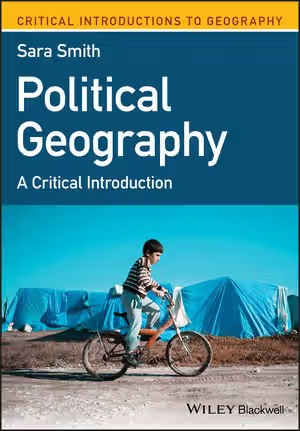
Smith, S. (2020). Political Geography: A Critical Introduction. Wiley-Blackwell. Critical Introductions to Geography.
Chapter Summary
The book has about 310 pages in thirteen chapters, interleaved with ten short "Geographer at Work" pieces in which political geographers, many of them the "rising scholars" mentioned by the publisher, describe their own research; the first is by Smith herself. Instead of beginning with the state and moving outwards, the order runs from citizenship and the nation through territory, borders, cities and social movements to decolonization, geopolitics, security, intimacy, biopolitics and the future. The publisher describes critical, postcolonial and feminist perspectives as woven through every chapter; Chapter 2, for example, opens with an epigraph and a question addressed to the reader, works through research case studies, and ends with further reading organized by theme.
Chapter 1: Introduction
The opening chapter sets out the book's approach; the publisher defines political geography as the study of how power struggles shape, and are shaped by, the places in which they occur. Chapter 2 refers back to one of its themes, that categories structure thought and can hide what is in front of us. It is followed by Smith's own "Geographer at Work" piece.
Chapter 2: Citizenship Fails
The chapter opens with Audra Simpson's account of refusing to be called an American at the border ("I am a Mohawk") and asks readers when they first became aware of their own citizenship. Defining citizenship as a legal relationship with rights and responsibilities, "the right to have rights", it argues that citizenship always fails to protect some people. Sections follow on "ordinary" citizenship and the DREAMers and DACA students, the unevenness of citizenship by race, sexuality and gender identity (the gap between de jure and de facto rights, illustrated by a man ejected from a London pub for kissing his date), insurgent citizenship (from a protest "kiss-in" to squatters in São Paulo), and Indigenous refusal of settler-state citizenship, centred on the 1972 Aboriginal Tent Embassy in Canberra. The chapter points forward to later chapters on security, biopolitics and geopolitics.
Chapter 3: Living the Nation
The chapter turns to nationalism and national belonging; the publisher lists the role of nationalism in shaping allegiances among the book's topics, and Chapter 2 notes that recognition and sovereignty are taken up again here. It is followed by a "Geographer at Work" piece by Michelle Daigle.
Chapters 4–5: Power/Territory; State/Borders
Two shorter chapters treat the core concepts of territory and of the state and its borders, each followed by a "Geographer at Work" piece (Azeezat Johnson; Ali Hamdan). The publisher notes that the book covers the Eurocentric origins of many of the discipline's key concepts.
Chapters 6–7: Urban Politics; Social Movements
The book then examines the spatial aspects of urban politics and of social movements, with a "Geographer at Work" piece by Willie Wright.
Chapter 8: Decolonizing Political Geography?
The question-mark title marks a chapter on decolonial critiques of the field, linked in the publisher's description to how critiques of political geography intersect with decolonial, feminist and queer movements. A "Geographer at Work" piece by Deondre Smiles follows.
Chapters 9–11: Geopolitics; Security; Intimate Geopolitics
Three chapters move from geopolitics and the relation between international relations and security to "intimate geopolitics", the connection between global politics and bodies and everyday life that is the focus of Smith's own research. Chapter 2 signals that Chapter 10 returns to mass incarceration. "Geographer at Work" pieces by Edgar Sandoval and Pavithra Vasudevan accompany these chapters.
Chapters 12–13: Biopolitics and Life Itself; Life in the Future, Among the Ruins
The final chapters deal with biopolitics, the government of life and populations, and, in the closing chapter, with the future. The publisher's list of topics includes the effects of non-human actors in politics. The book closes with a "Geographer at Work" piece by Mabel Gergan.
Key Concepts
Chapters 1–3: Introduction; Citizenship Fails; Living the Nation
- Citizenship as "the right to have rights": a legal relationship with the state that, by its structure, leaves some people unprotected.
- De jure and de facto citizenship: rights held in law versus rights that can actually be exercised in daily life.
- Insurgent citizenship: citizenship claimed by marginalized people through new spaces of political action rather than granted by the state.
- Refusal and Indigenous sovereignty: the rejection of settler-state citizenship in favour of the self-government of Indigenous nations.
Chapters 4–8: Territory, State, Cities, Movements, Decolonization
- Territory: space claimed and controlled through power, treated as a core concept with a history.
- Borders: the boundaries of states, presented in Chapter 2 as sites where racialized and gendered national identity is made.
- Decolonizing the discipline: questioning the Eurocentric origins of political geography's concepts.
Chapters 9–13: Geopolitics, Security, Intimacy, Biopolitics, the Future
- Geopolitics and security: the spatial practices of states and international relations, and who is made secure or insecure by them.
- Intimate geopolitics: the idea that geopolitics is made through bodies, love, friendship and birth as well as through states.
- Biopolitics: power exercised over life, bodies and populations.
Critical Analysis
Strengths
- Political geography through lived experience. Chapter 2 starts from the reader's own encounters with passports and immigration lines and builds its argument from concrete cases (DACA students in North Carolina, a London pub, the Aboriginal Tent Embassy), making abstract concepts tangible for students new to the field.
- Research shown, not just reported. The publisher stresses case studies that show how political geographers do research, and the ten "Geographer at Work" pieces give first-hand accounts of research from ten political geographers.
- A consistently critical perspective. Feminist, postcolonial, queer and Indigenous scholarship is integrated into each topic rather than added at the end, and the book openly addresses the Eurocentric origins of the discipline's concepts.
- Strong guidance for further study. Chapter 2's further reading is organized by theme (for example settler colonialism and Indigenous sovereignty, trans geographies), which makes it easy to follow a topic into the research literature.
Limitations
- Less on the conventional canon. No chapter is devoted to electoral geography or world-systems analysis, and the territory and state chapters are among the shortest in the book; students who need conventional coverage will want a second text.
- North American and settler-colonial emphasis. Chapter 2's cases come mainly from the United States, the United Kingdom, Canada and Australia, with Brazil as the main exception.
- Tied to its moment. Discussion of DACA under the Trump administration and of Brexit "as it approaches" places the book in 2019–2020; students should check later developments.
Where It Fits in the Course
Smith's book is the most accessible and most explicitly critical of the course's general political geography texts. Klaus Dodds's Geopolitics: A Very Short Introduction is a short companion that traces geopolitical thought from early twentieth-century theorists to critical approaches, useful background for Chapters 9–11. For a more conventional and comprehensive framework, Flint and Taylor's Political Geography: World-Economy, Nation-State and Locality organises the field through world-systems analysis and scales from global to local, and Painter and Jeffrey's Political Geography is a theoretically engaged text built around the state, territory, citizenship, nationalism and geopolitics. Reading Smith alongside either shows how differently the same concepts can be framed.
For depth on a single concept, Stuart Elden's The Birth of Territory traces the idea of territory in Western political thought and is a natural next step from Chapter 4. Harm de Blij's Why Geography Matters More Than Ever offers a contrasting, broader argument about place, distance and resources in global politics.
How to Use This Book
The publisher presents the book as accessible to students new to political geography while useful to graduate students seeking an overview. No prior study of political geography is needed.
- Read Chapters 1–2 first. They establish the approach and the habit of questioning categories that the rest of the book depends on.
- Follow the sequence for a course, or group chapters by theme: identity and belonging (2–3), territory and the state (4–5), the city and activism (6–7), and the global and the intimate (9–12), with Chapter 8 as a hinge between them.
- Use the "Geographer at Work" pieces as models for research projects: note each researcher's question, method and site.
- Answer the opening questions. Chapter 2 begins by asking readers about their own experience of citizenship; wherever a chapter opens this way, writing short answers before and after reading shows what the chapter changes.
- Pair with a conventional text (Flint and Taylor, or Painter and Jeffrey) if an examination expects coverage of classical political geography.