01 / Reading Guide
Reading Guide
Citation
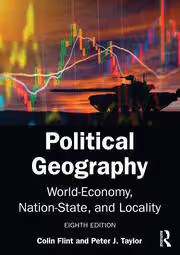
Flint, C., & Taylor, P. J. (2025). Political Geography: World-Economy, Nation-State, and Locality (8th ed.). Routledge.
Chapter Summary
The eighth edition runs to about 330 pages of text in a prologue, eight chapters and an epilogue, followed by a glossary and a bibliography; the front matter includes a section of tips for reading the book. The book's title states its organizing idea: political geography is examined at three scales, the world-economy, the nation-state and the locality, and the chapters move broadly from the first to the last. The publisher describes the approach as world-systems analysis complemented by the perspective of feminist geography, combining the research agendas of the two authors, and says this edition updates the examples throughout and adds new sections on global climate change, populism and the growing threat of global war.
Prologue: Episodes in the Life and Times of a Sub-discipline
A short history of political geography as a field, setting the book in the development of the subdiscipline before its own framework is introduced.
Chapter 1: A World-Systems Approach to Political Geography
The theoretical foundation, and one of the longer chapters. It sets out world-systems analysis as the book uses it, the framework associated with Immanuel Wallerstein: the capitalist world-economy, its division into core, semi-periphery and periphery, the inter-state system, and the long cycles of economic growth and hegemony against which the later chapters read political change. The tension the publisher highlights, between the global scale of economic processes and the territorial organization of politics, starts here.
Chapter 2: Geopolitics Rampant
Geopolitics at the global scale: how states and leaders understand the world and their place in it, how geopolitical world orders form and change, and the rivalry of hegemonic powers. The publisher's description and endorsements point to updated material on US–China competition, Russia's war with Ukraine and the revival of hegemonic rivalry.
Chapter 3: Geography of Imperialisms
Imperialism in the plural: formal empires and colonialism, informal imperialism, and their place in the core–periphery structure of the world-economy.
Chapter 4: Territorial States
The state as a territorial institution: sovereignty, territory and boundaries, and the role of states within the capitalist world-economy. At over forty pages it is among the most substantial chapters.
Chapter 5: Nation, Nationalism, and Citizenship
How nations are constructed, the varieties and uses of nationalism, the fusion of nation and state in the nation-state, and citizenship as a relationship between people and states.
Chapter 6: Political Geography of Democracy
The longest chapter, on liberal democracy, elections and voting, set within the world-economy framework. The publisher lists challenges to democracy and populism among the edition's themes.
Chapter 7: Cities as Localities
The turn to the local scale, treating cities as political places within the wider world-economy.
Chapter 8: Place and Identity Politics
The final chapter brings the analysis to place, everyday life and identity politics. Alexander Murphy's endorsement mentions transnational migration and non-traditional forms of identity politics among the contemporary developments the edition addresses.
Epilogue: A Political Geography Framework for Understanding Our 21st-Century World
A short conclusion that draws the scales together into a framework for interpreting the present, in line with the publisher's statement that the book aims to help students judge how the world got where it is and what may or should be done about it.
Key Concepts
Prologue and Chapter 1: The framework
- World-systems analysis: studying social change at the scale of the capitalist world-economy rather than of individual countries.
- Core, semi-periphery and periphery: the unequal zones of the world-economy, linked by unequal exchange.
- Hegemonic cycles and Kondratieff waves: long-run rhythms of hegemonic power and economic growth and stagnation, with their A- and B-phases.
- Scale: the book's division of political geography into the world-economy, the nation-state and the locality.
Chapters 2–5: Global and state scales
- Geopolitical codes and world orders: states' assumptions about allies and enemies, and the global orders those codes combine into.
- Critical geopolitics: analysing how geopolitical knowledge is produced and used.
- Formal and informal imperialism: control through colonial rule versus control through economic and political dependence.
- Sovereignty and territory: the state's claim to authority over a bounded space within the inter-state system.
- Nationalism and citizenship: the making of national identity and the rights and obligations tying people to states.
Chapters 6–8 and Epilogue: Democracy and localities
- Liberal democracy: elections, parties and voting, and their uneven distribution in the world-economy.
- Localities and place: the scale at which people experience politics directly.
- Identity politics and feminist geography: gender, ethnicity and everyday life as sites of political struggle.
Critical Analysis
Strengths
- A single, consistent framework. Rather than surveying topics, the book applies one approach, world-systems analysis complemented by feminist geography, at every scale. Virginie Mamadouh (University of Amsterdam), in an endorsement quoted by the publisher, points to its scalar organization, the systematic application of world-systems analysis and its broad coverage of other approaches, and praises the coherence it keeps while incorporating new scholarship.
- Long development. Meredith DeBoom's publisher-quoted endorsement notes that the text is forty years old; now in its eighth edition, it has been revised repeatedly to follow world events, and this edition adds material on climate change, populism, US–China competition and the war in Ukraine.
- Global and local connected. The three-scale structure lets students see how state territories, nationalism and democracy are shaped both by the world-economy above them and by places and identities below them.
- Support for readers. A prologue on the history of the subdiscipline, reading tips and a glossary help students new to the field and to the vocabulary of world-systems analysis.
Limitations
- One theoretical lens. The book is an argument for a particular approach. Students who want a neutral survey of political geography's theories, or who are unconvinced by world-systems analysis, should read a more pluralist textbook alongside it.
- Theory first. Chapter 1, almost forty pages of framework, comes before the more familiar topics of geopolitics, states and nations, and the later chapters build on it. Readers new to the field may find the start heavy and should expect to return to it.
- Current events date quickly. Much of the new material concerns events still unfolding at the time of writing (the war in Ukraine, US–China rivalry, artificial intelligence), and these sections will age faster than the framework.
Where It Fits in the Course
In the political geography list, the book is the main theoretical textbook at the core of a course. Dodds's Geopolitics: A Very Short Introduction is a concise introduction to geopolitical ideas that prepares for Chapter 2, and Sara Smith's Political Geography: A Critical Introduction is an introductory textbook that treats power in space at every scale through feminist, anti-colonial and critical approaches; it covers similar ground from a different angle and is the better first book for students who find world-systems analysis abstract. De Blij's Why Geography Matters More Than Ever is a general-audience argument about the importance of place, resources and environment in world affairs, suitable as background reading.
Painter and Jeffrey's Political Geography is a more theoretically engaged, concept-led text drawing on social theory; reading it after Flint and Taylor shows how the state, territory and citizenship look outside a world-systems frame. Elden's The Birth of Territory is a history of the concept of territory in Western political thought and deepens Chapter 4 for students heading into advanced or graduate work.
How to Use This Book
The book is aimed at students of political geography, geopolitics, international relations and political science, and more broadly at human geography and social science students. An introductory human geography or politics course and some knowledge of modern world history help.
A reading plan:
- Start with the reading tips and the Prologue, then work carefully through Chapter 1. Keep notes on its core terms (core, semi-periphery, periphery, hegemonic cycles, A- and B-phases), since every later chapter uses them; the glossary helps.
- Chapters 2–5 in order form the core of a course on geopolitics and the state: global geopolitics, imperialisms, territorial states, then nations and citizenship.
- Chapters 6–8 extend the analysis to democracy, cities and identity politics; a course weighted toward the state can treat Chapter 7 or 8 as optional, while a course on place and identity should not.
- Finish with the Epilogue, using its framework to analyse a current event of your choice.
A useful exercise for each chapter is to take one news story and ask how it looks at each of the book's three scales. Read a chapter of Smith or Painter and Jeffrey on the same topic to compare a different theoretical approach with the world-systems account.