01 / Reading Guide
Reading Guide
Citation
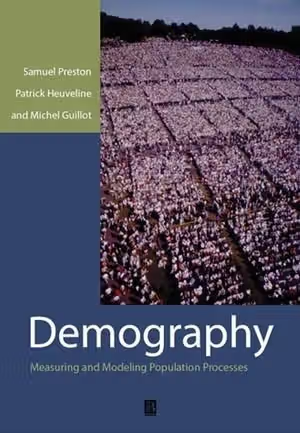
Preston, S. H., Heuveline, P., & Guillot, M. (2000). Demography: Measuring and Modeling Population Processes. Wiley-Blackwell.
Chapter Summary
The book has 12 chapters in about 320 pages. Wiley describes it as presenting and developing the basic methods and models that demographers use to study the behaviour of human populations, with procedures built from first principles and extensive applications. Chapter 12 is contributed by Alberto Palloni of the University of Wisconsin. The sequence runs from basic measures (Chapters 1 and 2), through life tables and fertility measurement (3 to 5), to projection and population models (6 to 9), and ends with data evaluation and estimation where data are poor (10 to 12).
Chapter 1: Basic Concepts and Measures
The opening chapter defines what a "population" is for demographers: either the people alive at a point in time or an enduring collectivity whose members keep changing. It introduces the balancing equation of population change, in which a population changes only through births, deaths, in-migration and out-migration, and then builds the structure of demographic rates. Its sections cover period rates and person-years, the principal period rates, growth rates, the estimation of person-years, the concept of a cohort and the probabilities of occurrence of events. The chapter uses algebra and calculus interchangeably, and illustrates the crude rates with Swedish data.
Chapters 2-4: Age-specific Rates and Probabilities; The Life Table and Single Decrement Processes; Multiple Decrement Processes
Chapter 2 moves from crude to age-specific rates and covers age standardization, the decomposition of differences between rates, the Lexis diagram and age-specific probabilities. Chapter 3 constructs period life tables, including choices for the very young and open-ended ages, interprets the table as a stationary population, treats mortality as a continuous process, and adapts the method to other single decrement processes. Chapter 4 extends this to multiple decrements, with cause-specific decomposition of differences in life expectancy.
Chapter 5: Fertility and Reproduction
The chapter covers period fertility rates and their decomposition, cohort fertility, birth interval analysis and reproduction measures.
Chapter 6: Population Projection
Starting from the difference between projections and forecasts, the chapter develops the cohort component method, its matrix form, the projection of the U.S. population by the U.S. Bureau of the Census, alternative forecasting methods, and the accuracy and uncertainty of projections.
Chapters 7-8: The Stable Population Model; Demographic Relations in Nonstable Populations
Chapter 7 starts from a simplified example of a stable population, presents Lotka's conditions and the equations that characterize a stable population, relates the intrinsic growth rate to the net reproduction rate, and treats the effects of changing fertility and mortality and the momentum of population growth. Chapter 8 generalizes to populations that are not stable, with relations in continuous age and time, age-structural dynamics and variable-r methods of estimation.
Chapter 9: Modeling Age Patterns of Vital Events
The chapter presents model age patterns of mortality, nuptiality, fertility and migration.
Chapters 10-11: Methods for Evaluating Data Quality; Indirect Estimation Methods
Chapter 10 covers statistical and demographic methods for finding coverage and content errors. Chapter 11 presents indirect estimation: the Brass method for child mortality from child survivorship, estimation of adult mortality from orphanhood, the sisterhood method for maternal mortality, maternity histories, and methods using age distributions from two censuses.
Chapter 12: Increment-Decrement Life Tables
Contributed by Alberto Palloni, the chapter generalizes the life table to populations in which people can both enter and leave a state, starting with a two-state system and ending with programs for calculating such tables.
Key Concepts
Chapters 1-5: Measurement
- Balancing equation: the identity that a population's size changes only through births, deaths and in- and out-migration.
- Person-years and occurrence/exposure rates: the denominator that makes demographic rates comparable.
- Cohort and period perspectives: following a real group over time versus summarizing one calendar period.
- Age standardization and decomposition: removing or attributing differences in rates due to age structure.
- Life table, multiple decrement table: tools for mortality and other exits from a population.
- Reproduction measures: summaries of fertility and replacement.
Chapters 6-9: Models
- Cohort component projection: advancing a population by age cohort with assumed fertility, mortality and migration.
- Stable population and momentum: the age structure produced by constant rates, and why growth continues after fertility falls.
- Variable-r methods: relations that hold when growth is not constant.
- Model age patterns: standard shapes of mortality, nuptiality, fertility and migration.
Chapters 10-12: Data and estimation
- Coverage and content error: undercount and misreporting in demographic data.
- Indirect estimation: methods such as the Brass method and the sisterhood method.
- Increment-decrement tables: life tables with movement in both directions between states.
Critical Analysis
Strengths
- First-principles development. Wiley describes procedures developed clearly and concisely from first principles. Chapter 1 shows the approach: the balancing equation, a lifeline representation of person-years and a single rate framework from which later functions follow. The authors note that using person-years as the denominator gives a firm basis for integrating many formulas.
- Algebra and calculus together. The authors announce that they use both interchangeably, which prepares readers to move between discrete tables and continuous models.
- Methods that work with poor data. Chapters 10 and 11, with the Brass, orphanhood and sisterhood methods, deal with data that are incomplete or unreliable, a situation that registration-poor settings make common.
- Compact scope. Twelve chapters and about 320 pages give a coherent toolkit in a compact book.
Limitations
- Methods, not causes. The chapters concentrate on measurement and models. There are no chapters on the social, economic and political determinants of fertility, mortality and migration, so it complements rather than replaces a substantive population text.
- Migration appears only as one component. Migration enters through the balancing equation, model age patterns (Section 9.4) and increment-decrement tables, without a chapter of its own.
- Dated examples. The book appeared in 2000 and uses data and projection examples of that time, such as the projection of the U.S. population in Section 6.6.
- Mathematical demands. Derivations rely on calculus and matrix notation. Software support is mentioned only for increment-decrement life tables (Section 12.7), so computation is left to the reader.
Where It Fits in the Course
Within the population and migration list, this is the formal-methods text. Weeks and López-Carr's Population: An Introduction to Concepts and Issues and Newbold's Population Geography: Tools and Issues explain how fertility, mortality and migration shape populations, and Newbold also introduces the basic tools of measurement; both are the places to build the substantive picture before turning to the derivations here. Koser's International Migration: A Very Short Introduction, de Haas, Castles and Miller's The Age of Migration and Massey and colleagues' Worlds in Motion cover migration, the component for which Preston, Heuveline and Guillot provide little more than a place in the accounting framework.
A student who wants to move from reading demographic statistics to computing them should read Newbold or Weeks first and use Preston, Heuveline and Guillot as the next step, with the book's methods applied to their own data.
How to Use This Book
The book is for graduate students and advanced undergraduates in demography, population geography, sociology or public health who have had a population course and are comfortable with algebra, logarithms and basic calculus.
A practical plan:
- Core: Chapters 1 to 3, then 5 and 6. They give the vocabulary of rates, the life table, fertility measures and projection.
- Second layer: Chapters 4, 7 and 8 for multiple decrements and stable population theory; Chapter 9 for model age patterns.
- For work with poor data: Chapters 10 and 11, which are the ones to use where registration is incomplete; Chapter 12 for multi-state processes such as marital or labor force status.
- Practice: work through the worked examples by recomputing them with a spreadsheet or statistical software, and apply each method to a population of your choice.