01 / Reading Guide
Reading Guide
Citation
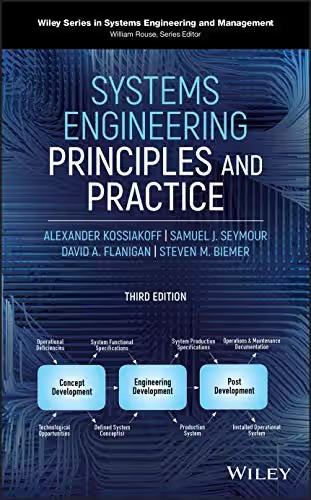
Kossiakoff, A., Seymour, S. J., Flanigan, D. A., & Biemer, S. M. (2020). Systems Engineering Principles and Practice (3rd ed.). John Wiley & Sons (Wiley Series in Systems Engineering and Management).
Chapter Summary
The third edition has 23 chapters in five parts, about 640 pages of text (Wiley lists 688 pages in all), and keeps the prefaces to all three editions. The authors are or were faculty of the systems engineering programme at the Johns Hopkins University Whiting School of Engineering, which Alexander Kossiakoff, a former director and chief scientist of the Johns Hopkins Applied Physics Laboratory, chaired. Wiley describes the book as an introductory first text on the development and acquisition of complex technical systems for advanced undergraduates and graduate students, organized to teach the reader to "think like a systems engineer", and lists updated material on risk, prototyping, modelling and simulation, and software systems engineering. Every chapter ends with a summary section, and the free excerpt of Chapter 1 shows a set of problems and a further reading list after it.
Part I, Chapter 1: Systems Engineering and the World of Modern Systems
The opening chapter, available as a free excerpt, defines the function of systems engineering as guiding the engineering of complex systems, and restricts "system" to engineered systems whose diverse elements have intricate relationships (a washing machine does not qualify). It explains how systems engineering differs from the traditional disciplines (it looks at the whole system, leads concept development and bridges specialties) and how it relates to project management, then surveys the systems engineering landscape, the "systems engineering viewpoint", examples of systems that require it, typical activities and documents, the profession, and a career development model built on experience, mentoring and a "T"-shaped combination of breadth and depth.
Part I, Chapters 2–4: Structure of Complex Systems; The System Development Process; Systems Engineering Management
Chapter 2 analyses systems into elements, hierarchies, building blocks, environment and interfaces, and discusses complexity. Chapter 3 presents the system life cycle used throughout the book, the evolutionary character of development, the "systems engineering method" and testing across development. Chapter 4 covers managing development: the work breakdown structure, the systems engineering management plan and the organization of systems engineering.
Part II, Chapters 5–8: Needs Analysis; Requirements Analysis; Functional Analysis; Evaluation and Selection
The concept development stage. Chapter 5 covers originating a new system, systems thinking, operations analysis, feasibility and needs validation. Chapter 6 develops system requirements: their sources, attributes, hierarchy, metrics, verification and validation, with a comparison of traditional and agile requirements development. Chapter 7 covers selecting a concept, functional analysis and allocation, functional products and traceability. Chapter 8 deals with alternatives analysis, operations research techniques, economics and affordability, concept selection and validation, again with a traditional-versus-agile comparison.
Part II, Chapters 9–12: Systems Architecting; Model-Based Systems Engineering (MBSE); Decision Analysis and Support; Risk Management
Chapter 9 introduces types of architecture, architecture frameworks and views, and architecture development, traceability and validation. Chapter 10 introduces MBSE, its languages and tools, and its use across the life cycle, with examples. Chapter 11, one of the longest, covers decision making, modelling, simulation, trade-off analysis and evaluation methods. Chapter 12 places risk management within the life cycle, with risk traceability and analysis techniques.
Part III, Chapters 13–17: Advanced Development; Software Systems Engineering; Engineering Design; Systems Integration; Test and Evaluation
The engineering development phase. Chapter 13 is about reducing uncertainty, including prototype development as a means of reducing risk and development testing. Chapter 14, the longest chapter, treats software: its components, complexity and abstraction, life-cycle models, analysis and design, coding, integration and test, and management. Chapter 15 covers component design, design validation and configuration management. Chapter 16 covers the integration hierarchy, types of integration, planning and facilities. Chapter 17 covers developmental and operational test and evaluation, human factors testing, test planning and test traceability, and testing systems of systems.
Part IV, Chapters 18–20: Production; Operation and Support; System of Systems Engineering
The post-development stage: systems engineering in the factory and the transition from development to production (Chapter 18); installation, in-service support and major upgrades, and the operational factors that should shape development (Chapter 19); and the differences, types, attributes and challenges of system of systems engineering (Chapter 20).
Part V, Chapters 21–23: Enterprise Systems Engineering; Systems Security Engineering; The Future of Systems Engineering
Three short chapters on wider domains: definitions, processes and challenges of enterprise systems engineering; types of security and their application to systems engineering; and areas for applying the systems approach and the education of future systems engineers.
Key Concepts
Part I: Foundations
- Systems engineering: guiding the engineering and development of complex systems, with the success of the whole system as the central objective.
- Systems engineering viewpoint: subordinating the goals of individual parts to those of the overall system.
- System life cycle: the stages from concept development through engineering development to post-development, which organize the book.
- Work breakdown structure and SEMP: the main tools for planning and managing systems engineering.
Part II: Concept development
- Needs analysis and operations analysis: establishing that a new system is needed and feasible.
- Requirements hierarchy and traceability: structuring requirements and tracing them through functions and design.
- Functional analysis and allocation: defining what the system must do and assigning functions to elements.
- Architecture frameworks and MBSE: describing a system through architectural views and formal models.
- Trade-off analysis and risk management: choosing among alternatives and controlling uncertainty.
Parts III–V: Development, deployment and domains
- Prototyping as risk mitigation: building prototypes to reduce uncertainty before full development.
- Integration and test and evaluation: assembling the system and verifying it in developmental and operational testing.
- System of systems: collections of independent systems that must work together.
- Enterprise and security systems engineering: extending the systems approach to organizations and to security.
Critical Analysis
Strengths
- A clear life-cycle structure. The parts follow a system from foundations and concept development through engineering development to production, operation and support, so the book can be used as a map of the discipline.
- Concept development treated in depth. Part II gives eight chapters to needs, requirements, functions, evaluation, architecture, MBSE, decision analysis and risk, the stage where, as Chapter 1 argues, systems engineers lead the design.
- Updated for current practice. This edition adds a chapter on MBSE, comparisons of traditional and agile approaches in requirements and concept evaluation, and chapters on systems of systems, enterprise and security engineering.
- Strong on the profession. Chapter 1 discusses what distinguishes systems engineering from other disciplines and from project management, and how systems engineers develop, which helps students see what the role involves.
Limitations
- Breadth over depth in newer topics. MBSE, enterprise systems engineering, security and systems of systems each receive a single chapter of 13–21 pages, enough for orientation but not for practice; SysML modelling, for instance, needs a dedicated text.
- Light on mathematics. Quantitative methods are concentrated in Chapters 8 and 11, and the table of contents has no chapters on reliability, maintainability or life-cycle cost models; students who need these must look elsewhere.
- Large-programme orientation. The authors' background at the Applied Physics Laboratory and the emphasis on development and acquisition of complex systems give the book a large-programme orientation; readers in small product teams will need to scale its processes down.
- Long. About 640 pages make it difficult to cover in one course; selection is necessary.
Where It Fits in the Course
In this systems engineering course, Kossiakoff and colleagues are the main process-oriented text. Blanchard and Fabrycky's Systems Engineering and Analysis covers the same life cycle with far more quantitative analysis (decision models, economics, optimization, reliability and life-cycle costing); Chapter 1 of Kossiakoff lists it as further reading, and the two complement each other well. Jon Holt's Systems Engineering Demystified is a beginner's introduction built around MBSE and SysML and is a good companion to Chapter 10.
Buede and Miller's The Engineering Design of Systems offers a model-based treatment of requirements and architecture that extends Chapters 6–10, and Crawley, Cameron and Selva's System Architecture is a graduate text that develops architecting, covered here in Chapter 9, into a full decision discipline. Dym and colleagues' Engineering Design: A Project-Based Introduction is a first course in engineering design that can come before this book.
How to Use This Book
The book suits advanced undergraduates and graduate students in engineering or science, and engineers moving into systems roles; familiarity with at least one engineering discipline helps with the examples. The free excerpt of Chapter 1 on Wiley's site is a good way to judge the style before committing.
A practical plan for one semester:
- Core: Part I (Chapters 1–4) for the vocabulary and life-cycle model, then Chapters 5–8 for the heart of concept development.
- Choose by focus: Chapters 9–10 for architecture and MBSE, Chapters 11–12 for decision and risk analysis; a project-based course benefits from all four.
- Development and deployment: Chapters 13 and 15–17 for engineering development, integration and test; Chapter 14 for students working on software-intensive systems; Chapters 18–19 for production and support.
- Optional: Part V and Chapter 20, for seminars or term papers.
Work the end-of-chapter problems (those for Chapter 1, for instance, ask for explanation and discussion rather than calculation) and use the further reading lists to go deeper. Pair Chapter 10 with a modelling text or tool and Chapters 8 and 11 with Blanchard and Fabrycky's quantitative chapters if the course requires calculation.